1957 Lotus Seven Series 1
Explore the 1957 Lotus Seven Series 1: programme history, design, verified rarity scope, specifications and credited photography.
The Lotus Seven Series 1 established an open sports-car form that would outlive Lotus’s own production. This profile follows the original Lotus-built first series, with its small factory production reference kept separate from later Caterhams and independent look-alikes.
History and verified programme identity
Lotus’s heritage statistics identify the Seven Series 1 as Type 7, covering 1957–1960 and listing a volume of 243. The manufacturer describes early Ford 100E side-valve power and a three-speed gearbox, while noting options for more power. The first series belongs to Lotus’s original production history. Later ownership of the Seven rights by Caterham does not extend the Lotus Series 1 manufacturing scope indefinitely, and contemporary derivative cars are not added to the factory reference. The introductory 1957 date is the programme year, not a claim that every photographed first-series car was completed in that year.
Engineering and design
The Series 1 makes its chassis and running gear visible in a way that an enclosed coupe does not. Separate front wings, a small passenger compartment and a compact rear body leave the wheels prominent in the silhouette. The manufacturer also describes labour-intensive double-curvature aluminium body panels, which helps explain the later move toward a simpler Series 2 construction. An open car can look elementary while still containing careful decisions about frame stiffness, suspension movement and occupant position. The visual simplicity should therefore be read as a particular design arrangement, rather than as evidence that all Seven-shaped cars share the same original parts or construction.
The physical car in the supplied photograph
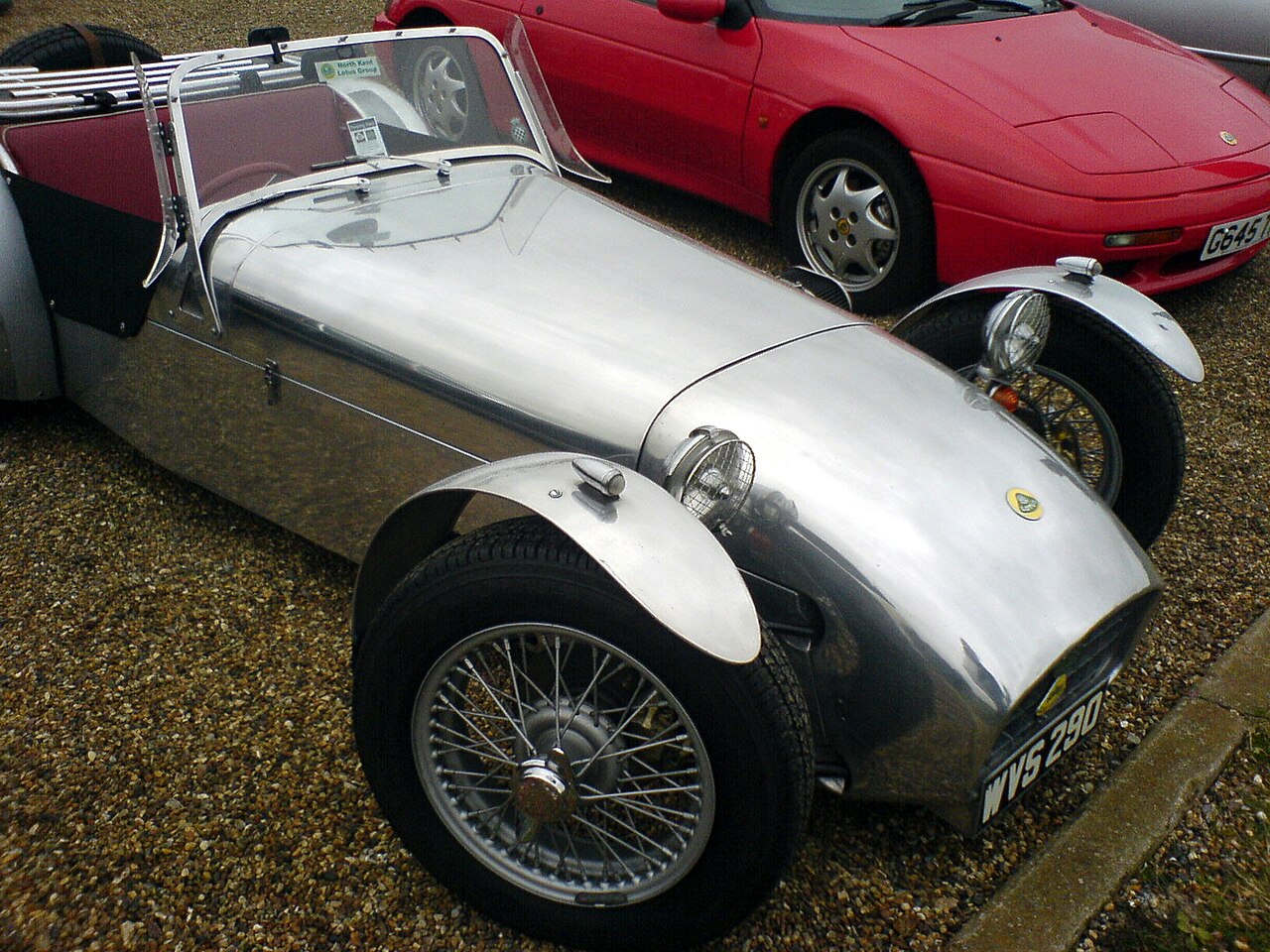
The supplied photograph shows a 1959 Seven Series 1 at the Lotus Brands Hatch Celebration in 2007. The creator identifies the series explicitly. Its pale body, upright windscreen and wire wheels are visible, with another Lotus behind it. The caption retains the photographed example’s year and event date. The background vehicle is not part of the Series 1 production reference, and the image does not authenticate every present component.
An open car whose wheels remain visible
The Series 1 image lets the reader see the front wheels, wings and passenger compartment in one view. Unlike an enclosed sports racer, the Seven does not hide its running gear inside a broad continuous outer body. That visible separation is part of the car’s character. It also makes component details tempting to generalize: the wire wheels in one photo can easily become an assumed standard feature of every first-series car. The correct approach is to preserve them as the photographed example’s appearance and use factory literature for the programme specification. The same applies to an engine or a later screen. A small, recognizable design can accommodate considerable individual variation over decades of ownership, so accurate captions add more value than an unqualified claim that the car looks exactly as it left the factory.
Collecting and chassis evidence
For a Series 1, the original Lotus chassis record and the completion history are especially useful where a car was assembled from components. An engine change, altered wheels or later body repair should be dated rather than treated as a universal model specification. The rights-transfer boundary matters equally: a later Caterham can be an interesting car in its own right, but it needs a separate make and build history. The 243-car factory statement remains a source-reported series volume, not a survivor census. It should not be combined with an unrelated regional registration count or an estimated number of modern replicas.
Related Lotus designs and meaningful comparisons
The Mark VI shows the earlier customer sports-car context, while the Seven Series 2 demonstrates how Lotus revised the same fundamental idea for later production. Comparing the body materials and the front wings is useful because those visible details connect with the manufacturer’s account of production changes. The Type 14 Elite offers a contemporary enclosed alternative, but it belongs to a different structural programme. Clear series identification helps a collection catalogue explain this variety without making the word Seven a catch-all for every minimal open sports car.
Reading the sources
The programme sources and the photograph answer different questions. Manufacturer and custodial records establish the original model, Type, category and published production scope. The creator’s file establishes the pictured subject, setting and image permission. An individual chassis history can then add ownership, competition entries and dated repairs without changing the scope of the original programme. Build references are not survivor counts, and a later specification does not automatically become an additional newly manufactured vehicle. Where primary evidence does not establish a complete fabrication census, that field remains unassigned.
Specifications and rarity evidence
| Programme reference year | 1957 |
|---|---|
| Model / Type | Seven Series 1 — Type 7 |
| Body / competition role | Lotus-built first-series open roadster |
| Manufacturer series period | 1957–1960 |
| Type identity | Type 7 |
| Early engine reference | Ford 100E side-valve four-cylinder |
| Early gearbox reference | Three-speed |
| Photographed example | 1959 Series 1 at Brands Hatch, 2007 |
| Published build / register reference | 243 |
| Independently audited completed tally | Not assigned |
| Count scope | Published complete named programme reference: 243. This is a source-reported reference, not an independently audited completed tally or a surviving-car census. |
| Original inventory status | LOT-011 — Verified |
Frequently asked questions
Does the 243-car reference include Caterham Sevens?
No. It is Lotus’s published volume for the Lotus-built Series 1 programme, 1957–1960. Later Caterham production and independent derivatives are separate.
How is Seven Series 1 classified?
This is a named original Lotus road-car production programme. Its source-reported series reference is below the 7,500 screening threshold; it is not a surviving-car estimate or an announced numbered allocation.
Which technical details are established for the programme?
The primary record supports manufacturer series period: 1957–1960; type identity: Type 7; early engine reference: Ford 100E side-valve four-cylinder. These are programme or explicitly attributed photo references. A particular surviving car’s engine, chassis repairs and competition preparation require its own dated documentation.
Does the photographed appearance establish factory originality?
The caption records a real creator-identified Seven Series 1 subject and its later setting. It establishes the illustration’s scope, while original components, restoration work and individual race provenance require chassis-specific evidence. A competition number, current paint or museum display is not used as an originality certificate.
What rarity or archive scope is verified?
Published complete named programme reference: 243. This is a source-reported reference, not an independently audited completed tally or a surviving-car census.
Who photographed the supplied image?
Mariegriffiths at English Wikipedia via Wikimedia Commons, under CC BY-SA 3.0. The original file and licence are linked with the image. Retain the creator, source and licence when uploading, exporting or reusing it; local retouching and synthetic enlargement have not been performed.
Related Lotus profiles
Sources and photo credits
Photograph: Mariegriffiths at English Wikipedia via Wikimedia Commons original source, CC BY-SA 3.0. Source-provided thumbnail supplied without local cropping, retouching or synthetic enlargement.
Built in limited numbers
Published complete named programme reference: 243. This is a source-reported reference, not an independently audited completed tally or a surviving-car census.
Gallery
Specifications
Factory specifications may vary by model year, market and configuration.
Identity & production
- Official model
- Seven Series 1