1947 Toyopet Model SA
Explore the Toyopet Model SA: history, verified identity, specification references, rarity evidence and real credited photos.
The Toyopet Model SA brought a small, technically ambitious sedan into Toyota’s post-war range in October 1947. Its backbone frame, independent suspension and compact four-cylinder engine make it more than a historical footnote. Toyota records only 215 built across the named model programme.
Toyota’s first small passenger car arrives after the war
The official Toyota heritage entry identifies the two-door SA as the company’s first small passenger car, marketed in October 1947. The Toyopet name was chosen through a public naming competition and used with the related small-truck project. That background explains why this car’s name differs from later familiar Toyota badges. A useful history should preserve those distinctions rather than calling every early post-war Toyota a Crown, or assuming the small sedan and the commercial vehicle were one production identity.
Toyota: Model SA official history, 215-car reference and specification
The compact body expresses an unusually ambitious package
The rounded roof, flowing wings and short overall length give the SA a recognisably compact silhouette. Toyota lists representative dimensions of 3,800 mm long and a 2,400 mm wheelbase. More significantly, the heritage account describes a backbone frame and four-wheel independent suspension. These are structural decisions that shape the car beneath its period styling. They make the SA an interesting engineering study, without needing to claim it was a direct mechanical predecessor of every later Toyota passenger-car platform.
A small Type S engine supports a different transport scale
Toyota’s representative specification lists a front-mounted 995 cc Type S side-valve inline-four driving the rear wheels, with a 27 PS reference at 4,000 rpm. Those modest numbers need the context of a small post-war sedan. They should not be judged as though the car were conceived for a modern motorway duty cycle. For a surviving vehicle, original engine identity, cooling equipment and later maintenance changes are more useful research questions than borrowing a larger Toyota engine’s performance figures.
Toyota: Model SA official history, 215-car reference and specification
Technological ambition did not guarantee a large market
Toyota’s history links the SA’s emphasis on technology with restrictions on passenger-car production during the occupation period. It also explains the limited sales outcome through the car’s poor suitability for the taxi trade, which dominated demand. This is a particularly useful reminder that low production can reflect circumstances rather than an announced collectible allocation. The 215-car reference covers the complete SA model in Toyota’s record, rather than a numbered edition marketed as exclusive when new.
Toyota: Model SA official history, 215-car reference and specification
A later production survivor illustrates the complete model
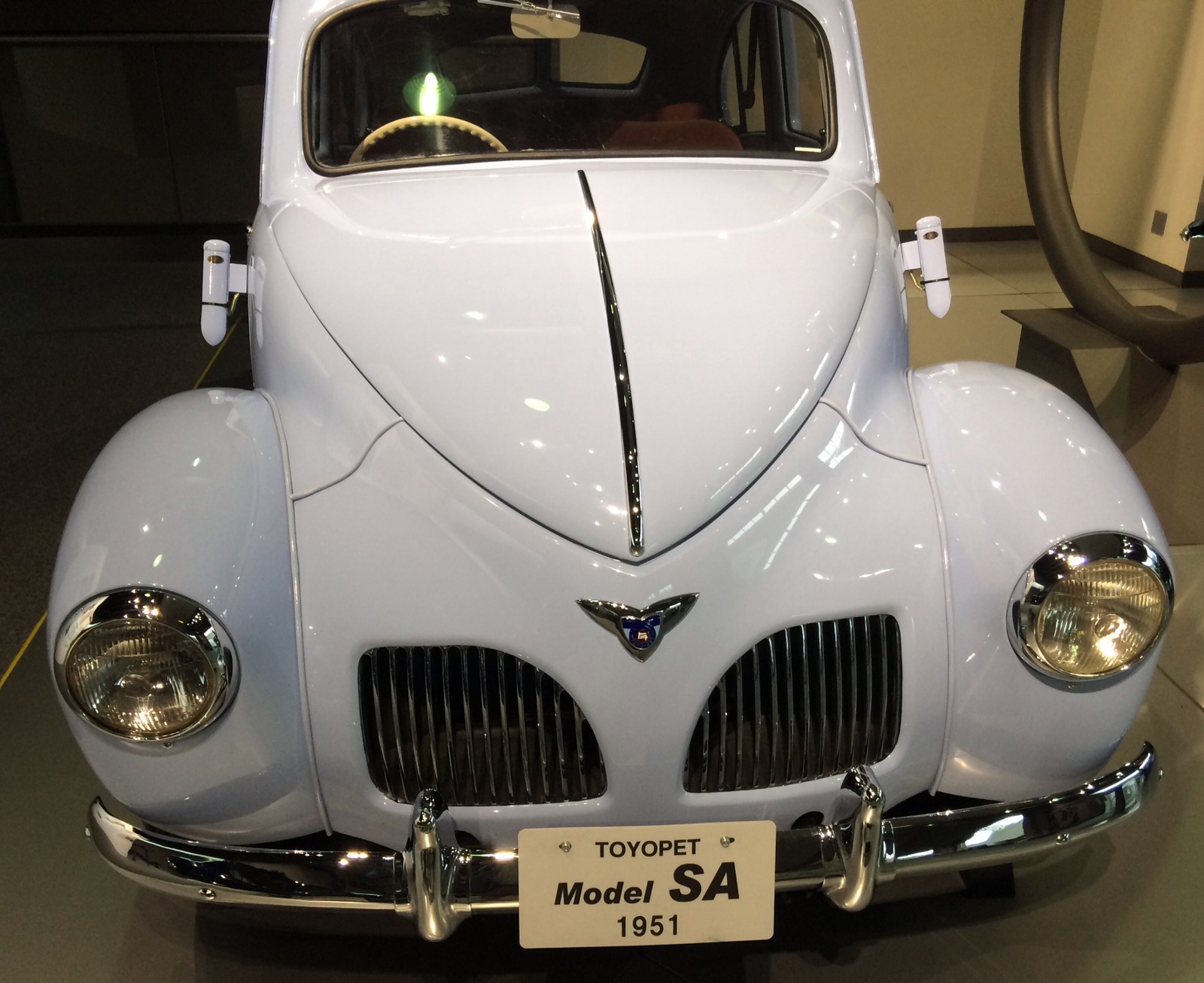
Ghostofakina’s photograph identifies a 1951 Model SA at the Toyota Automobile Museum. The car therefore illustrates the same production family after its 1947 introduction, not a newly authenticated launch-year chassis. Its visible museum label helps keep that distinction clear. Exterior photographs can establish shape and presentation, while chassis and engine records establish an individual vehicle’s identity. Restored trim, paint and mechanical work should be documented within that file, rather than treated as evidence of an additional special edition.
Specifications and identity reference
| Introduction | October 1947 |
|---|---|
| Manufacturer historical total | 215 Model SA cars |
| Engine | Type S; 995 cc side-valve inline-four |
| Published output reference | 27 PS at 4,000 rpm |
| Layout | Front engine; rear-wheel drive |
| Structure reference | Backbone frame; four-wheel independent suspension |
| Image scope | 1951 production example; same SA model family |
Rarity and production scope
Toyota’s official history attributes 215 cars to the complete Toyopet Model SA programme. That whole-model scope meets the rarity boundary without carving out one year of a larger ordinary grade. The 1951 museum example illustrates a later car within the same family; it is not described as a 1947-built chassis. The source’s historical total remains attributed, while exact completed production and the number of survivors are not newly audited in structured fields.
What the photograph represents
A 1951 Toyopet Model SA photographed by Ghostofakina. This is a later production example of the model introduced in 1947; the photograph is not relabelled as a 1947-built car. The museum setting and later specification remain distinct from the programme introduction date.
Related Toyota profiles
Frequently asked questions
Is the pictured SA a 1947-built car?
The image source identifies it as a 1951 example. The profile’s 1947 date records the model’s introduction, not the pictured chassis’s build year.
Was the SA a numbered limited edition?
No. Its rarity comes from the complete model’s small historical production, not an announced numbered-edition allocation.
What is the production-count boundary for this profile?
Toyota’s official history attributes 215 cars to the complete Toyopet Model SA programme. That whole-model scope meets the rarity boundary without carving out one year of a larger ordinary grade. The 1951 museum example illustrates a later car within the same family; it is not described as a 1947-built chassis. The source’s historical total remains attributed, while exact completed production and the number of survivors are not newly audited in structured fields.
Sources and further reading
Research checked 19 October 2026. Linked manufacturer heritage pages, factory announcements, official distributor publications and labelled contemporary coverage support the specifically identified claims. Photographic descriptions identify the illustrated subject. Design analysis and suggested authentication steps are editorial interpretation.
Built in limited numbers
Toyota’s official history attributes 215 cars to the complete Toyopet Model SA programme. That whole-model scope meets the rarity boundary without carving out one year of a larger ordinary grade. The 1951 museum example illustrates a later car within the same family; it is not described as a 1947-built chassis. The source’s historical total remains attributed, while exact completed production and the number of survivors are not newly audited in structured fields.
Gallery
Specifications
Factory specifications may vary by model year, market and configuration.
Identity & production
- Official model
- Toyopet Model SA
Sources and verification
Source citations are being prepared for this profile.