1936 Toyoda Model AA
Explore the Toyoda Model AA: history, verified identity, specification references, rarity evidence and real credited photos.
The Model AA marks Toyota’s transition from an industrial ambition into a passenger-car manufacturer. Introduced in 1936 under the Toyoda name, its streamlined sedan body and six-cylinder engine belong to a programme that Toyota’s heritage record totals at 1,404 cars.
A passenger car before Toyota Motor Company was established
Toyota’s official vehicle history places the AA within the automobile department of Toyoda Automatic Loom Works, under Kiichiro Toyoda’s leadership. The car preceded the establishment of Toyota Motor Company in 1937. Keeping the original Toyoda name makes that chronology visible: this is the beginning of a manufacturing venture, rather than a later Toyota sedan carrying a nostalgic badge. Its importance comes from the complete production project, including the attempt to provide a usable passenger car at a time when the business was still taking shape.
Toyota: Model AA official vehicle history and representative specification
Streamlining serves passengers as well as appearance
The AA’s rounded body sits within the international streamlining ideas of the 1930s. Toyota’s account connects the body shape and distribution of weight with improved rear-passenger comfort and cabin space. In design terms, this changes the emphasis from a collection of separate mechanical forms to a more integrated passenger compartment. The broad roof and substantial rear body should therefore be read as part of the car’s intended usefulness. They are not simply decorative features added to make an early vehicle look futuristic.
The six-cylinder specification anchors the historical record
The representative factory table lists a 3,389 cc Type A inline-six and a 65 PS reference at 3,000 rpm. It also gives a 2,850 mm wheelbase. Those are useful identity and specification anchors without pretending that an unrestored survivor still produces its original output. Early historical records can use different conventions for power and vehicle specification, so the original units should stay attached. Present mechanical condition, substituted components and a running assessment belong to the individual car’s inspection history.
Toyota: Model AA official vehicle history and representative specification
An original survivor tells a different story from a replica
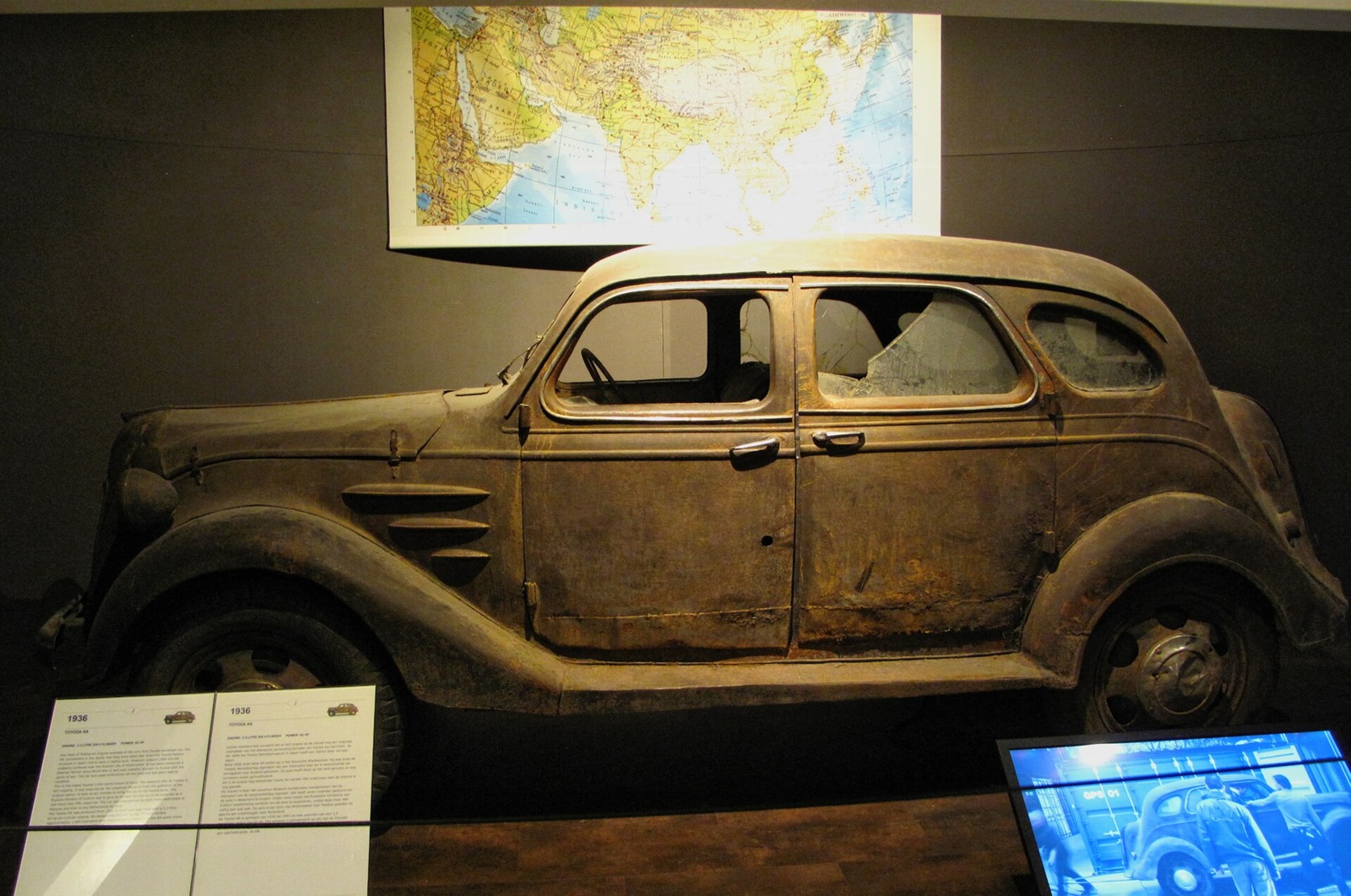
The included photograph shows the heavily altered AA preserved at the Louwman Museum, rather than a pristine recreation presented as untouched original manufacture. Toyota UK has documented the discovery of an AA near Vladivostok and its later museum preservation. The weathered body makes the distinction especially clear. For a heritage profile, use and modification are part of the evidence, even when they interrupt the original design. A restored or reconstructed example can explain factory appearance, but it should be labelled separately from an original survivor.
Toyota UK: discovery and preservation of the original Model AA
The production reference covers the original AA programme
Toyota’s heritage entry attributes 1,404 units to the AA by 1942. This is the whole named production-model reference used here, not an arbitrary total for a first model year or one surviving market. The related AB open car and later Toyota sedans do not become extra AA units because their history is connected. An individual provenance file should compare the vehicle’s construction, documents and repair history with period evidence; the museum photograph alone cannot reconstruct the manufacturing history of every AA chassis.
Specifications and identity reference
| Reference identity | Toyoda Model AA; introduced 1936 |
|---|---|
| Manufacturer historical reference | 1,404 units by 1942 |
| Engine reference | Type A; 3,389 cc inline-six |
| Published output reference | 65 PS at 3,000 rpm |
| Representative wheelbase | 2,850 mm |
| Included image | Heavily altered original survivor at the Louwman Museum |
Rarity and production scope
The 1,404-unit figure is attributed to Toyota’s official AA heritage record and covers the original named production programme. It is not a newly compiled survivor census. The photograph illustrates a heavily modified museum survivor, not as-new factory condition or a replica counted as another original car. Exact completed-production fields remain blank pending a separately audited chassis register. Later replicas, the AB open model and unrelated Toyota sedans remain outside the AA count.
What the photograph represents
The heavily modified original Toyoda AA preserved at the Louwman Museum, photographed by Rutger van der Maar. It illustrates a surviving early car with extensive historical alterations, rather than an untouched factory specification or a later replica. Its present appearance should not be used to reconstruct every original body detail.
Related Toyota profiles
Frequently asked questions
Why is the name Toyoda used in the title?
The AA was developed within Toyoda Automatic Loom Works before Toyota Motor Company was established; the historical name preserves that context.
Why does the photographed car look different from immaculate AA displays?
It is the altered original survivor preserved at Louwman. A recreation of factory appearance has a different evidentiary role and should be labelled as such.
What is the production-count boundary for this profile?
The 1,404-unit figure is attributed to Toyota’s official AA heritage record and covers the original named production programme. It is not a newly compiled survivor census. The photograph illustrates a heavily modified museum survivor, not as-new factory condition or a replica counted as another original car. Exact completed-production fields remain blank pending a separately audited chassis register. Later replicas, the AB open model and unrelated Toyota sedans remain outside the AA count.
Sources and further reading
- Toyota: Model AA official vehicle history and representative specification
- Toyota UK: discovery and preservation of the original Model AA
Research checked 19 October 2026. Linked manufacturer heritage pages, factory announcements, official distributor publications and labelled contemporary coverage support the specifically identified claims. Photographic descriptions identify the illustrated subject. Design analysis and suggested authentication steps are editorial interpretation.
Built in limited numbers
The 1,404-unit figure is attributed to Toyota’s official AA heritage record and covers the original named production programme. It is not a newly compiled survivor census. The photograph illustrates a heavily modified museum survivor, not as-new factory condition or a replica counted as another original car. Exact completed-production fields remain blank pending a separately audited chassis register. Later replicas, the AB open model and unrelated Toyota sedans remain outside the AA count.
Gallery
Specifications
Factory specifications may vary by model year, market and configuration.
Identity & production
- Official model
- Toyoda Model AA
Sources and verification
Source citations are being prepared for this profile.