1965 Toyota Sports 800
Explore the Toyota Sports 800: history, verified identity, specification references, rarity evidence and real credited photos.
Toyota’s first production sports car paired a 790 cc air-cooled flat twin with an exceptionally light body and a removable roof panel. Introduced in April 1965, the Sports 800 used economy of mass and size to create its character; Toyota UK records 3,131 built through 1969.
A small sports car grows from the Publica Sports idea
Toyota UK traces the Sports 800 to the Publica Sports concept shown in 1962, followed by the production car’s domestic launch in April 1965. The transition involved more than changing a show-car badge. A dramatic sliding canopy gave way to conventional doors and a removable roof section. The resulting car kept the compact two-seat ambition while making access and use more practical. Its UP15 identity belongs to this production programme, distinct from both the earlier concept and the later gas-turbine research vehicle.
Toyota UK: Sports 800 history, construction and complete production reference
Low weight makes modest engine output meaningful
The manufacturer history specifies a 790 cc 2U-B air-cooled, horizontally opposed two-cylinder engine with two carburettors and a 45 bhp reference. It also gives a weight of about 580 kg. The important engineering relationship is between those figures: the car asks a small engine to move a very small mass. That is a different route to sporting character from simply increasing displacement. Historical output and weight references should remain model specifications, rather than being presented as a current measured result for the photographed example.
A removable roof broadens the car’s appeal
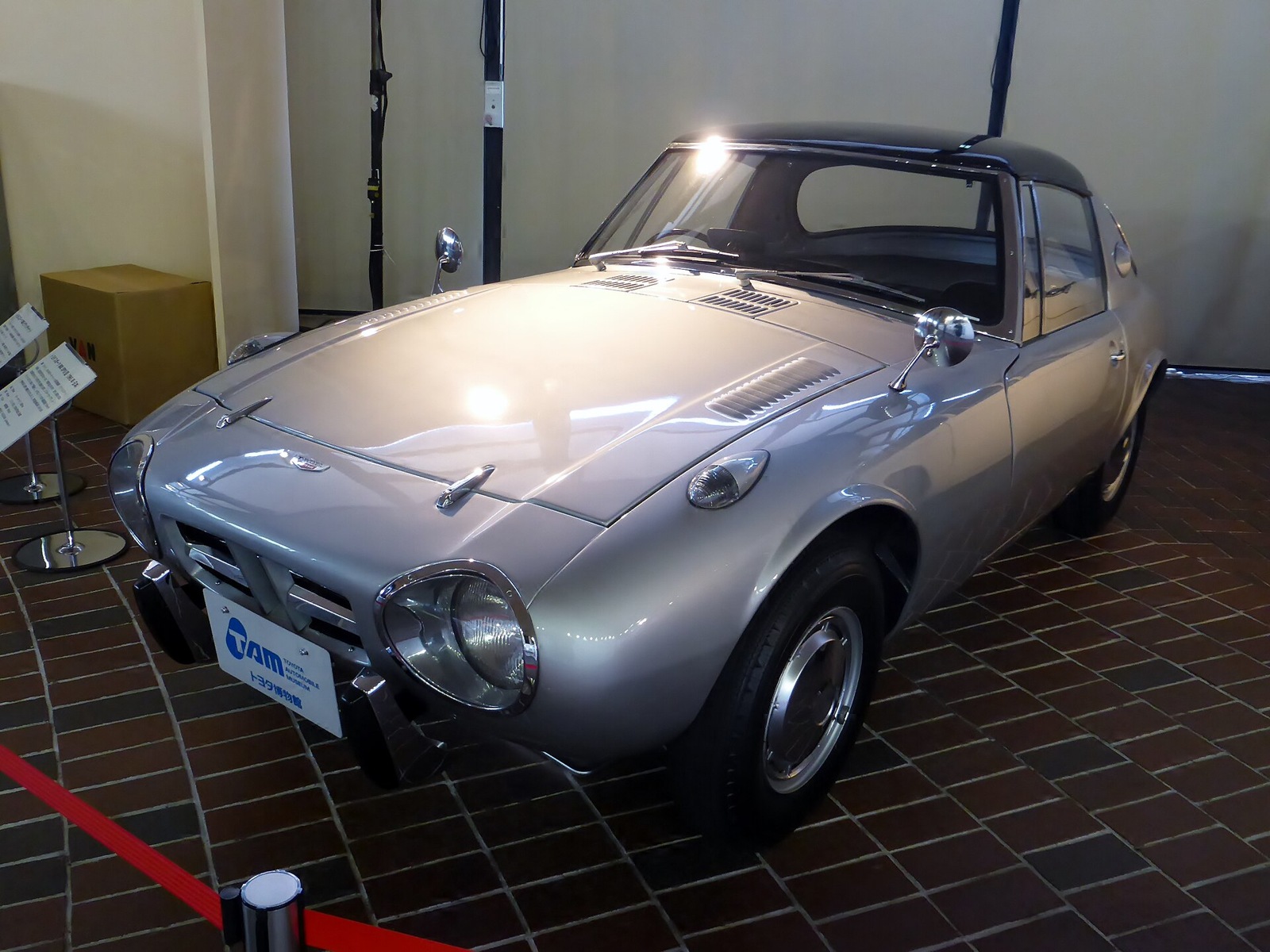
The production roof panel could be removed and stored, creating an open-air experience without discarding the entire upper structure. Viewed as design, the arrangement works particularly well with the car’s narrow body and compact glass area. The low nose and rounded front wings give the small engine bay a distinctive face. The photograph shows those identifying proportions clearly. An owner’s later roof seals, paintwork and trim condition need their own assessment rather than being inferred from another restored car’s appearance.
Toyota UK: Sports 800 history, construction and complete production reference
Construction choices connect the body with the driving idea
Toyota’s account describes thin-gauge steel for the Publica-derived monocoque and aluminium in selected panels, the roof section and seat frames. This gives the lightness story substance beyond a small quoted kerb weight. For an inspection, the interaction of materials also makes repair quality and panel history worth recording. None of this establishes that a surviving car has retained every original component. It instead provides a documented specification against which the construction and subsequent work on an individual example can be understood.
Toyota UK: Sports 800 history, construction and complete production reference
The complete production run remains the counting boundary
Toyota UK records 3,131 Sports 800 cars built from 1965 to 1969 by Kanto Auto Works. Regional steering layouts and later exports sit inside that programme rather than creating additional totals. The same account describes domestic competition use, including a Sports 800’s third place behind two 2000GTs in the 1967 Fuji 24-hour event. That history helps explain the car’s reputation, but the road production profile should remain separate from an authenticated history of any particular racing chassis or later restored example.
Specifications and identity reference
| Launch | April 1965 |
|---|---|
| Programme reference | 3,131 cars; 1965–1969 |
| Engine | 2U-B; 790 cc air-cooled flat twin |
| Published output reference | 45 bhp at 5,400 rpm |
| Representative mass | About 580 kg |
| Roof | Removable panel; stored in the car |
| Production partner | Kanto Auto Works |
Rarity and production scope
The attributed 3,131-car reference covers the full Sports 800 production programme from 1965 to 1969. Steering-layout variants and later private exports remain within that total. The 1962 Publica Sports concept and the 1977 gas-turbine hybrid experiment are separate historical identities, not extra ordinary Sports 800 production added here. Toyota’s historical figure is retained with its scope; exact completed-production and survivor fields remain blank rather than presenting a newly verified chassis census.
What the photograph represents
A production Toyota Sports 800 photographed by Tokumeigakarinoaoshima. The image illustrates the compact UP15 road car, not the later gas-turbine hybrid conversion. It is a visual model reference rather than an inspection of this example’s originality, current condition or mechanical output.
Related Toyota profiles
Frequently asked questions
Is the Sports 800 the same car as the gas-turbine hybrid?
The hybrid experiment used a Sports 800-based vehicle, but it is a separate research identity with a different powertrain and purpose.
Why does a 45 bhp sports car matter?
Its documented low mass, compact package and lightweight construction explain its sporting approach without requiring a large engine.
What is the production-count boundary for this profile?
The attributed 3,131-car reference covers the full Sports 800 production programme from 1965 to 1969. Steering-layout variants and later private exports remain within that total. The 1962 Publica Sports concept and the 1977 gas-turbine hybrid experiment are separate historical identities, not extra ordinary Sports 800 production added here. Toyota’s historical figure is retained with its scope; exact completed-production and survivor fields remain blank rather than presenting a newly verified chassis census.
Sources and further reading
Research checked 19 October 2026. Linked manufacturer heritage pages, factory announcements, official distributor publications and labelled contemporary coverage support the specifically identified claims. Photographic descriptions identify the illustrated subject. Design analysis and suggested authentication steps are editorial interpretation.
Built in limited numbers
The attributed 3,131-car reference covers the full Sports 800 production programme from 1965 to 1969. Steering-layout variants and later private exports remain within that total. The 1962 Publica Sports concept and the 1977 gas-turbine hybrid experiment are separate historical identities, not extra ordinary Sports 800 production added here. Toyota’s historical figure is retained with its scope; exact completed-production and survivor fields remain blank rather than presenting a newly verified chassis census.
Gallery
Specifications
Factory specifications may vary by model year, market and configuration.
Identity & production
- Official model
- Toyota Sports 800
Sources and verification
Source citations are being prepared for this profile.