1947 Fiat 1100S
Explore the Fiat 1100S: post-war sporting design, the complete 401-car programme, corrected history and a credited documentary photograph.
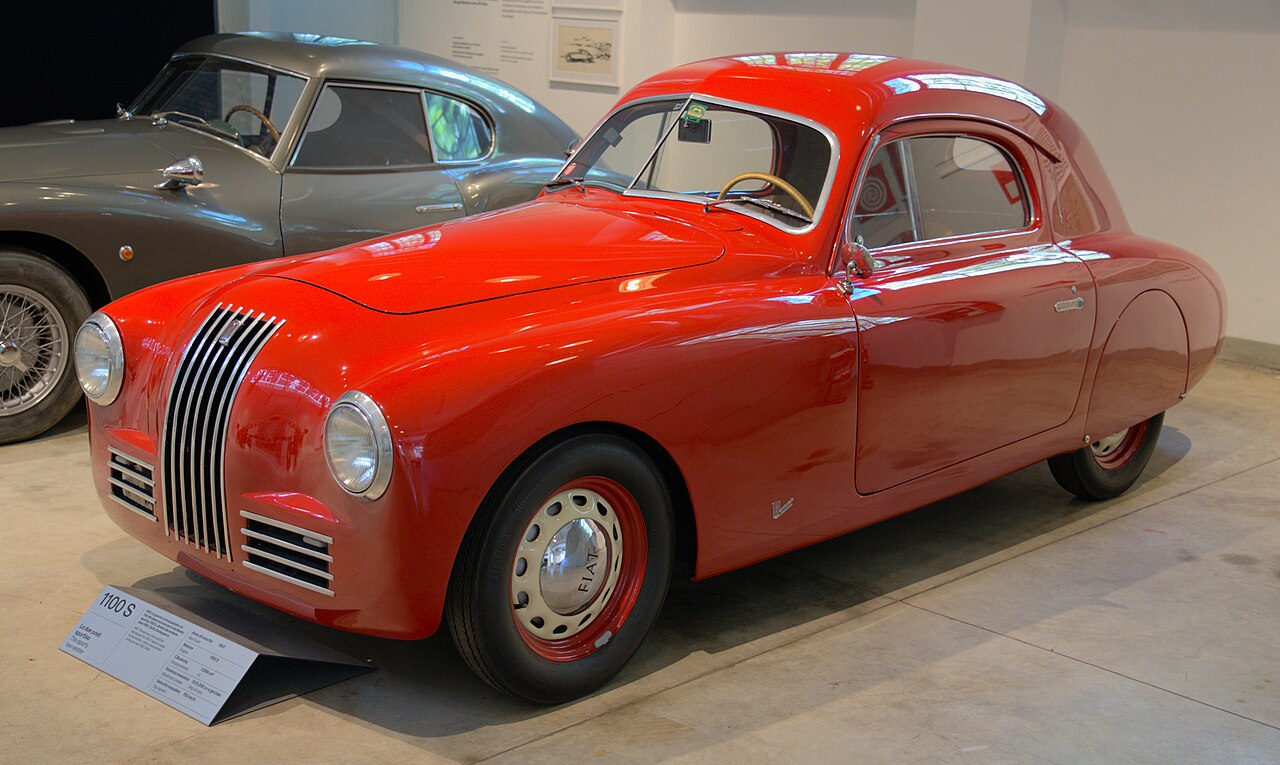
The Fiat 1100S gave post-war Italian motoring a compact sporting shape.
History and purpose
The Fiat 1100S gave post-war Italian motoring a compact sporting shape. Stellantis Heritage dates the programme to 1947–1950 and records 401 cars. This corrects the source inventory’s separate 1939 heading for an ostensibly equivalent 1100S. The model belongs to the immediate post-war period, while its lineage reaches back to Fiat’s earlier small sporting machines. That distinction matters: a predecessor can explain a design without becoming another production year of the later model. Combining the two inventory references into one profile preserves the useful historical connection and prevents the same finite programme from being uploaded twice under different dates.
Design and engineering
The red museum example has rounded wings, a compact enclosed cabin and a strongly tapered body. Its small overall visual mass makes it a useful counterpoint to Mefistofele’s immense engine-led proportions. The design gathers the passenger compartment tightly between the axles, then carries the curved surfaces into a short tail. Bright circular lamps and a narrow front opening keep the face simple. These observations help explain the body as a purposeful sporting package without assigning a particular competition result to the photographed car. The manufacturer’s engine record supplies the technical anchor; the picture supplies a clear account of the surviving visible shape.
Identifying the original configuration
The correct programme identity is Fiat 1100S, with 1947 as the reference year. Both original workbook references are retained for duplicate detection. The number 401 covers the original named programme, rather than a racing-entry subset or an estimate of survivors. A competition photograph alone would not establish that a later-bodied car belongs to this series. Chassis paperwork, period configuration and the relationship between body and mechanical specification remain important for an individual example. The supplied photograph identifies a 1947 1100S at Centro Storico Fiat, matching the manufacturer’s chronology without requiring an invented chassis number or an unverified ownership history.
Collector context and preservation
A collector archive can make the 1100S more useful by recording its compact architecture as carefully as its racing associations. Front, side and rear views help preserve the transition from rounded wings to cabin and tail; engine and chassis photographs then connect those proportions with the mechanical record. Comparison with Fiat’s earlier sporting lineage belongs in the history field, where it explains development without creating duplicate profiles. The 1100S also offers a clear bridge from pre-war sporting ideas to post-war production. Keeping the whole-series tally, original dates and merged inventory references together gives researchers a stable foundation for adding individual provenance later.
Reading the evidence for this profile
The original source links below identify the programme and the historical statements used in this article. The photograph has its own creator and licence record, separate from the manufacturer’s vehicle history. Keep both when transferring this profile into a collection catalogue. A manufacturing tally describes how many cars belong to a defined original programme; it does not measure how many survive, how many are publicly visible, or how many retain all their original components. Those individual questions require dated chassis and restoration evidence. The reference year likewise describes the programme’s introduction or named historic configuration, while the supplied caption states the photographed setting and any established individual identity. This lets future research expand the car’s history without blurring the scope of the record already assembled here.
Specifications and verified rarity
| Reference year | 1947 |
|---|---|
| Model / programme | 1100S |
| Body / role | Compact two-seat sporting berlinetta |
| Documented engineering | Front-mounted 1,089 cc four-cylinder; manufacturer-rated 51 hp |
| Architecture / transmission reference | Rear-wheel-drive compact sporting architecture |
| Exact manufacturing tally | 401 |
| Eligibility bound | 401 for the documented scope or parent programme |
| Rarity scope | Complete original Fiat 1100S programme: 401 cars, 1947–1950. FIA-025 and FIA-026 are consolidated as the same named programme; the workbook’s 1939 1100S title is not a second series. |
| Inventory reference | FIA-026 — Verified |
Frequently asked questions
What is the Fiat 1100S?
The 1947–1950 Fiat sporting berlinetta, with a complete 401-car programme. The two workbook 1100S rows represent one identity here.
What engineering details are documented?
Front-mounted 1,089 cc four-cylinder; manufacturer-rated 51 hp. Rear-wheel-drive compact sporting architecture. The specification table identifies the documented model, concept package or explicitly named donor architecture. It does not certify an unseen engine number, individual component condition or a restoration specification from the exterior photograph.
Why is 1947 used in the profile title?
This is the reference year for the original configuration, introduction or public presentation explained in the history section. A photographed example can be younger. Where the supplied inventory used a different date, its original title remains an identity alias so that the same programme is not uploaded twice.
What belongs in an individual vehicle file?
Connect the chassis identity with original configuration records, dated photographs, custodial history and restoration paperwork. Record changes to paint, trim, mechanical components and bodywork as dated events. This profile establishes the named subject and its rarity or physical archive scope; the individual file supplies the history of the particular example.
What rarity or archive scope is verified?
Complete original Fiat 1100S programme: 401 cars, 1947–1950. FIA-025 and FIA-026 are consolidated as the same named programme; the workbook’s 1939 1100S title is not a second series.
Who took the supplied photograph?
MrWalkr via Wikimedia Commons, under CC BY-SA 4.0. The original file and licence links accompany the image. Retain that credit when the photograph is uploaded, exported or reused.
Related Fiat profiles
Sources and photo credits
Photograph: MrWalkr via Wikimedia Commons original file, CC BY-SA 4.0. Source-provided photograph supplied without local cropping, retouching or text removal. A source thumbnail is used where available. Source-identified 1947 Fiat 1100S at Centro Storico Fiat; the photo does not assign an individual chassis number.
Built in limited numbers
Complete original Fiat 1100S programme: 401 cars, 1947–1950. FIA-025 and FIA-026 are consolidated as the same named programme; the workbook’s 1939 1100S title is not a second series.
Gallery
Specifications
Factory specifications may vary by model year, market and configuration.
Identity & production
- Official model
- 1100S