1924 Fiat Mefistofele
Discover Fiat Mefistofele: Eldridge’s aviation-engined record car, its 1924 Arpajon run, original identity and a credited museum photograph.
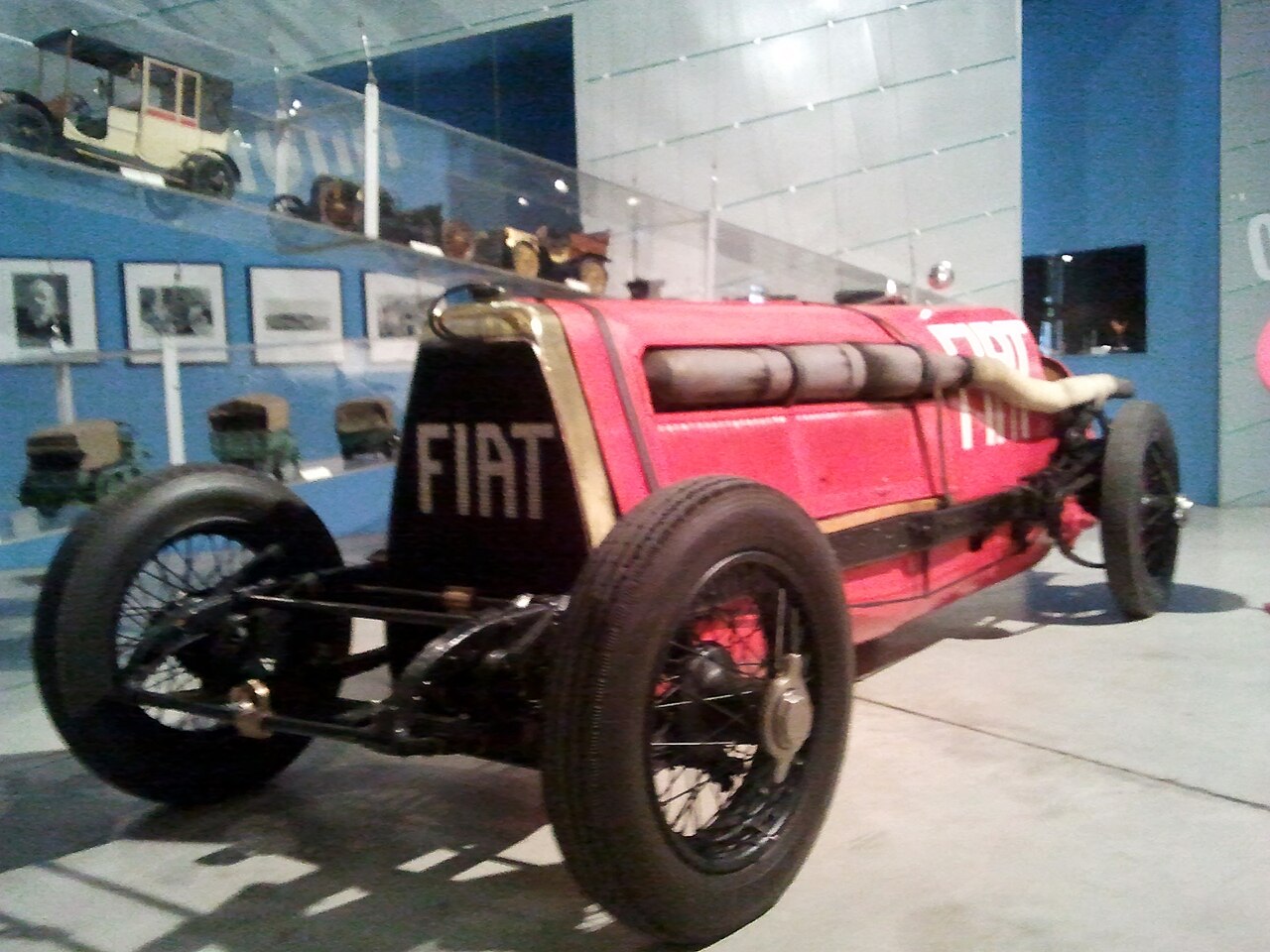
Fiat Mefistofele brought aviation scale to a road-record machine.
History and purpose
Fiat Mefistofele brought aviation scale to a road-record machine. Ernest Eldridge created the car in 1923 around a 1908 Fiat SB4 donor, and its defining reference event was the 12 July 1924 run at Arpajon. Fiat records a speed of 234.98 km/h. The huge six-cylinder aircraft engine demanded a longer chassis, producing a vehicle whose proportions still communicate the task immediately. The story connects two dates and two configurations of a physical car: the earlier racing donor and Eldridge’s later record machine. For this profile, 1924 names the celebrated record configuration rather than suggesting that every component was newly manufactured in that year.
Design and engineering
The supplied museum photograph shows the red body stretching far beyond its small passenger compartment. A tall front cooling face, substantial exposed wheels and a narrow upper body give the machine an almost industrial presence. The long bonnet is a visual consequence of the documented aviation engine, while the chain-drive architecture belongs to an earlier phase of high-speed automotive engineering. The photograph is valuable because these proportions remain legible without a driver or a demonstration run. It allows the viewer to compare the space occupied by the power unit with the space left for the person directing it, a relationship central to the car’s identity.
Identifying the original configuration
Mefistofele should remain a complete named identity in a catalogue. An entry simply labelled Fiat SB4 could describe the donor before conversion, another historic reference or a model-level racing account. Here the record configuration is anchored by Fiat’s own history and the museum photograph’s identification. The source inventory’s earlier SB4 row is held as an unresolved separate configuration rather than uploaded as another Mefistofele. Later maintenance and display condition also belong in dated records. The body visible today documents the preserved historic subject; it cannot alone prove that each mechanical component is unchanged from the Arpajon run.
Collector context and preservation
An effective collection presentation can pair this car with the much smaller 1100S and the experimental Turbina. The comparison reveals how different purposes altered Fiat proportions: record speed, compact sporting use and a new propulsion idea. Preserve the event date, engine designation and donor history together, because removing any one of those weakens the explanation of the vehicle. Fiat’s historical account also places the car’s acquisition for the company collection in 1969. That custodial event should be treated as a later chapter, allowing an archive to follow the machine from its record attempt to its role as a physical witness to early automotive ambition.
Reading the evidence for this profile
The original source links below identify the programme and the historical statements used in this article. The photograph has its own creator and licence record, separate from the manufacturer’s vehicle history. Keep both when transferring this profile into a collection catalogue. A manufacturing tally describes how many cars belong to a defined original programme; it does not measure how many survive, how many are publicly visible, or how many retain all their original components. Those individual questions require dated chassis and restoration evidence. The reference year likewise describes the programme’s introduction or named historic configuration, while the supplied caption states the photographed setting and any established individual identity. This lets future research expand the car’s history without blurring the scope of the record already assembled here.
Specifications and verified rarity
| Reference year | 1924 |
|---|---|
| Model / programme | Mefistofele |
| Body / role | Unique open land-speed-record car |
| Documented engineering | Fiat A12/A12 bis aviation-derived 21.7-litre inline six |
| Architecture / transmission reference | Extended chassis and chain final drive |
| Exact manufacturing tally | 1 |
| Eligibility bound | 1 for the documented scope or parent programme |
| Rarity scope | The original Eldridge Mefistofele record-car configuration, completed from a 1908 Fiat SB4 donor. One surviving original named car; the donor configuration is not a second manufactured Mefistofele. |
| Inventory reference | FIA-016 — Verified |
Frequently asked questions
What is the Fiat Mefistofele?
The original Eldridge aviation-engined Fiat record car, using a 1908 donor and remembered for its 1924 Arpajon record. Its one-car scope does not count the earlier donor state twice.
What engineering details are documented?
Fiat A12/A12 bis aviation-derived 21.7-litre inline six. Extended chassis and chain final drive. The specification table identifies the documented model, concept package or explicitly named donor architecture. It does not certify an unseen engine number, individual component condition or a restoration specification from the exterior photograph.
Why is 1924 used in the profile title?
This is the reference year for the original configuration, introduction or public presentation explained in the history section. A photographed example can be younger. Where the supplied inventory used a different date, its original title remains an identity alias so that the same programme is not uploaded twice.
What belongs in an individual vehicle file?
Connect the chassis identity with original configuration records, dated photographs, custodial history and restoration paperwork. Record changes to paint, trim, mechanical components and bodywork as dated events. This profile establishes the named subject and its rarity or physical archive scope; the individual file supplies the history of the particular example.
What rarity or archive scope is verified?
The original Eldridge Mefistofele record-car configuration, completed from a 1908 Fiat SB4 donor. One surviving original named car; the donor configuration is not a second manufactured Mefistofele.
Who took the supplied photograph?
SurfAst via Wikimedia Commons, under CC BY-SA 3.0. The original file and licence links accompany the image. Retain that credit when the photograph is uploaded, exported or reused.
Related Fiat profiles
Sources and photo credits
- Original manufacturer, museum or custodial record
- Fiat historical collection: donor, engine and later custody
Photograph: SurfAst via Wikimedia Commons original file, CC BY-SA 3.0. Source-provided photograph supplied without local cropping, retouching or text removal. A source thumbnail is used where available. Fiat Mefistofele preserved at Centro Storico Fiat; documentary museum photograph of the named record car.
Built in limited numbers
The original Eldridge Mefistofele record-car configuration, completed from a 1908 Fiat SB4 donor. One surviving original named car; the donor configuration is not a second manufactured Mefistofele.
Gallery
Specifications
Factory specifications may vary by model year, market and configuration.
Identity & production
- Official model
- Mefistofele