1934 Ford Model 40 Special Speedster
Explore 1934 Ford Model 40 Special Speedster: sourced history, design, specifications, rarity evidence and a real photograph with creator credits.
Edsel Ford’s 1934 Model 40 Special Speedster turned an executive’s personal interest in design into a remarkable physical automobile.
History and purpose
Edsel Ford’s 1934 Model 40 Special Speedster turned an executive’s personal interest in design into a remarkable physical automobile. Its identity is anchored by Ford House and the Frist Art Museum’s original exhibition account. The long, low body was unlike an ordinary Ford roadster, and the named commission must remain distinct from Edsel’s earlier 1932 Model 18 speedster. The preserved car also has a layered mechanical history: the exhibition account identifies its present engine as a Mercury flathead V8 rated at 100 brake horsepower. That detail belongs to the surviving configuration and should not be silently rewritten as its original 1934 installation.
Design and engineering
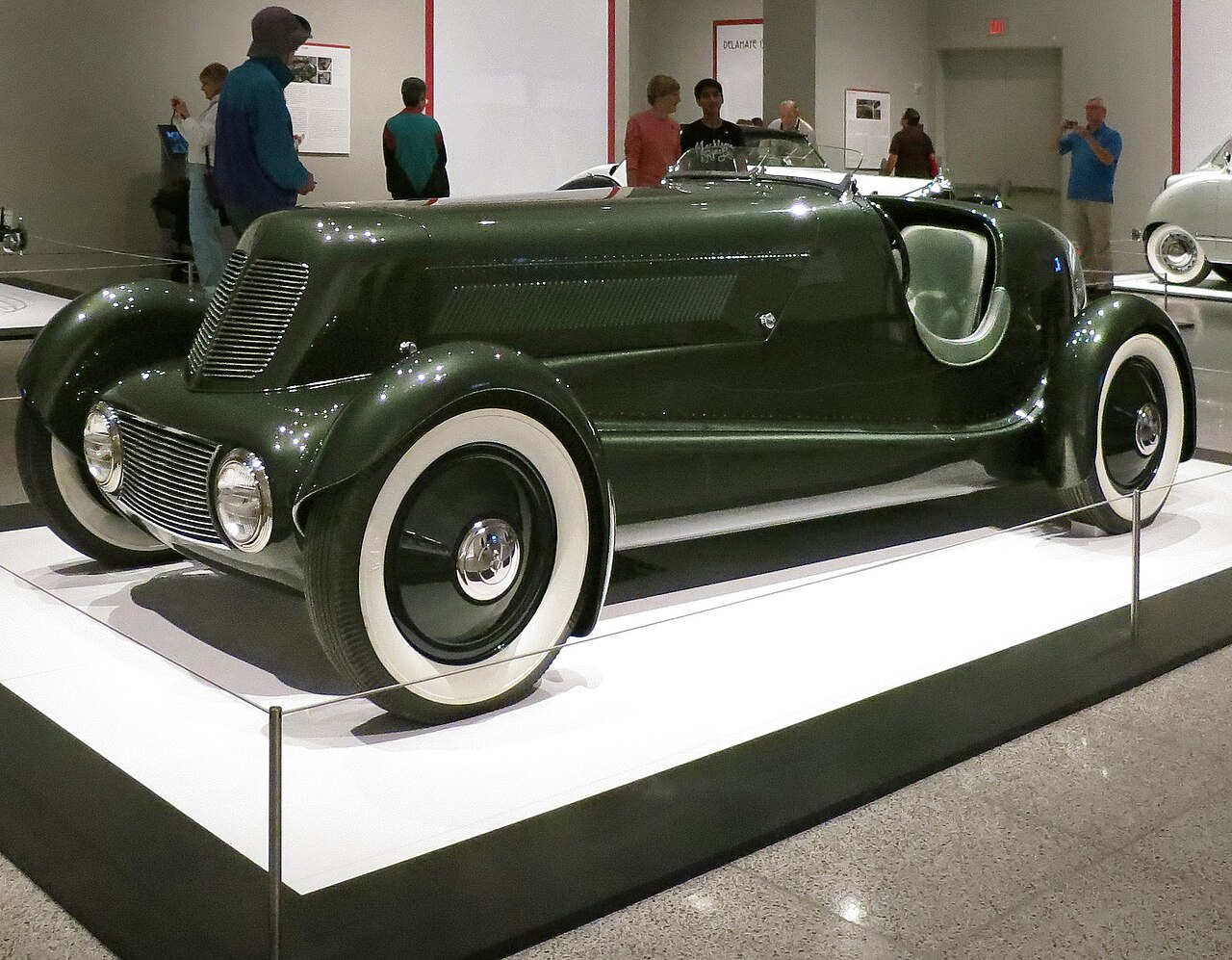
The museum photograph shows a dark green body arranged as one flowing horizontal shape. The bonnet is exceptionally long, the passenger opening is small and the rear body curves down around enclosed wheels. The low nose and restrained lighting pull the eye along the car rather than upward. This is a different kind of visual drama from an exposed-wheel early touring Ford: the mechanical package is gathered into a continuous surface. The bright wheel details and narrow windscreen provide scale without competing with the overall silhouette. These observations explain why the speedster is valuable as a design object as well as a personal historic vehicle.
Identifying the original configuration
Identify the commission by its full Model 40 Special Speedster name and the 1934 reference year. A generic Edsel Ford speedster title can refer to the separate earlier car, while an ordinary Model 40 heading can include many unrelated production bodies. The institutional record supplies the unique subject and later preservation history; the photograph shows that named physical car in display. It does not certify every installed component as unchanged from its first completion. For the vehicle file, keep the commission, subsequent ownership, restoration and Mercury-engine configuration as dated chapters. That makes the one-car identity clear while allowing its material history to remain complex.
Collector context and preservation
The speedster works particularly well beside the X-100 and the Mustang I concept. Each uses a small passenger area to create a very different design proposition: personal elegance, experimental luxury and compact sporting exploration. Preserve the speedster’s whole silhouette before concentrating on individual details. Views of the nose, wheel enclosures and passenger opening help document the unusually low relationship between body and occupants. Restoration photographs and engine records then explain how the surviving object reached its current state. A careful collection presentation can celebrate its shape and commission without treating later preservation work as an interruption to the historic story.
Reading the evidence for this profile
The original source links below identify the programme and the historical statements used in this article. The photograph has its own creator and licence record, separate from the manufacturer’s vehicle history. Keep both when transferring this profile into a collection catalogue. A manufacturing tally describes how many cars belong to a defined original programme; it does not measure how many survive, how many are publicly visible, or how many retain all their original components. Those individual questions require dated chassis and restoration evidence. The reference year likewise describes the programme’s introduction or named historic configuration, while the supplied caption states the photographed setting and any established individual identity. This lets future research expand the car’s history without blurring the scope of the record already assembled here.
Specifications and verified rarity
| Reference year | 1934 |
|---|---|
| Model / programme | Model 40 Special Speedster |
| Body / role | Edsel Ford’s unique personal speedster |
| Documented engine | Flathead V8; preserved configuration uses a Mercury engine rated 100 bhp |
| Architecture / transmission | Custom low open body on a modified Ford-derived chassis |
| Exact manufacturing tally | 1 |
| Eligibility bound | 1 for the documented scope or parent programme |
| Rarity scope | The original 1934 Model 40 Special Speedster commissioned for Edsel Ford. One named physical commission; the earlier 1932 Model 18 speedster is a different vehicle. |
| Inventory reference | FRD-026 — Verified |
Frequently asked questions
What is the Ford Model 40 Special Speedster?
The unique 1934 personal Model 40 commission for Edsel Ford, with a documented later Mercury-powered preserved configuration.
What engineering defines this Ford?
Flathead V8; preserved configuration uses a Mercury engine rated 100 bhp. Custom low open body on a modified Ford-derived chassis. These are the documented programme or preserved-concept specifications. Connect an individual vehicle’s installed components to its own dated records before assigning a factory configuration to that particular example.
Why is 1934 the reference year?
It identifies the introduction or original historical configuration described in this article. The photograph can show a later example or a later display of the original subject. The source inventory’s original heading remains an identity alias wherever the date or model name has been corrected.
How should an individual Model 40 Special Speedster be documented?
Start with the chassis identity and connect it to dated construction, registration or custodial records. Keep exterior, interior, engine and underbody photographs together. Record changes to finish, equipment and mechanical specification as separate events, so the physical car’s history can grow without changing the definition of the original programme.
What rarity or archive scope is verified?
The original 1934 Model 40 Special Speedster commissioned for Edsel Ford. One named physical commission; the earlier 1932 Model 18 speedster is a different vehicle.
Who took the supplied photograph?
Jim Evans via Wikimedia Commons, under CC BY-SA 4.0. The original file and licence links accompany the image. Retain that credit when the photograph is uploaded, exported or reused.
Related Ford profiles
Sources and photo credits
- Manufacturer, institutional or original custodial record
- Ford House: named original speedster and collection context
Photograph: Jim Evans via Wikimedia Commons original file, CC BY-SA 4.0. Source-provided photograph supplied without local cropping, retouching or text removal. A source thumbnail is used where available. Edsel Ford’s original Model 40 Special Speedster in institutional display; later preserved configuration.
Built in limited numbers
The original 1934 Model 40 Special Speedster commissioned for Edsel Ford. One named physical commission; the earlier 1932 Model 18 speedster is a different vehicle.
Gallery
Specifications
Factory specifications may vary by model year, market and configuration.
Identity & production
- Official model
- Model 40 Special Speedster