1962 Ford Mustang I Concept
Explore 1962 Ford Mustang I Concept: sourced history, design, specifications, rarity evidence and a real photograph with creator credits.
The 1962 Ford Mustang I concept explored a compact sporting form before the production Mustang became a familiar road car.
History and purpose
The 1962 Ford Mustang I concept explored a compact sporting form before the production Mustang became a familiar road car. The Henry Ford preserves the physical roadster and documents its engineering, including a small Taunus-derived V4 mounted behind the occupants. That museum record makes the concept a strong archive subject, but it does not require a guessed complete prototype count. This profile therefore records a verified physical concept with the fabrication tally unknown. The Mustang I should also remain distinct from the later 1963 Mustang II show car: the shared name links a development story, while the bodies and mechanical arrangements identify different experimental objects.
Design and engineering
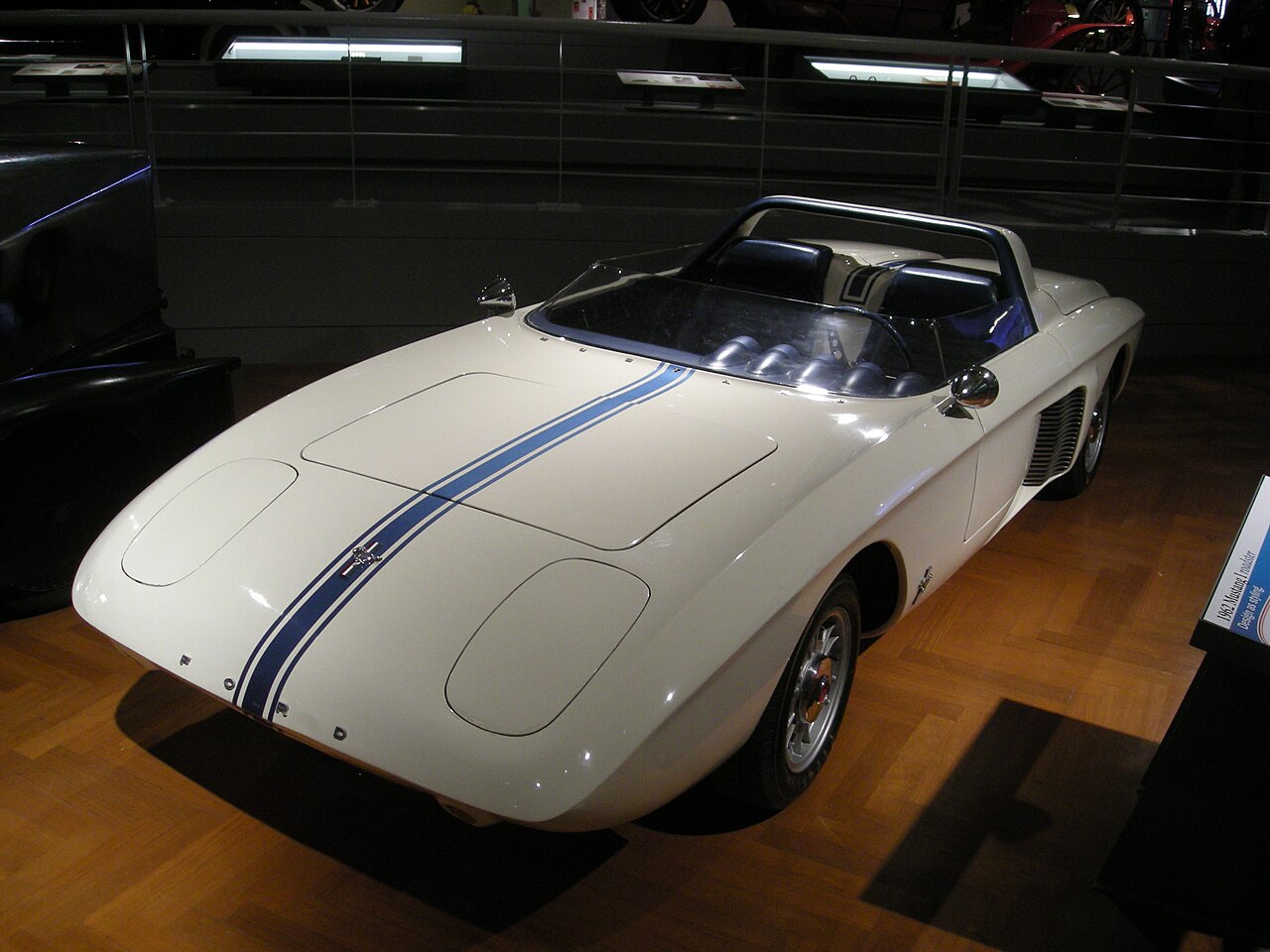
The museum photograph shows a very low white body, a narrow blue central stripe and an open two-seat passenger compartment. The front section drops away from the cockpit, while side openings interrupt the body behind the seats. These proportions make the compact sporting intent legible even in an indoor display setting. The V4 architecture is an important technical anchor because it separates the roadster from the familiar front-engine production Mustang. The image itself documents shape and display condition rather than unseen mechanical operation. Read the short nose, passenger opening and rear body together to understand how the concept organised its space around a small mid-mounted power unit.
Identifying the original configuration
Retain the Roman numeral I in the profile title. A broad 1962 Mustang label can blur the distinction between the physical roadster, styling studies and the later retail car. The museum’s object record supplies the correct subject and the independently licensed image matches that preserved roadster. Exact counts of mock-ups, running cars and development objects should be added only when their definitions are clear. For an individual concept file, the preserved object’s custody and configuration matter more than a production-style serial count. Keep later display photographs dated and avoid attaching equipment from the 1963 Mustang II or the 1964 production introduction to this earlier vehicle.
Collector context and preservation
The Mustang I is especially useful beside the X-100 because both are experimental Fords with very different attitudes to size. One communicates broad luxury and the other compact sporting economy. A viewer can understand that difference directly from the images, then use the technical records to explain the engine placement. Future archive photography can add the cockpit, controls and rear mechanical compartment without replacing the whole-car view. Conservation notes should distinguish preserved appearance from operating condition. A concept’s historical significance does not depend on demonstrating it at speed; its physical layout and documented development identity already make it a valuable witness to Ford’s design exploration.
Reading the evidence for this profile
The original source links below identify the programme and the historical statements used in this article. The photograph has its own creator and licence record, separate from the manufacturer’s vehicle history. Keep both when transferring this profile into a collection catalogue. A manufacturing tally describes how many cars belong to a defined original programme; it does not measure how many survive, how many are publicly visible, or how many retain all their original components. Those individual questions require dated chassis and restoration evidence. The reference year likewise describes the programme’s introduction or named historic configuration, while the supplied caption states the photographed setting and any established individual identity. This lets future research expand the car’s history without blurring the scope of the record already assembled here.
Specifications and verified rarity
| Reference year | 1962 |
|---|---|
| Model / programme | Mustang I Concept |
| Body / role | Compact two-seat experimental roadster |
| Documented engine | 1.5-litre Ford Taunus-derived V4 |
| Architecture / transmission | Mid-engine two-seat roadster; four-speed manual |
| Exact manufacturing tally | Not established |
| Eligibility bound | Physical concept archive scope; tally unknown |
| Rarity scope | Verified physical 1962 Mustang I roadster preserved by The Henry Ford. Concept archive scope; exact total of all styling and running prototypes is not established here. |
| Inventory reference | FRD-066 — Verified |
Frequently asked questions
What is the Ford Mustang I Concept?
The preserved 1962 two-seat mid-engine Mustang I concept, a separate physical subject from the later Mustang II show car and retail Mustang.
What engineering defines this Ford?
1.5-litre Ford Taunus-derived V4. Mid-engine two-seat roadster; four-speed manual. These are the documented programme or preserved-concept specifications. Connect an individual vehicle’s installed components to its own dated records before assigning a factory configuration to that particular example.
Why is 1962 the reference year?
It identifies the introduction or original historical configuration described in this article. The photograph can show a later example or a later display of the original subject. The source inventory’s original heading remains an identity alias wherever the date or model name has been corrected.
How should an individual Mustang I Concept be documented?
Start with the chassis identity and connect it to dated construction, registration or custodial records. Keep exterior, interior, engine and underbody photographs together. Record changes to finish, equipment and mechanical specification as separate events, so the physical car’s history can grow without changing the definition of the original programme.
What rarity or archive scope is verified?
Verified physical 1962 Mustang I roadster preserved by The Henry Ford. Concept archive scope; exact total of all styling and running prototypes is not established here.
Who took the supplied photograph?
Michael Barera via Wikimedia Commons, under CC BY-SA 4.0. The original file and licence links accompany the image. Retain that credit when the photograph is uploaded, exported or reused.
Related Ford profiles
Sources and photo credits
Photograph: Michael Barera via Wikimedia Commons original file, CC BY-SA 4.0. Source-provided photograph supplied without local cropping, retouching or text removal. A source thumbnail is used where available. 1962 Ford Mustang I roadster preserved at The Henry Ford; original physical concept, photographed in later museum display.
Built in limited numbers
Verified physical 1962 Mustang I roadster preserved by The Henry Ford. Concept archive scope; exact total of all styling and running prototypes is not established here.
Gallery
Specifications
Factory specifications may vary by model year, market and configuration.
Identity & production
- Official model
- Mustang I Concept