1996 Peugeot Touareg Concept
Explore the Touareg Concept: history, verified identity, specification references, rarity evidence and real credited photos.
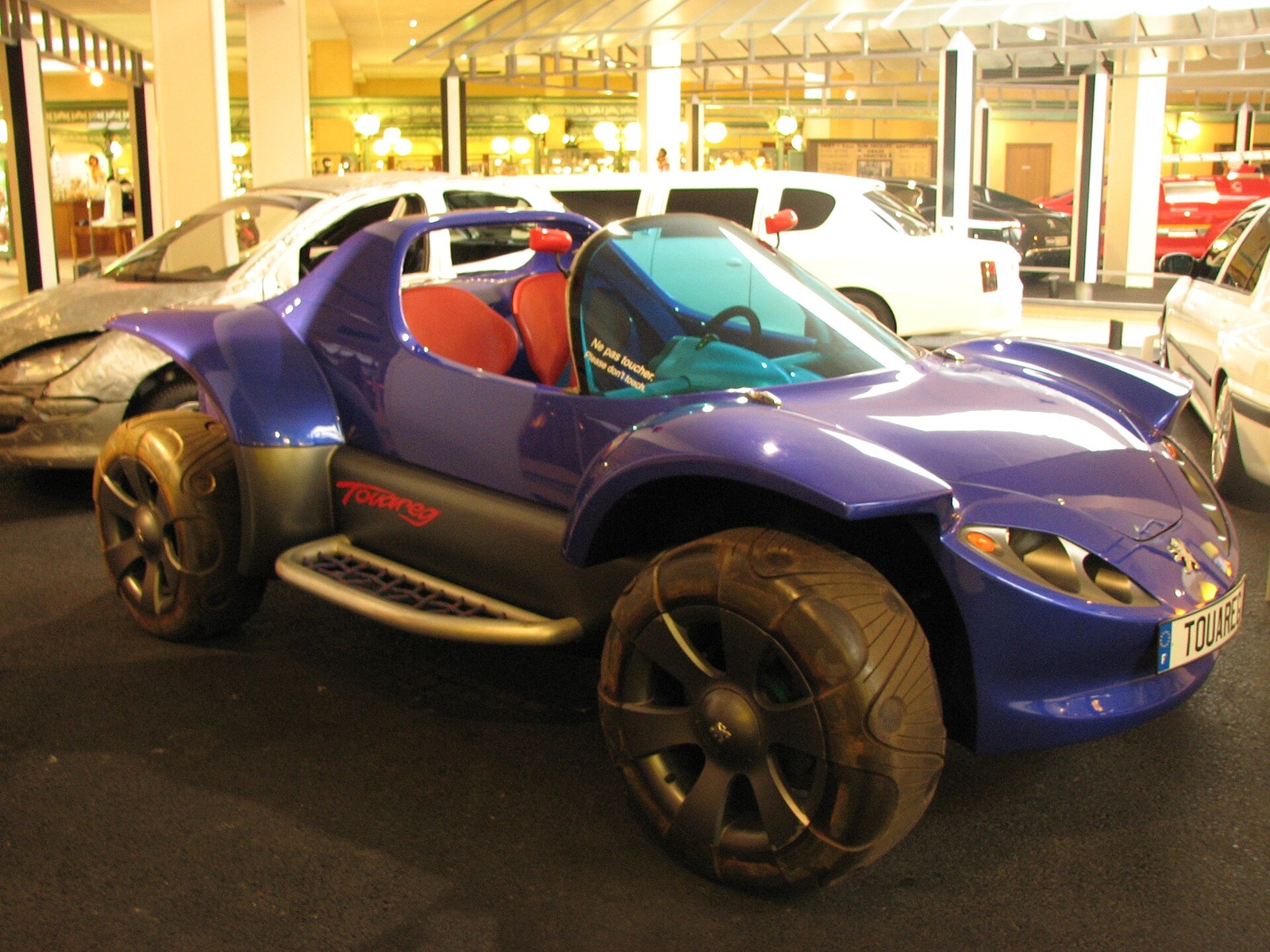
Peugeot's Touareg was a compact electric buggy study presented in 1996, long before the name became familiar on a Volkswagen SUV. The factory concept explored leisure travel through a small open vehicle with battery-electric propulsion. Its importance lies in a very different idea of the electric car from either a conventional urban hatchback or a high-performance demonstrator. This profile follows the physical Peugeot exhibit and keeps its historical operating claims clearly attributed.
The Peugeot identity behind a familiar name
The Touareg name needs both a manufacturer and a date to identify this vehicle correctly. Peugeot's 1996 study is not an early Volkswagen production SUV, a shared-platform project or a later conversion of one. The manufacturer's concept retrospective places it within Peugeot's own electric-mobility exploration. That source gives the project a distinct archive identity even though the name's later use elsewhere can dominate ordinary searches.
Peugeot: Touareg within its factory concept programme
An electric buggy rather than a conventional car
Peugeot describes a small buggy-style concept propelled by an electric motor and batteries. The open leisure format shifts attention from the normal family-car brief towards recreation, compactness and direct contact with the surroundings. Photographs of the actual exhibit help explain its proportions and access arrangement. Those visible design features can be discussed without assigning a road homologation class or claiming that the vehicle was offered as a customer-production off-roader.
A historical four-hour claim
The manufacturer overview associates the Touareg with a four-hour operating reference. That is not the same as a certified kilometre range, and it is not converted into one here. Duration depends on how a vehicle is used, including terrain, speed and load, while the original batteries' present condition would be another question altogether. The useful historical fact is the claim's stated form and source, not a modern range figure reconstructed from assumptions.
Peugeot: Touareg within its factory concept programme
Where it sits in Peugeot’s electric history
The Touareg sits close in time to Peugeot's experiments with compact urban EVs and shared-mobility ideas. It demonstrates that electrification research was not limited to one body type. A leisure buggy could investigate a different relationship between packaging, driving and the setting in which a vehicle is used. That interpretation concerns the design brief; it does not establish a direct production lineage or prove that later Peugeot electric models use the same hardware.
Peugeot: electric concept chronology
Following the physical exhibit
Dated show and museum photographs distinguish the Touareg from renders, scale models and unrelated vehicles sharing its name. For a surviving concept, custody and condition documentation would be needed to establish its present equipment and any changes. The selected manufacturer history supports the factory programme but does not reconcile an exclusive construction count. Repeated exhibitions therefore remain display events, not additional manufactured vehicles or evidence of a customer allocation.
Specifications and identity reference
| Reference presentation | 1996 |
|---|---|
| Manufacturer | Peugeot |
| Vehicle proposition | Small electric leisure buggy |
| Propulsion | Battery-electric motor system |
| Historical operating claim | Four hours; manufacturer overview |
| Range conversion | No certified kilometre figure inferred |
| Unrelated namesake | Later Volkswagen Touareg SUV |
| Completed physical-build total | Not assigned |
Rarity and production scope
Verified physical Peugeot Touareg concept. The four-hour reference remains an attributed historical duration claim, not a certified range or present battery assessment. No customer series or exclusive build census is assigned.
This is an Archive record. Concepts, restored heritage vehicles, works cars and competition programmes are not added to customer road-production totals. A programme profile does not establish how many physical chassis were made, and repeated exhibition appearances do not create additional vehicles.
What the photograph represents
Physical Peugeot Touareg electric buggy concept at a display. It is distinct from the later Volkswagen SUV; no present battery range is inferred from the photograph.
Related Peugeot heritage profiles
Frequently asked questions
Is this the Volkswagen Touareg?
No. It is Peugeot’s separately documented 1996 electric buggy concept.
Does four hours establish a particular certified range?
No. The duration is not converted into an invented kilometre figure.
What is the production-count boundary for this profile?
Verified physical Peugeot Touareg concept. The four-hour reference remains an attributed historical duration claim, not a certified range or present battery assessment. No customer series or exclusive build census is assigned.
Sources and further reading
Research checked 16 October 2026. Linked factory, heritage and specialist-register records support the specifically attributed claims. Photographic descriptions identify the illustrated subject. Design analysis and suggested authentication steps are editorial interpretation.
Built in limited numbers
Verified physical Peugeot Touareg concept. The four-hour reference remains an attributed historical duration claim, not a certified range or present battery assessment. No customer series or exclusive build census is assigned.
Gallery
Specifications
Factory specifications may vary by model year, market and configuration.
Identity & production
- Official model
- Peugeot Touareg Concept
Sources and verification
Source citations are being prepared for this profile.