1984 Lotus Etna Concept
Explore the 1984 Lotus Etna Concept: programme history, design, verified rarity scope, specifications and credited photography.
The Lotus Etna is a physical concept with an ambitious proposed road-car role and a later running-restoration history. Lotus dates its Birmingham reveal to 1984, correcting the workbook’s 1983 reference while preserving that original label for duplicate checks.
History and verified programme identity
Lotus’s manufacturer timeline identifies the Giugiaro-designed Etna reveal at the Birmingham Motor Show in 1984. Broad Arrow’s custodial catalogue separately documents the surviving concept and its later conversion to running condition. Those two phases should not be collapsed into a claim that the original show car demonstrated every proposed system. The catalogue identifies a prototype 4.0-litre Type 909 V8 and five-speed gearbox in the later car. The 909 engine reference is not automatically a complete official chassis-Type designation. This remains a concept archive rather than a series-production road-car tally.
Engineering and design
A concept can communicate a packaging and design intention before its entire proposed mechanical system is operational. The Etna’s broad glazing, low nose and enclosed rear body make a distinct coupe proposition visible. The later running restoration recorded by its custodian is therefore part of the car’s history, not proof of original production readiness. Proposed active systems and projected performance should retain their proposed status. The supplied photograph cannot establish their installation or operation. The original design identity, later mechanical development and photographed appearance can each be described accurately without inventing a road-production launch.
The physical car in the supplied photograph
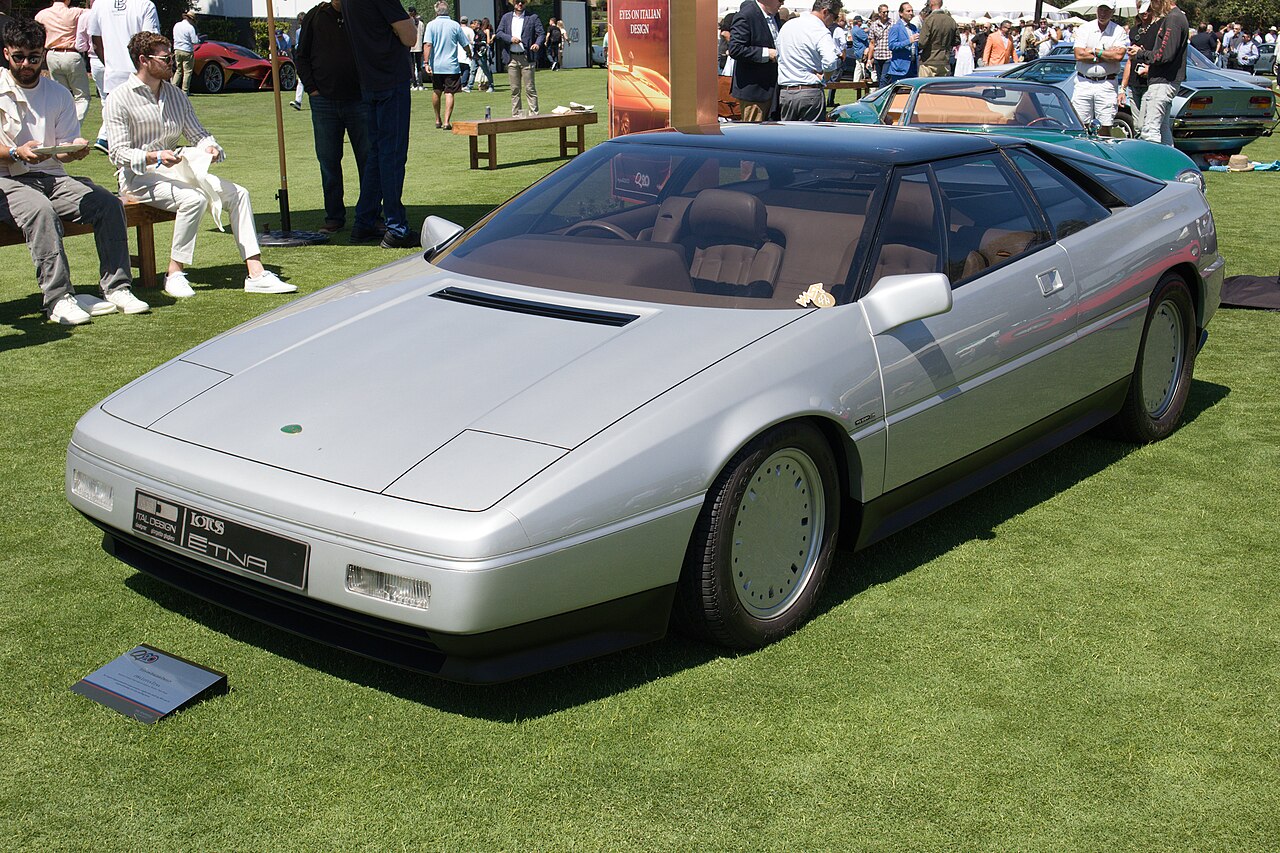
Prova MO’s photograph shows the silver 1984 Lotus Etna concept on grass at The Quail in August 2023. Its low enclosed nose, broad glazed cabin and smooth wheel covers are visible among visitors. The exact-source concept identification is retained, and its modern appearance is not described as a newly manufactured production Etna.
A closer look at the design
The Quail photograph makes the Etna’s design readable as a complete physical object. Its wide glazed upper volume sits above a low, clean nose, while the enclosed wheels and rear body create a very different impression from the open competition cars in this batch. These are observations about shape, rather than measurements of drag or performance. The official reveal record supplies the original concept date, and the later custodial account supplies the running-restoration boundary. Combining them allows a detailed archive entry without treating concept promises as completed engineering. A future individual history can add workshop evidence for the later mechanical work. The profile’s central task is to preserve the distinction between the original design statement and the subsequent operable car, so readers can understand both stages without one erasing the other.
Collecting and chassis evidence
A concept’s collector file needs a more detailed chronology than a normal registration-year entry. Record the original display, storage history, mechanical restoration and subsequent appearances separately. The custodian describes the later car becoming drivable; the original show model’s degree of functionality must therefore remain a dated question. Ownership and restoration records can clarify which body, canopy and mechanical components belong to which stage. A source-described one-off is useful context, but this profile does not invent an independently audited fabrication census or claim that a production series was completed.
Related Lotus designs and meaningful comparisons
The Turbo Esprit supplies an actual series-production road-coupe comparison, while the Type 92 shows a separate competition active-suspension experiment. These links explain the difference between demonstrated production, experimental systems and a concept’s proposed role. The Etna is not merged with either programme because it shares a marque, technology theme or wedge-shaped appearance.
Reading the sources
The programme sources and the photograph answer different questions. Manufacturer and custodial records establish the original model, Type, category and published production scope. The creator’s file establishes the pictured subject, setting and image permission. An individual chassis history can then add ownership, competition entries and dated repairs without changing the scope of the original programme. Build references are not survivor counts, and a later specification does not automatically become an additional newly manufactured vehicle. Where primary evidence does not establish a complete fabrication census, that field remains unassigned.
Specifications and rarity evidence
| Programme reference year | 1984 |
|---|---|
| Model / Type | Etna Concept — Etna / Type 909 engine programme |
| Body / competition role | Giugiaro-designed physical concept coupe |
| Manufacturer reveal year | 1984 |
| Reveal event | Birmingham Motor Show |
| Design attribution | Giorgetto Giugiaro / Italdesign |
| Later custodial engine reference | Prototype 4.0-litre Type 909 V8 |
| Later transmission reference | Five-speed manual |
| Photo event | The Quail, August 2023 |
| Published build / register reference | No complete tally assigned |
| Independently audited completed tally | Not assigned |
| Count scope | Verified physical 1984 Etna concept, separate from series road production. Original display status, projected systems and later running restoration are distinct; no series-production tally or independently audited one-off fabrication census assigned. |
| Original inventory status | LOT-093 — Verified |
Frequently asked questions
Does the later running Etna prove that every proposed system worked in 1984?
No. The original concept reveal and the later running restoration are different stages. Proposed systems and projected performance are not certified as tested production equipment.
How is Etna Concept classified?
This is a physical Lotus concept programme, separate from road production. A later running restoration does not demonstrate that all projected systems worked in the original show model.
Which technical details are established for the programme?
The primary record supports manufacturer reveal year: 1984; reveal event: Birmingham Motor Show; design attribution: Giorgetto Giugiaro / Italdesign. These are programme or explicitly attributed photo references. A particular surviving car’s engine, chassis repairs and competition preparation require its own dated documentation.
Does the photographed appearance establish factory originality?
The caption records a real creator-identified Etna Concept subject and its later setting. It establishes the illustration’s scope, while original components, restoration work and individual race provenance require chassis-specific evidence. A competition number, current paint or museum display is not used as an originality certificate.
What rarity or archive scope is verified?
Verified physical 1984 Etna concept, separate from series road production. Original display status, projected systems and later running restoration are distinct; no series-production tally or independently audited one-off fabrication census assigned.
Who photographed the supplied image?
Prova MO via Wikimedia Commons, under CC BY-SA 4.0. The original file and licence are linked with the image. Retain the creator, source and licence when uploading, exporting or reusing it; local retouching and synthetic enlargement have not been performed.
Related Lotus profiles
Sources and photo credits
- Primary manufacturer or programme record
- Broad Arrow original 2025 auction catalogue: Etna, lot 112, printed pages 44–45
Photograph: Prova MO via Wikimedia Commons original source, CC BY-SA 4.0. Source-provided thumbnail supplied without local cropping, retouching or synthetic enlargement.
Built in limited numbers
Verified physical 1984 Etna concept, separate from series road production. Original display status, projected systems and later running restoration are distinct; no series-production tally or independently audited one-off fabrication census assigned.
Gallery
Specifications
Factory specifications may vary by model year, market and configuration.
Identity & production
- Official model
- Etna Concept