1954 Fiat Turbina
Meet the 1954 Fiat Turbina: experimental propulsion, distinctive finned body, documented museum identity and a credited prototype photograph.
The Fiat Turbina turned a propulsion research question into a memorable physical prototype.
History and purpose
The Fiat Turbina turned a propulsion research question into a memorable physical prototype. MAUTO identifies the car as a 1954 Fiat and describes its experimental turbine power unit and sports-car-derived chassis. Its public presentation belongs to the 1954 Turin Motor Show period, while the museum records Fiat’s donation in 1962. Those dates describe different chapters: the original research vehicle and its later custodial life. This is an archive profile with a documented physical subject. The source inventory’s one-car wording is not silently converted into an independently verified fabrication tally, because a museum-held prototype identity and a complete accounting of every development article are different kinds of evidence.
Design and engineering
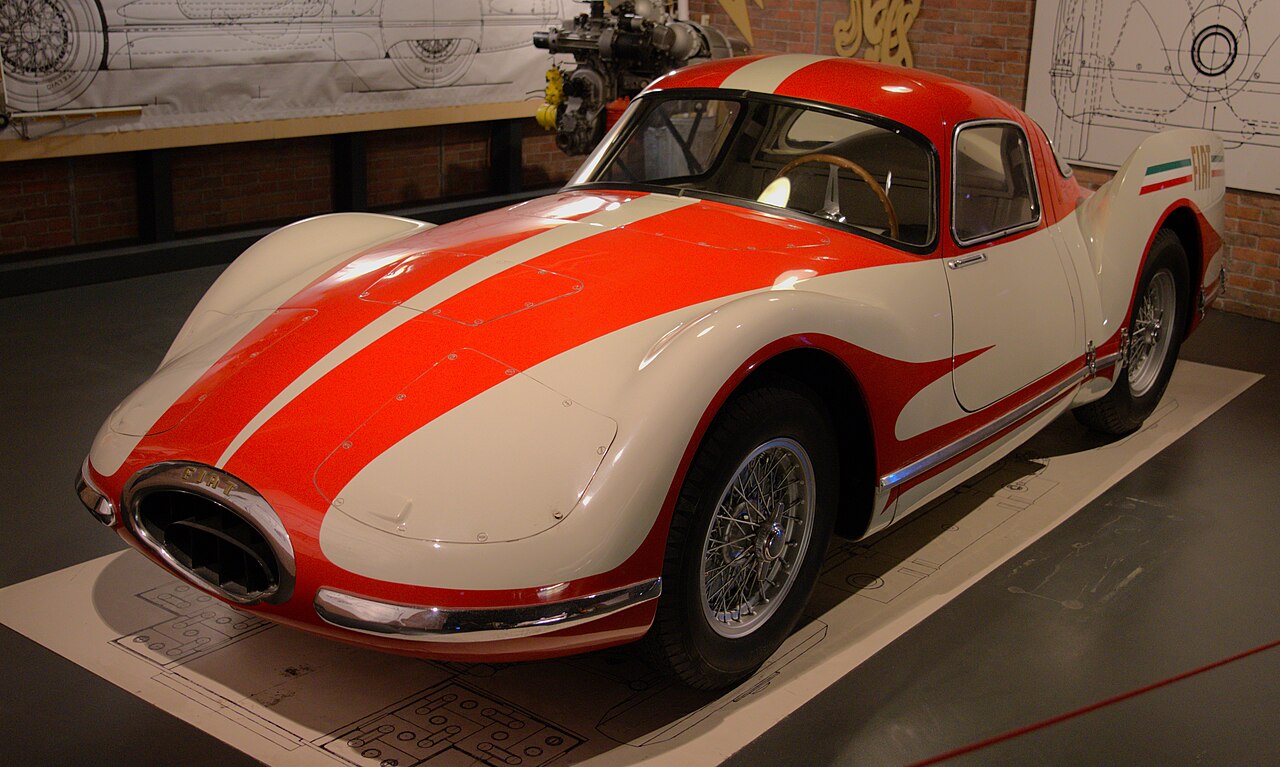
The museum photograph makes the Turbina’s unusual silhouette easy to read. A pale upper body sits above a contrasting red lower section, while pronounced rear fins direct attention toward the engine end of the car. The cockpit is compact and the nose is exceptionally clean in relation to the dramatic tail. These visual choices help communicate a research vehicle interested in airflow and propulsion packaging. The car’s presence also differs from that of a production grand tourer: its body explains an experiment. The source image and museum record identify the same distinctive prototype without requiring a speculative road registration, production gearbox or modern performance test.
Identifying the original configuration
Turbina is the name of this preserved experimental Fiat, rather than a trim level offered across ordinary production cars. A profile should keep the physical vehicle, its development purpose and later museum custody together. The exact manufacturing field remains unset and the eligibility field records archive scope, reflecting the nature of the checked evidence. Factory experiments can have associated drawings, rigs and components, but those objects should not be counted as completed cars without documentation. Equally, a later model or a scale reproduction should not inherit the prototype’s identity because it resembles the same design. The credited photograph shows the museum vehicle itself.
Collector context and preservation
For collection use, this car rewards a display that connects shape with engineering intent. The 8V profiles offer a useful starting point for studying the chassis lineage described by MAUTO; Mefistofele provides a much earlier example of Fiat architecture altered around an unconventional power source. Preserve museum accession context and dated restoration photographs alongside the original presentation date. Detail views of the fins, glazing and engine installation can make the prototype understandable to readers who first discover it through its name. A careful archive does not need an inflated production claim: the documented experiment and its surviving physical form already give the Turbina a distinctive place in Fiat history.
Reading the evidence for this profile
The original source links below identify the programme and the historical statements used in this article. The photograph has its own creator and licence record, separate from the manufacturer’s vehicle history. Keep both when transferring this profile into a collection catalogue. A manufacturing tally describes how many cars belong to a defined original programme; it does not measure how many survive, how many are publicly visible, or how many retain all their original components. Those individual questions require dated chassis and restoration evidence. The reference year likewise describes the programme’s introduction or named historic configuration, while the supplied caption states the photographed setting and any established individual identity. This lets future research expand the car’s history without blurring the scope of the record already assembled here.
Specifications and verified rarity
| Reference year | 1954 |
|---|---|
| Model / programme | Turbina |
| Body / role | Physical experimental turbine prototype |
| Documented engineering | Experimental gas-turbine propulsion |
| Architecture / transmission reference | Two-seat research berlinetta; 8V-derived chassis package |
| Exact manufacturing tally | Not established |
| Eligibility bound | Physical concept archive scope; tally unknown |
| Rarity scope | MAUTO-documented physical 1954 Fiat Turbina prototype, admitted as an archive subject. Exact fabrication tally is not independently established; neither a serial-production limit nor a completed manufacturing total is claimed. |
| Inventory reference | FIA-034 — Verified |
Frequently asked questions
What is the Fiat Turbina?
Fiat’s museum-documented 1954 turbine research prototype. It is included as a physical archive subject, with exact fabrication tally unknown.
What engineering details are documented?
Experimental gas-turbine propulsion. Two-seat research berlinetta; 8V-derived chassis package. The specification table identifies the documented model, concept package or explicitly named donor architecture. It does not certify an unseen engine number, individual component condition or a restoration specification from the exterior photograph.
Why is 1954 used in the profile title?
This is the reference year for the original configuration, introduction or public presentation explained in the history section. A photographed example can be younger. Where the supplied inventory used a different date, its original title remains an identity alias so that the same programme is not uploaded twice.
What belongs in an individual vehicle file?
Connect the chassis identity with original configuration records, dated photographs, custodial history and restoration paperwork. Record changes to paint, trim, mechanical components and bodywork as dated events. This profile establishes the named subject and its rarity or physical archive scope; the individual file supplies the history of the particular example.
What rarity or archive scope is verified?
MAUTO-documented physical 1954 Fiat Turbina prototype, admitted as an archive subject. Exact fabrication tally is not independently established; neither a serial-production limit nor a completed manufacturing total is claimed.
Who took the supplied photograph?
MrWalkr via Wikimedia Commons, under CC BY-SA 4.0. The original file and licence links accompany the image. Retain that credit when the photograph is uploaded, exported or reused.
Related Fiat profiles
Sources and photo credits
Photograph: MrWalkr via Wikimedia Commons original file, CC BY-SA 4.0. Source-provided photograph supplied without local cropping, retouching or text removal. A source thumbnail is used where available. 1954 Fiat Turbina at Museo Nazionale dell’Automobile, Turin; museum identity and distinctive finned prototype body matched.
Built in limited numbers
MAUTO-documented physical 1954 Fiat Turbina prototype, admitted as an archive subject. Exact fabrication tally is not independently established; neither a serial-production limit nor a completed manufacturing total is claimed.
Gallery
Specifications
Factory specifications may vary by model year, market and configuration.
Identity & production
- Official model
- Turbina