2007 Citroën C-Cactus Concept
Explore the 2007 Citroën C-Cactus Concept: sourced history, design, specifications and rarity evidence, with credited documentary photos.
The 2007 Citroën C-Cactus approaches the compact car through a question of essentials. Its rounded body and pared-back interior proposal give the first C-Cactus a distinct identity, separate from the later concepts and production models that reused the Cactus name.
The original C-Cactus idea
Citroën’s original announcement places C-Cactus at Frankfurt in 2007 and describes an HDi diesel-hybrid proposal built around reducing unnecessary complexity. Citroën Origins identifies the 2007 object, with five seats and dimensions of 4.20 by 1.80 by 1.49 metres. The sources present different mass figures, so this profile does not collapse them into a single unqualified specification.
Reducing complexity can be an architectural idea rather than merely a claim about price. The concept invites readers to ask which parts contribute to the experience of using a car and which can be reconsidered. That is a more specific historical proposition than describing every unusual detail as futuristic.
The matching 2007 Frankfurt photograph
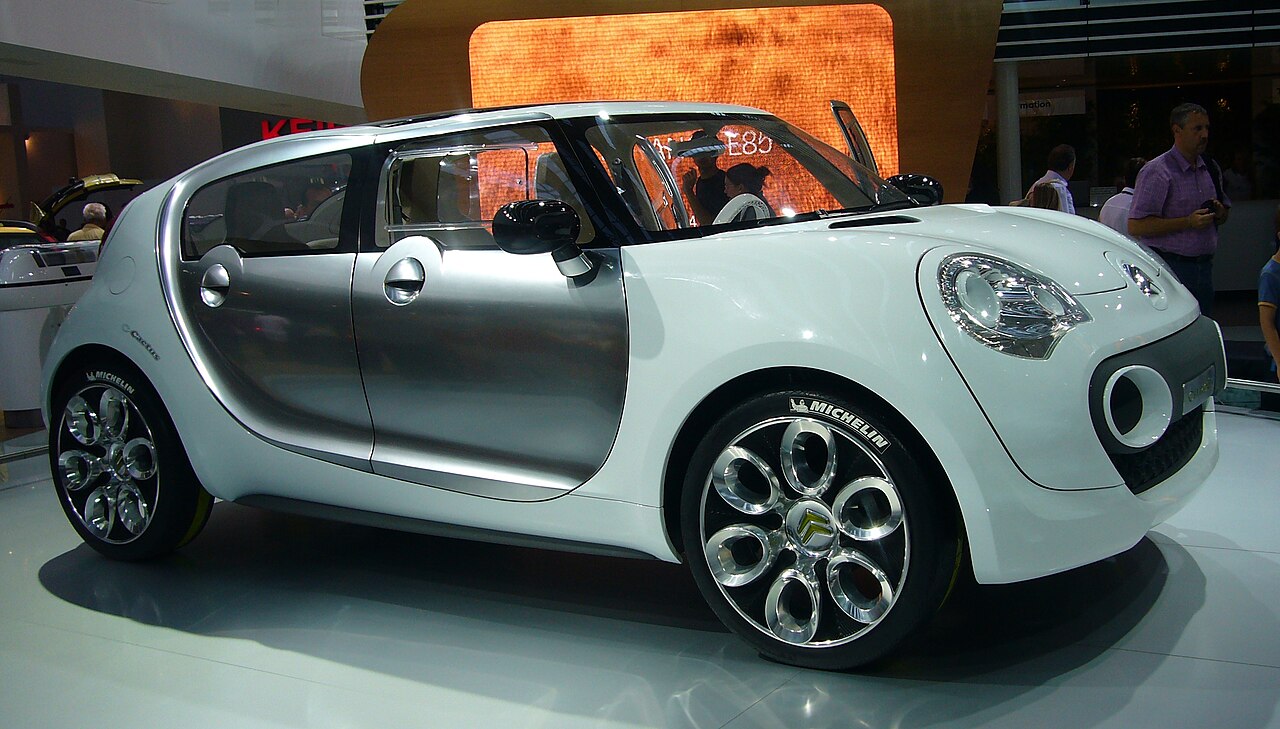
The supplied photo is identified at the 2007 IAA and shows the original concept’s pale body and dark side enclosure. Round front lighting elements, a curved nose and distinctive patterned wheels make its identity clear. Large areas of side glass expose the cabin, while the low body edge gives the shape a compact visual foundation.
This image was selected over photographs of the different 2013 Cactus concept. Similar names are not enough to make photographs interchangeable. The visible first-generation concept has its own rounder face and body treatment, so the dated source file is essential for keeping the page’s year, technical proposal and photo aligned.
Essential features need an explicit design brief
A simplicity proposal should explain what was retained as well as what was reduced. Passenger accommodation, access, controls and the physical construction need to be considered together. A reduced component count, where presented by a manufacturer, is only one part of the argument; the use of the remaining components matters too.
For historical interpretation, the most useful materials are cabin photographs and drawings that show how the proposal works. They allow the reader to connect the broad idea of essential motoring with specific choices. This profile does not assign later production Airbump equipment or customer trim features to the 2007 vehicle without concept-specific evidence.
A distinct chapter in the Cactus name’s history
The concept’s importance is strengthened by clear boundaries. Keep the original 2007 show vehicle, any later experimental configurations and the customer C4 Cactus in separate records. A shared name can then be used to discuss a continuing theme without erasing the differences between physical objects.
C-AirPlay and Osmose provide focused comparisons through compact-car experience and passenger packaging. The three concepts can be read as different answers to the question of what a small Citroën should offer. C-Cactus contributes the essential-features argument, giving the archive a theme that is practical as well as visual.
Specifications and verified rarity
| Reference year | 2007 |
|---|---|
| Model / project | C-Cactus Concept |
| Body / role | Five-seat compact concept |
| Debut | Frankfurt Motor Show, 2007 |
| Seats | Five |
| Dimensions | 4.20 × 1.80 × 1.49 m |
| Powertrain theme | HDi diesel-hybrid proposal |
| Rarity scope | Physical 2007 Frankfurt C-Cactus concept. The 2013 Cactus concept and later C4 Cactus production range are separate subjects; exact fabrication tally unset. |
| Exact manufacturing tally | Not established |
| Inventory reference | CIT-128 — Verified |
Frequently asked questions
Is this the 2013 Cactus concept?
No. The profile and photo concern the original 2007 C-Cactus.
Why is no single mass figure supplied?
The cited official records present differing figures without enough context to reconcile them here.
Can production C4 Cactus trim equipment be applied?
No. Equipment needs evidence specific to the 2007 concept.
What is the central design theme?
Reconsidering complexity and retaining the features central to the compact-car experience.
What rarity or archive scope is verified?
Physical 2007 Frankfurt C-Cactus concept. The 2013 Cactus concept and later C4 Cactus production range are separate subjects; exact fabrication tally unset.
Who took the supplied photograph?
Overlaet via Wikimedia Commons, under CC BY-SA 3.0. Keep the photographer, original-file link and licence credit with the image.
Related Citroën profiles
Sources and photo credits
Photograph: Overlaet via Wikimedia Commons original file, CC BY-SA 3.0. Source photograph supplied without local cropping, retouching or text removal. A source-provided thumbnail is used where available. Original C-Cactus concept at IAA Frankfurt 2007, identified by its source. Images of the 2013 concept were rejected.
Built in limited numbers
Physical 2007 Frankfurt C-Cactus concept. The 2013 Cactus concept and later C4 Cactus production range are separate subjects; exact fabrication tally unset.
Gallery
Specifications
Factory specifications may vary by model year, market and configuration.
Identity & production
- Official model
- C-Cactus Concept