2000 Citroën Osmose Concept
Explore the 2000 Citroën Osmose Concept: sourced history, design, specifications and rarity evidence, with credited documentary photos.
The 2000 Citroën Osmose is a small car organized around people and access. Its upright glazed body turns the passenger compartment into the most visible part of the vehicle, making the physical concept a compelling study of shared urban travel.
A single documented mobility experiment
Citroën Origins records one Osmose manufactured in 2000, with a five-seat layout and dimensions of 3.35 by 1.75 by 1.70 metres. The official entry lists sliding doors, a rear-view camera, hybrid traction and a zero-emission mode. It places the presentation at the Paris Motor Show. The archive’s zero mass placeholder is not used as a specification.
The hybrid description matters. “Zero-emission mode” is not the same as proving that the whole vehicle was battery-electric. The profile preserves the wording’s technical scope without inventing a battery capacity, range or contemporary charging standard. A historical concept is most interesting when its period proposition is allowed to remain specific.
The side view makes access central
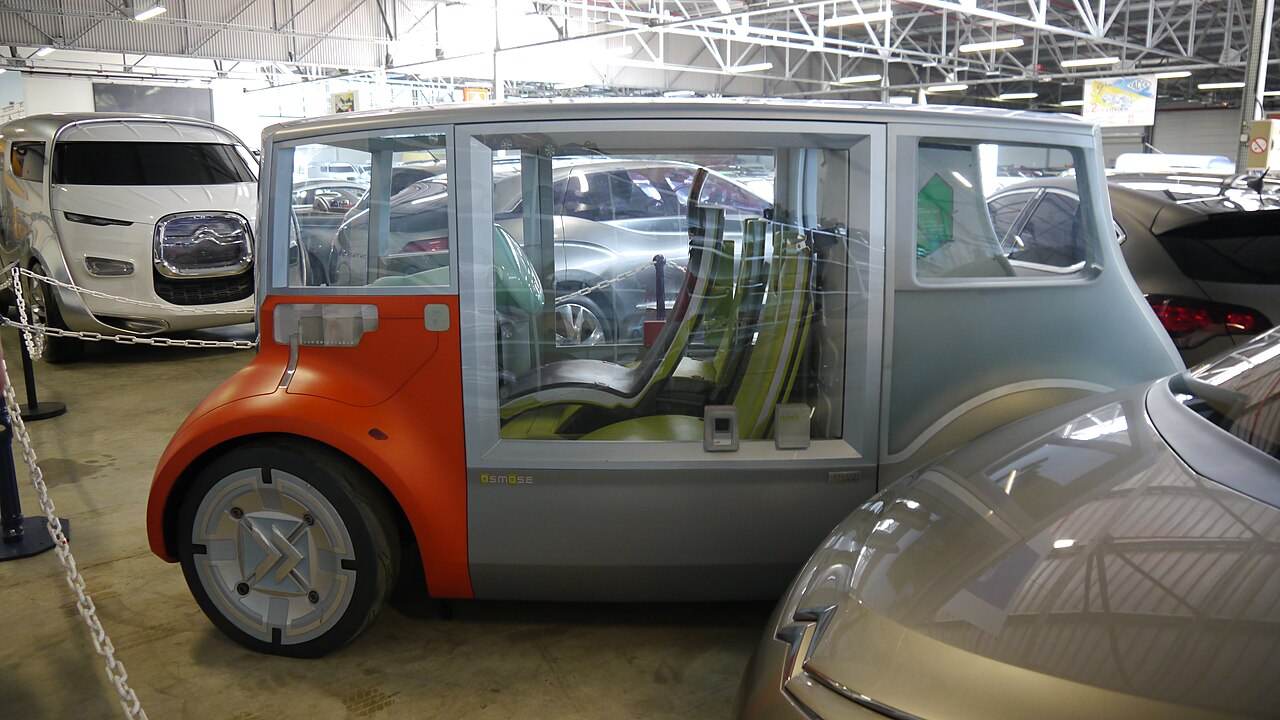
The museum photograph shows an orange front section and a grey, almost box-like cabin with large windows. An open side entrance exposes the seating area directly. The upright rear and tall glass make the cabin feel like a compact room on wheels. Neighbouring cars establish that this is a collection image, not a staged demonstration of passenger service.
The body does not rely on a long bonnet to communicate its identity. Most of its visible volume is associated with the cabin, while the bright front provides a visual anchor. This is an interpretation of the photograph’s proportions; the official dimensions provide the actual measurement. The two kinds of evidence complement one another.
User-friendliness as an architectural question
A sliding door changes the space needed around a vehicle when people enter or leave. In general design terms, it is an access choice as much as a styling choice. Osmose’s visible opening invites that discussion without requiring an unsupported claim that the car operated a particular public transport service.
The rear-view camera also belongs in its historical context. It is an identified concept feature, not proof of autonomous operation. Keeping these distinctions clear allows the reader to appreciate the project’s ambitions while avoiding a modern story pasted over a period object. Mobility ideas can be advanced without every technology familiar today being present.
The object behind the mobility story
The most useful preservation record would document door hardware, cabin fittings and the display or control systems that accompanied the concept. These details are especially vulnerable to being lost when a mobility project is remembered mainly through a slogan. Photographs of the complete object should be paired with evidence of how the proposed interaction was meant to work.
Osmose is a natural counterpart to C10 and Xanae. Each can be approached through the compact passenger-space question, but each gives a different answer in form and access. Read together, the profiles reveal an experimental tradition that is richer than a sequence of unusual-looking cars.
Specifications and verified rarity
| Reference year | 2000 |
|---|---|
| Model / project | Osmose Concept |
| Body / role | Compact shared-mobility concept |
| Seats | Five in the official archive |
| Dimensions | 3.35 × 1.75 × 1.70 m |
| Powertrain theme | Hybrid traction with a zero-emission mode |
| Access and visibility | Sliding doors; rear-view camera |
| Rarity scope | Citroën Origins explicitly records one Osmose manufactured in 2000. |
| Exact manufacturing tally | 1 |
| Inventory reference | CIT-112 — Verified |
Frequently asked questions
How many does the official archive record?
One manufactured Osmose.
Was it simply a battery-electric car?
The archive specifies hybrid traction and a zero-emission mode.
Does the camera imply autonomous driving?
No. A camera is an identified feature, not evidence of autonomous operation.
What is the most visible design theme?
The upright glazed cabin and large sliding-door access.
What rarity or archive scope is verified?
Citroën Origins explicitly records one Osmose manufactured in 2000.
Who took the supplied photograph?
Klaus Nahr from Germany via Wikimedia Commons, under CC BY-SA 2.0. Keep the photographer, original-file link and licence credit with the image.
Related Citroën profiles
Sources and photo credits
Photograph: Klaus Nahr from Germany via Wikimedia Commons original file, CC BY-SA 2.0. Source photograph supplied without local cropping, retouching or text removal. A source-provided thumbnail is used where available. Osmose at the Citroën Conservatoire with its side entrance open.
Built in limited numbers
Citroën Origins explicitly records one Osmose manufactured in 2000.
Gallery
Specifications
Factory specifications may vary by model year, market and configuration.
Identity & production
- Official model
- Osmose Concept