2001 Citroën C-Crosser Concept
Explore the 2001 Citroën C-Crosser Concept: sourced history, design, specifications and rarity evidence, with credited documentary photos.
The 2001 Citroën C-Crosser Concept combines a tall all-purpose body with a much less conventional control and cargo arrangement. Its identity belongs to the original Frankfurt experiment, before the C-Crosser name appeared on a customer production SUV.
The original C-Crosser proposal
Citroën UK’s period press material, preserved by Citroënët, describes a six-seat concept with a 2.0-litre HPi petrol engine, four-wheel drive, four-wheel steering and Hydractive III suspension. A movable drive-by-wire control arrangement removes conventional pedals. The roof, rear seating and tailgate arrangement was intended to let the passenger vehicle transform toward an open cargo configuration.
The later production SUV has a separate platform and history. Its specifications cannot fill gaps in this concept record merely because the name matches. The 2001 show vehicle deserves its own chronology and mechanism description, especially because the control arrangement is central to what made it experimental.
The Frankfurt photograph captures the closed form
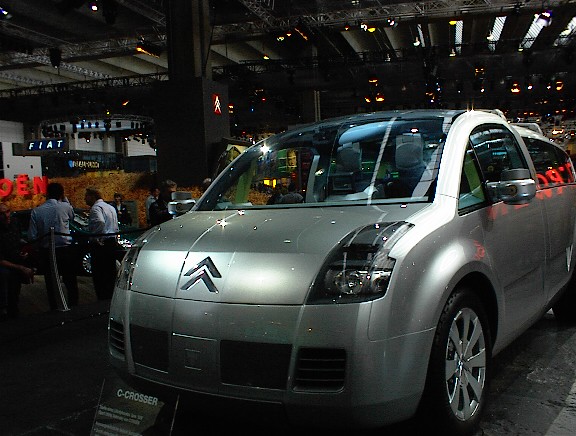
The supplied image shows the silver concept on its 2001 IAA stand. A high front, dark lower grille sections and tall vertical lamps give the vehicle an upright character. The windscreen rises into the roof, and the large wheels sit under broad arches. The photographed configuration is enclosed rather than transformed into an open load carrier.
This closed-body view provides the starting point for understanding the transformation. It shows where the cabin and rear volume begin, but it does not demonstrate the movement of panels or the control system. A sequence of period images is needed to explain those functions. The photograph’s value is a clear dated record of the original concept at its show presentation.
Controls and cargo need their own evidence
A movable driving interface changes the relationship between the driver and the cabin. It raises questions about visibility, ergonomics and how steering and acceleration commands reach the vehicle. The period description establishes the proposed arrangement; it does not certify modern regulatory approval or everyday reliability.
Similarly, a transformable rear body is best explained through intermediate positions, hinges and stowage locations. Those details tell the reader what the mechanism actually does. A good technical archive would preserve operating diagrams and demonstration images alongside the dramatic exterior photograph, making the distinction between a real mechanism and an illustrated possibility clear.
A different kind of utility-car experiment
C-Crosser can be compared with C-Buggy through the idea of outdoor use. The enclosed transformable vehicle and the open two-seat concept approach that theme from different directions. One emphasizes a configurable body and control arrangement; the other makes exposure and minimal enclosure visually central.
Its collector story therefore lies in the breadth of the original brief. The car should be remembered as a specific physical experiment with several interacting systems, not as an early photograph of the later production SUV. Clear naming, dated sources and model-specific images preserve that distinction for readers arriving through a search for C-Crosser history.
Specifications and verified rarity
| Reference year | 2001 |
|---|---|
| Model / project | C-Crosser Concept |
| Body / role | Transformable six-seat SUV concept |
| Debut | Frankfurt Motor Show, 2001 |
| Seats | Six |
| Powertrain | 2.0-litre HPi petrol engine |
| Chassis / controls | Four-wheel drive, four-wheel steering, Hydractive III and drive-by-wire controls |
| Rarity scope | Physical 2001 Frankfurt C-Crosser concept. This is not the later production SUV of the same name; exact fabrication tally unset. |
| Exact manufacturing tally | Not established |
| Inventory reference | CIT-113 — Verified |
Frequently asked questions
Is this the production C-Crosser SUV?
No. This profile concerns the distinct 2001 concept.
What engine is documented for the concept?
A 2.0-litre HPi petrol engine.
Did it use conventional pedals?
The period description specifies a movable drive-by-wire arrangement without conventional pedals.
Does the supplied image show the cargo transformation?
No. It shows the enclosed display configuration at IAA 2001.
What rarity or archive scope is verified?
Physical 2001 Frankfurt C-Crosser concept. This is not the later production SUV of the same name; exact fabrication tally unset.
Who took the supplied photograph?
Axel Schwenke from Meschede, Deutschland via Wikimedia Commons, under CC BY-SA 2.0. Keep the photographer, original-file link and licence credit with the image.
Related Citroën profiles
Sources and photo credits
Photograph: Axel Schwenke from Meschede, Deutschland via Wikimedia Commons original file, CC BY-SA 2.0. Source photograph supplied without local cropping, retouching or text removal. A source-provided thumbnail is used where available. C-Crosser concept at IAA Frankfurt 2001. This is the original concept, not the later production SUV.
Built in limited numbers
Physical 2001 Frankfurt C-Crosser concept. This is not the later production SUV of the same name; exact fabrication tally unset.
Gallery
Specifications
Factory specifications may vary by model year, market and configuration.
Identity & production
- Official model
- C-Crosser Concept