2002 Citroën C-Airdream Concept
Explore the 2002 Citroën C-Airdream Concept: sourced history, design, specifications and rarity evidence, with credited documentary photos.
The 2002 Citroën C-Airdream places an elegant coupé around an unusual driving interface. The smoothly glazed exterior is only one part of its identity: the period concept also asks how much of the driving task can be gathered into the steering-wheel area.
A coupé with a hand-control experiment
The preserved Citroën period material describes a 2+2 coupé with a 3.0-litre V6, automatic transmission and Hydractive III suspension. Electronic hand controls for acceleration, braking and gear selection are integrated around a fixed-centre steering wheel, replacing the conventional pedal arrangement. The interior discussion also records a large glazed roof and a carefully furnished cabin.
Electronic controls do not make the car an electric vehicle. The documented powertrain remains a V6. This distinction is useful for readers who encounter the futuristic cockpit first and assume the propulsion system must have been equally unconventional. C-Airdream combined a different interface with a clearly identified engine arrangement.
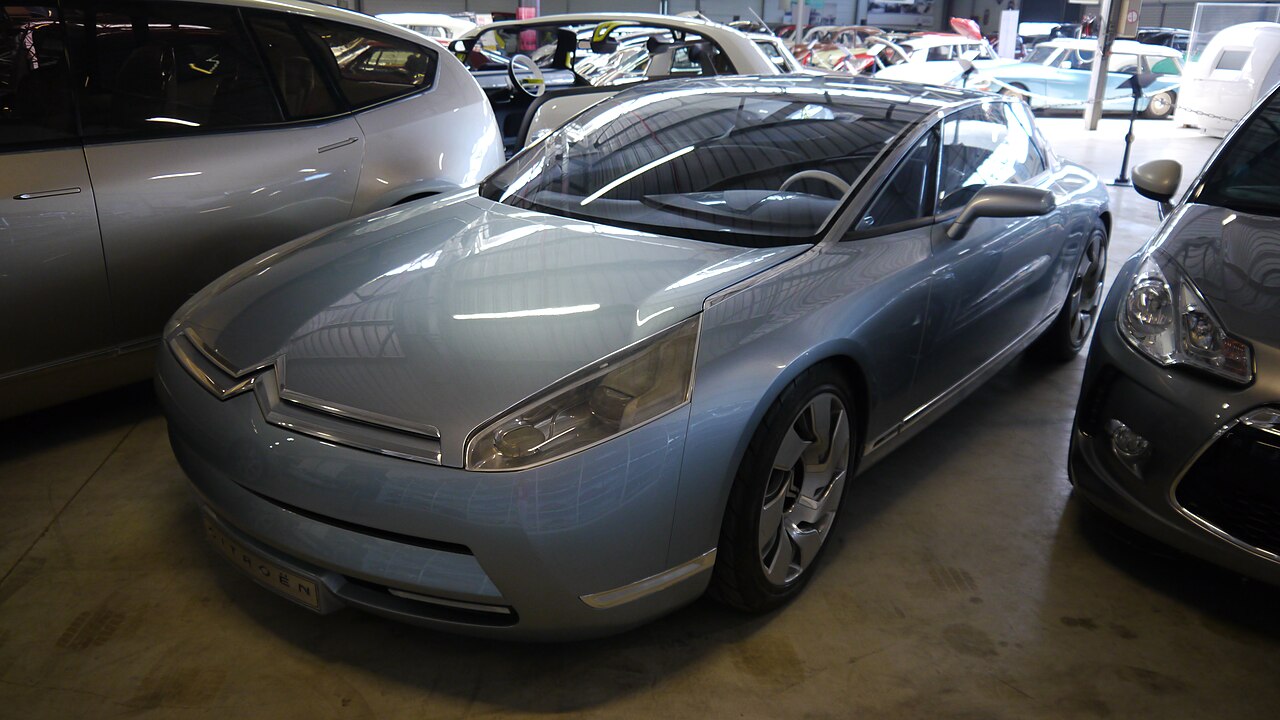
The collection photograph shows the long coupé form
The supplied image looks across the silver-blue nose toward the sweeping cabin. Slender lamps sit low in the front, while a large windscreen blends visually with the roof glass. The low body and long side glazing make the passenger enclosure appear continuous. The museum’s neighbouring cars remain visible, preserving the documentary setting.
The shape uses surface and reflection rather than heavy ornament. Light falling across the bonnet emphasizes its clean planes, and the dark glass supplies contrast. This gives the car a composed appearance, but an exterior photograph cannot establish the cockpit’s operational qualities. The body image and the technical source serve different parts of the story.
A driving interface is part of vehicle architecture
Moving acceleration and braking functions to the hands changes more than the location of a switch. It changes how the driver’s body is organized within the cockpit and how information and commands share the steering area. The concept is therefore best discussed through both ergonomic drawings and photographs of the actual controls.
A careful history should distinguish the installed demonstration from claims about future adoption. A feature can be technically interesting without becoming a normal production arrangement. Preserving the experiment’s specific hardware and its period description lets readers judge the proposal on its own terms, rather than through hindsight about which ideas became commonplace.
How to read the Airdream with other concepts
C-Crosser offers a useful comparison because both raise questions about the driving interface. Their bodies and intended roles are very different: one is a transformable utility concept, the other a low coupé. The shared question becomes clearer precisely because the physical forms do not match.
For an archive display, begin with the exterior silhouette, then show the cockpit and finally explain the hand-control sequence. That progression takes readers from a readily understood design to the less familiar mechanism. Conservation records should pay particular attention to electronics, controls and glazing, which are essential to interpreting the complete object.
Specifications and verified rarity
| Reference year | 2002 |
|---|---|
| Model / project | C-Airdream Concept |
| Body / role | 2+2 concept coupé |
| Powertrain | 3.0-litre V6 and automatic transmission |
| Suspension | Hydractive III |
| Accommodation | 2+2 |
| Control concept | Fixed-centre steering wheel; electronically transmitted hand controls |
| Rarity scope | Documented physical C-Airdream concept and period engineering description. Exact fabrication tally unset. |
| Exact manufacturing tally | Not established |
| Inventory reference | CIT-115 — Verified |
Frequently asked questions
Was C-Airdream battery-electric?
No. The cited period specification identifies a 3.0-litre V6.
What makes its controls unusual?
Acceleration, braking and gear selection are handled around a fixed-centre steering wheel.
What is the seating format?
A 2+2 coupé.
Does the exterior image demonstrate the controls?
No. Their arrangement is established by the separate period technical material.
What rarity or archive scope is verified?
Documented physical C-Airdream concept and period engineering description. Exact fabrication tally unset.
Who took the supplied photograph?
Klaus Nahr from Germany via Wikimedia Commons, under CC BY-SA 2.0. Keep the photographer, original-file link and licence credit with the image.
Related Citroën profiles
Sources and photo credits
- Citroën period press, preserved by Citroënët: C-Airdream engineering
- Citroën period press, preserved by Citroënët: C-Airdream interior
Photograph: Klaus Nahr from Germany via Wikimedia Commons original file, CC BY-SA 2.0. Source photograph supplied without local cropping, retouching or text removal. A source-provided thumbnail is used where available. C-Airdream at the Citroën Conservatoire. General exterior view, rather than proof of control-system operation.
Built in limited numbers
Documented physical C-Airdream concept and period engineering description. Exact fabrication tally unset.
Gallery
Specifications
Factory specifications may vary by model year, market and configuration.
Identity & production
- Official model
- C-Airdream Concept