1994 Citroën Xanae Concept
Explore the 1994 Citroën Xanae Concept: sourced history, design, specifications and rarity evidence, with credited documentary photos.
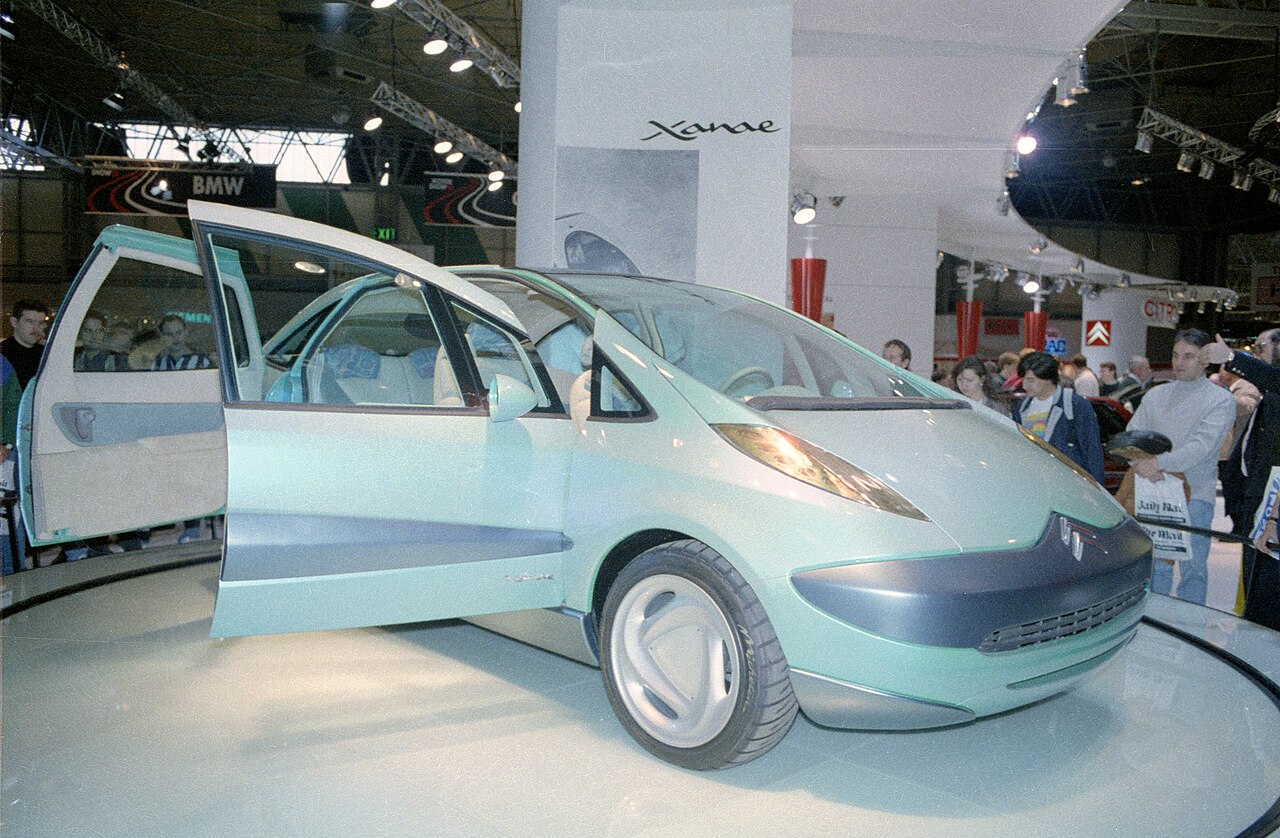
The 1994 Citroën Xanae makes the passenger compartment the centre of the story. Its tall glass, unusual door opening and rounded body explore how a compact vehicle can combine the visual character of a car with the accommodation of a people carrier.
A working proposal for a different compact car
Citroën’s period le Double Chevron material describes an operational concept built for the 1994 Paris show. It records a 4.20-metre body, a five-person cabin, a 2.0-litre 16-valve engine and an electronically controlled automatic transmission. The right-hand doors open in opposite directions without a central pillar; swivelling front seats and modular rear accommodation support the passenger-space experiment.
Those facts explain why Xanae is more than a dramatic door photograph. The designers were presenting a coherent package in which exterior form, access and the arrangement inside could be examined together. The surviving object gives that discussion a tangible reference, while the original press material separates installed features from later interpretations.
The open-door image shows the idea directly
The supplied contemporary show photograph presents a pale blue vehicle with its side doors open. A broad windscreen extends the glazed area upward, and the high cabin contrasts with the low, rounded nose. The opening is visually substantial: it reveals the passenger space as one continuous area rather than a narrow aperture cut into a conventional side.
The silver-toned wheels and smooth surfaces keep attention on the overall architecture. The photograph’s lighting creates highlights across the front and cabin, reinforcing their soft forms. This visual reading does not certify structural performance without a pillar. That question requires the construction and engineering evidence, whereas the image makes the access concept understandable at a glance.
A cabin can be a design argument
Swivelling or removable seating changes the way an interior is imagined. It invites the reader to consider conversation, entry and flexible use alongside the forward-facing journey. Those possibilities should be described as part of the period concept, without assuming that every imagined arrangement would be used while driving.
A useful archive presentation would add a sequence of interior views: the normal travel layout, the alternative seat positions and the door-opening operation. Such a sequence explains the design more clearly than a single broad claim of versatility. It also preserves which features actually existed on the physical concept, an important distinction in a field filled with attractive proposal sketches.
Xanae beside Osmose and C-Airlounge
Xanae can be compared with Osmose through the question of access, and with C-Airlounge through the question of how a cabin becomes a shared space. The comparison is editorial interpretation. It does not turn the three concepts into a single platform or imply identical mechanisms.
The car’s collector significance lies in this clear experimental role. Dated photographs, original project documents and conservation records can show how the object has survived and whether details changed between displays. Those records make it possible to revisit the original passenger-space proposal with precision, rather than reducing the history to a general claim that it predicted everything that followed.
Specifications and verified rarity
| Reference year | 1994 |
|---|---|
| Model / project | Xanae Concept |
| Body / role | Compact experimental MPV |
| Powertrain | 2.0-litre 16-valve engine; electronically controlled automatic |
| Length | 4.20 m |
| Seats | Five, with a modular interior |
| Access | Opposed doors without a centre pillar on the right-hand side |
| Rarity scope | Documented physical, operational Xanae concept shown at Paris in 1994. Exact fabrication tally unset. |
| Exact manufacturing tally | Not established |
| Inventory reference | CIT-101 — Verified |
Frequently asked questions
Was Xanae only a styling sketch?
Citroën’s period account describes an operational physical vehicle.
What engine arrangement is documented?
A 2.0-litre 16-valve engine with an electronically controlled automatic transmission.
Which side had the pillarless opening?
The cited period description specifies the right-hand side.
Why show the doors open?
The view explains the connection between cabin space and the access design.
What rarity or archive scope is verified?
Documented physical, operational Xanae concept shown at Paris in 1994. Exact fabrication tally unset.
Who took the supplied photograph?
Mike Roberts from London, United Kingdom via Wikimedia Commons, under CC BY-SA 2.0. Keep the photographer, original-file link and licence credit with the image.
Related Citroën profiles
Sources and photo credits
Photograph: Mike Roberts from London, United Kingdom via Wikimedia Commons original file, CC BY-SA 2.0. Source photograph supplied without local cropping, retouching or text removal. A source-provided thumbnail is used where available. Xanae concept at a motor-show display. The original source image shows its open right-hand doors.
Built in limited numbers
Documented physical, operational Xanae concept shown at Paris in 1994. Exact fabrication tally unset.
Gallery
Specifications
Factory specifications may vary by model year, market and configuration.
Identity & production
- Official model
- Xanae Concept