1988 Citroën Activa 1 Concept
Explore the 1988 Citroën Activa 1 Concept: sourced history, design, specifications and rarity evidence, with credited documentary photos.
The 1988 Citroën Activa 1 brings the experimental story down to the chassis. Its low, smooth saloon body serves a programme in which suspension, steering and cabin access became part of a coordinated vision of the future car.
The first Activa is its own project
Citroën Origins records Activa 1 in 1988, with five seats and a 4.75-by-1.90-by-1.27-metre body. Its listed innovations include four-wheel steering combined with Hydractive suspension and remote simultaneous door opening. These are the verified themes of the prototype. The archive’s empty or malformed technical fields are not treated as reliable mass or output specifications.
“Activa” subsequently appears on another concept and on a production Xantia derivative. Those uses belong to a connected story, but they are not interchangeable vehicle identities. A profile of the first concept should preserve its own year, body and experimental configuration instead of collecting every later Activa specification under one title.
Reading the clearer collection photograph
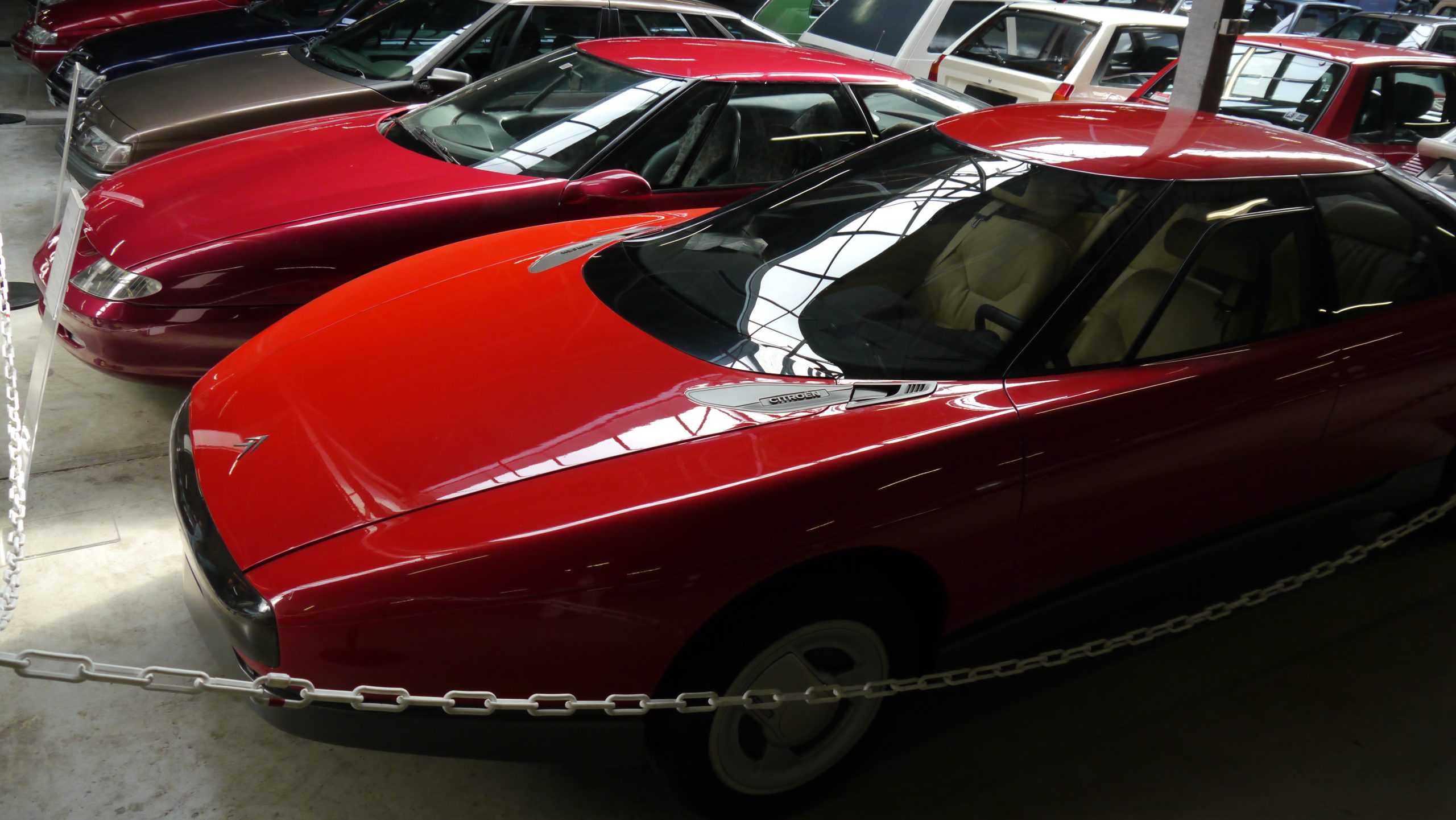
The foreground car in the supplied high-resolution image has red-orange bodywork, a broad curved windscreen and a long dark side-glass band. A slim front treatment leaves the bonnet surface largely uninterrupted. The roof and windows appear visually integrated into the body. The separately photographed Activa 2 sits alongside it in the collection, providing a useful comparison.
The image’s value is documentary as well as aesthetic. It lets the reader compare the two physical concepts without relying on a tiny picture that can resemble a model. The parked museum setting does not demonstrate suspension movement, but it clearly establishes the first car’s low saloon proportions and the way its cabin is enclosed.
Steering, suspension and the meaning of an experiment
A chassis experiment can be visually quiet. The mechanisms that change a car’s attitude or steering behaviour are not necessarily expressed through wings, intakes or dramatic bodywork. Activa 1 is a useful reminder that a concept’s most important proposition may lie beneath the photographed surface.
To explain such a project well, an archive needs operating diagrams, development notes and contemporary demonstrations alongside the exterior view. Those sources can distinguish what was installed from what was proposed and what later reached production. The photograph supplies the object’s visible identity; a movement sequence or technical drawing answers a different set of questions.
Comparing Activa 1 with Activa 2
The neighbouring Activa 2 provides the natural next chapter. Its coupé silhouette changes the visual presentation of the experimental theme, whereas the earlier car reads as a broader passenger-car proposition. This is a comparison of body forms and project roles, not an assertion that every mechanism was carried over unchanged.
For collectors and design historians, the pair rewards a joined narrative with separate records. Keep each car’s photo credit, year and technical source attached to the correct identity. Then use the related profile to explain the progression. That approach gives the Activa story continuity without erasing the differences that make the individual archive objects interesting.
Specifications and verified rarity
| Reference year | 1988 |
|---|---|
| Model / project | Activa 1 Concept |
| Body / role | Five-seat experimental saloon |
| Seats | Five |
| Dimensions | 4.75 × 1.90 × 1.27 m |
| Chassis themes | Hydractive suspension and four-wheel steering |
| Door feature | Remote opening of the doors together |
| Rarity scope | Documented physical 1988 Activa 1 experimental project; distinct from Activa 2 and production Xantia Activa. Exact fabrication tally unset. |
| Exact manufacturing tally | Not established |
| Inventory reference | CIT-087 — Verified |
Frequently asked questions
Is Activa 1 the 1990 coupé?
No. Activa 1 is the 1988 saloon concept; the coupé is Activa 2.
What chassis ideas does the official archive list?
Hydractive suspension and four-wheel steering.
Does a parked photograph demonstrate active suspension?
No. It establishes the visible object; operation needs technical or demonstration evidence.
Are the archive’s zero mass fields specifications?
No. Placeholder values are omitted rather than published as vehicle measurements.
What rarity or archive scope is verified?
Documented physical 1988 Activa 1 experimental project; distinct from Activa 2 and production Xantia Activa. Exact fabrication tally unset.
Who took the supplied photograph?
Klaus Nahr from Germany via Wikimedia Commons, under CC BY-SA 2.0. Keep the photographer, original-file link and licence credit with the image.
Related Citroën profiles
Sources and photo credits
Photograph: Klaus Nahr from Germany via Wikimedia Commons original file, CC BY-SA 2.0. Source photograph supplied without local cropping, retouching or text removal. A source-provided thumbnail is used where available. Activa 1 in the foreground at the Citroën Conservatoire, with Activa 2 alongside it. The high-resolution source photograph replaces a rejected low-resolution view.
Built in limited numbers
Documented physical 1988 Activa 1 experimental project; distinct from Activa 2 and production Xantia Activa. Exact fabrication tally unset.
Gallery
Specifications
Factory specifications may vary by model year, market and configuration.
Identity & production
- Official model
- Activa 1 Concept