BMW 3 Series Racing Prototype Art Car — Sandro Chia, 1992
Explore BMW 3 Series Racing Prototype Art Car Sandro Chia: history, specifications, rarity and FAQs, with authentic photos and visible source credits.
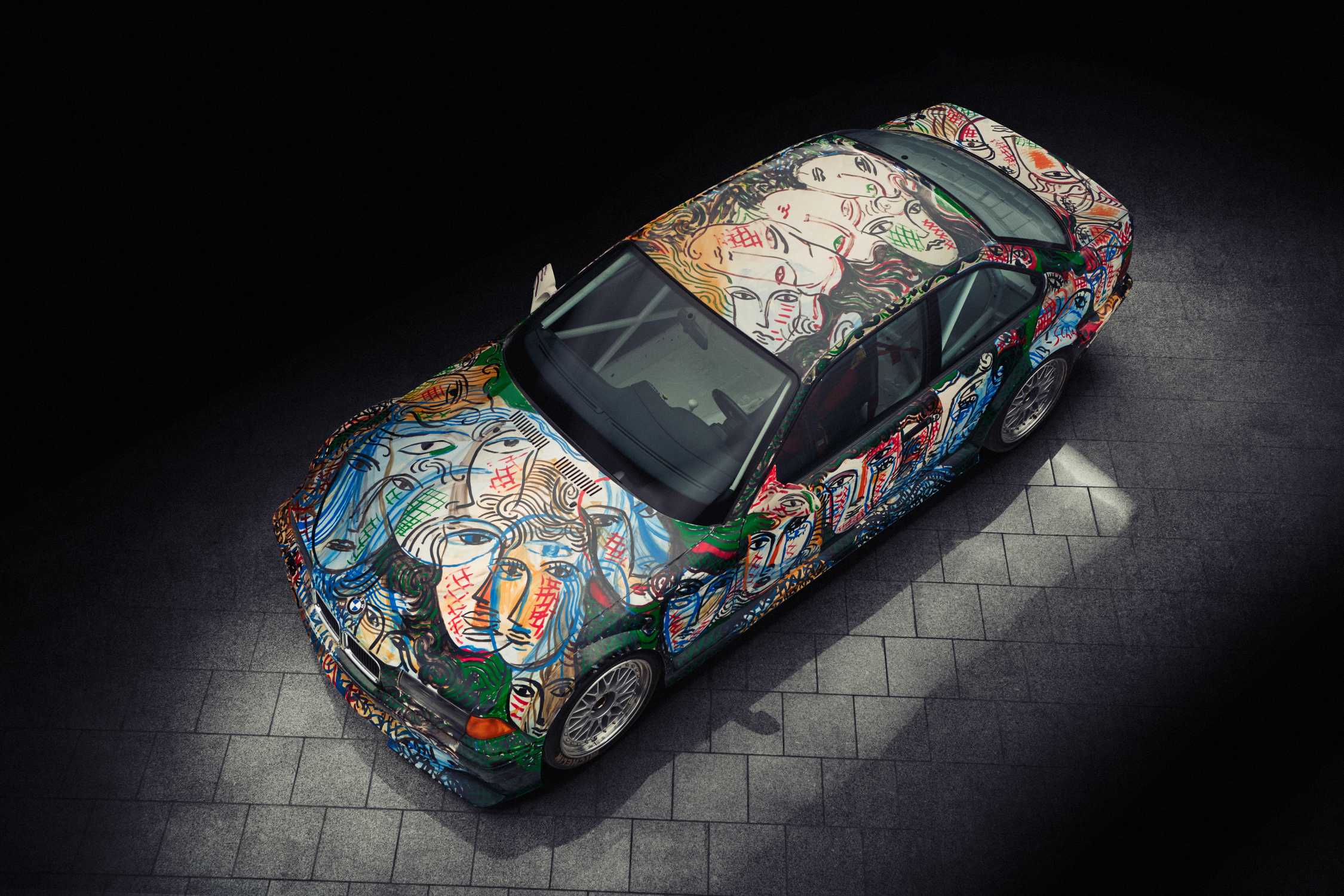
Sandro Chia created BMW Art Car number 13 in 1992 on a 3 Series touring-car racing prototype. Faces and vivid color spread across the vehicle, making the racing body a support for figurative painting. The work asks the viewer to look at a car that appears, through its painted faces, to look back.
Record: BMW-051 · Individual BMW Art Car · Germany · 1992.
Specifications and rarity
| Item | Documented reference and scope |
|---|---|
| Art Car number | 13 |
| Artist / creation year | Sandro Chia, 1992 |
| Base vehicle | BMW 3 Series touring-car racing prototype, E36 |
| Historical engine reference | 2,494 cc four-cylinder; four valves per cylinder |
| Factory catalogue reference | 370 bhp; 300 km/h |
| Purpose | Original painted racing prototype in the Art Car collection |
| Count scope | One original Chia Art Car; not an M Roadster edition |
Sandro Chia covered a racing BMW in faces and color
The documented vehicle corrects the workbook’s 1998 M Roadster label. It is an E36 3 Series racing prototype from the 1992 Art Car project. BMW-051 is preserved as the inventory reference, while the title, chassis family and specifications follow the factory collection catalogue.
Faces change the relationship between viewer and object
The painted faces are the most immediate visual feature. Instead of leaving the body as a continuous neutral shell, Chia populates it with recognizable human forms. That gives the surface a different emotional quality from an abstract racing livery or a uniform color finish.
As the viewer moves around the car, individual faces enter and leave view. A wheel arch interrupts one area, while the bonnet presents another. The composition therefore depends on the car’s volume. It is not simply a rectangular painting whose edges have been trimmed to fit one door.
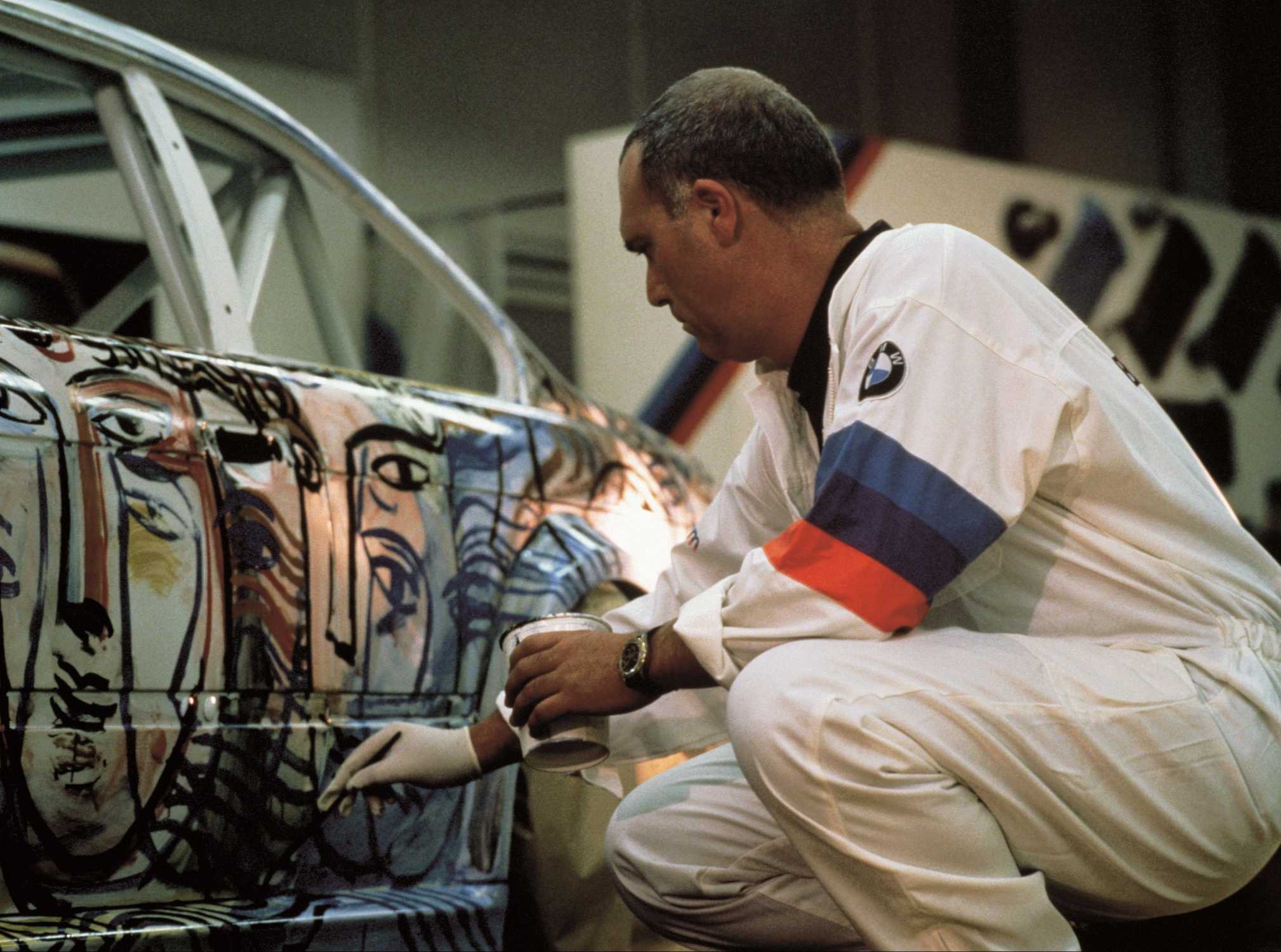
This is an interpretation of the visible work, rather than a fixed translation of each face. It helps explain why the complete-car view and a historical working photograph belong together. The first establishes the overall distribution, while the second shows the artist applying his imagery to the vehicle.
A racing prototype provides a distinctive canvas
The body has the recognizable architecture of an E36 3 Series, developed for touring-car competition. Its wheels, aerodynamic treatment and racing stance remain visible beneath the paint. The artwork gains interest from that combination of familiar automobile form and an unusual painted surface.
The words touring-car in this description refer to a racing category and purpose. They do not identify a BMW Touring estate body. That distinction is particularly useful in this batch because the E46 M3 Touring concept is also included. Similar wording can describe very different objects when its context is lost.
Nor does the Chia car become an M Roadster because another BMW artwork uses an open body. Artist, base vehicle, project year and collection number need to remain attached to one another. Correcting the model makes the artistic comparison more meaningful, as well as improving the technical record.
A historical racing specification with a clear source
BMW’s Art Car catalogue lists a 2,494 cc four-cylinder with four valves per cylinder, along with 370 bhp and a 300 km/h reference. Those numbers describe the historical racing prototype associated with the artwork. They are not the specification of a customer E36 M3 with a six-cylinder engine.
The engine difference is a useful reminder that a racing car and a road car sharing a broad silhouette need not share every major mechanical component. Regulations, development purpose and competition preparation can produce a quite different configuration within a recognizable model family.
The profile retains the catalogue’s units and context. It does not claim a current test result for the exhibition object or attach a race victory that the selected source does not document. The car’s individuality is already established by the original Chia work.
An original artwork rather than a customer special edition
The count of one belongs to the original Art Car. It does not mean that only one E36 racing BMW existed, and it does not count miniatures, posters or later tribute-painted cars. The rarity is a specific relationship between the artist and the physical project.
That is a different kind of rarity from the M3 GT’s limited production run. A special edition can comprise hundreds of cars sharing one specification; an Art Car is an individually authored object. Both can be documented in the same encyclopedia without giving their production fields the same meaning.
Chia can be compared with the earlier M3 artworks by Michael Jagamara Nelson and Ken Done. Their artistic approaches differ even when the vehicles belong to BMW’s racing tradition. The comparison draws attention to authorship and body form instead of reducing the collection to a list of famous names.
Modern and historical photography preserve two contexts
The selected modern photograph identifies Chia’s Art Car and credits Enes Kucevic. The second image supplies another documented perspective on the original work. Image publication and artwork creation are separate dates, so the captions retain the source context rather than labelling a modern picture as a 1992 photograph.
Looking across the two views makes it possible to follow the painted faces through the front and sides. The racing body creates breaks and changes of plane that a flat reproduction cannot fully explain. Those physical relationships are central to the experience of seeing a painted automobile.
The photo credit and artwork credit are separate. Chia authored the surface; the credited photographer or BMW archive supplied the image. Visible captions preserve both roles, with source links that let the reader examine the original identification.
Frequently asked questions
Was Sandro Chia’s Art Car an M Roadster?
No. BMW identifies a 1992 3 Series touring-car racing prototype, E36.
Which Art Car number is it?
Number 13.
Does touring-car mean an estate body?
No. Here it describes a competition category; it is unrelated to the estate-bodied M3 Touring concept.
What engine does the historical catalogue list?
A 2,494 cc four-cylinder with four valves per cylinder and a 370 bhp reference.
How many are counted here?
One original Chia artwork/car, excluding reproductions and other racing BMWs.
Who receives the artwork credit?
Sandro Chia. The photographer and image supplier receive separate credits in each caption.
Explore related verified BMW profiles
- BMW M3 Art Car — Michael Jagamara Nelson, 1989
- BMW M3 Art Car — Ken Done, 1989
- BMW V12 LMR Art Car — Jenny Holzer, 1999
Sources and photo credits
Photo: Enes Kucevic / BMW Group PressClub · Press/editorial use only. BMW-supplied press photograph under BMW PressClub terms. Artwork: Sandro Chia, 1992. Original supplied photograph retained without local cropping or content alteration.
Photo: Werner Deisenroth / BMW Group PressClub · Press/editorial use only. BMW-supplied press photograph under BMW PressClub terms. Artwork: Sandro Chia, 1992. Original supplied photograph retained without local cropping or content alteration.
Why this machine matters
The photo credit and artwork credit are separate. Chia authored the surface; the credited photographer or BMW archive supplied the image. Visible captions preserve both roles, with source links that let the reader examine the original identification.
Built in limited numbers
One original Chia Art Car; not an M Roadster edition
Gallery
Specifications
Factory specifications may vary by model year, market and configuration.
Identity & production
- Official model
- BMW 3 Series Racing Prototype Art Car — Sandro Chia, 1992
- Base model
- 3 Series E36
- Worldwide production
- 1
Powertrain & performance
- Engine
- 2,494 cc four-cylinder; four valves per cylinder