Bentley EXP2
Bentley EXP2 is the oldest surviving Bentley and the marque’s first race-winning car. Its importance lies in the connection between experimental engineering, the 3 Litre’s production development and Frank Clement’s Brooklands victory. This profile follows the named historic vehicle, BM8752, while distinguishing its original development life from its restored appearance.
Bentley EXP2 is the oldest surviving Bentley and the marque’s first race-winning car. Its importance lies in the connection between experimental engineering, the 3 Litre’s production development and Frank Clement’s Brooklands victory. This profile follows the named historic vehicle, BM8752, while distinguishing its original development life from its restored appearance.
Bentley EXP2 at a glance
| Manufacturer | Bentley |
|---|---|
| Model / family | 3 Litre |
| Profile scope | Named experimental prototype |
| Historical reference year | 1919 |
| Inventory reference | BEN-002 |
| Engine reference | 2,996 cc inline-four petrol |
| Documented individual subject | EXP2, registration BM8752; second of three experimental 3 Litre prototypes |
| Manufacturer power reference | 70 bhp; Heritage Collection specification, not universal installed condition |
| Inventory date note | 1920 in supplied inventory; historical build or launch reference corrected above |
Why EXP2 matters in Bentley history
A prototype can explain a manufacturer more clearly than a later flagship. EXP2 belongs to the period when Bentley was still establishing what its cars should be, before a long history of racing achievements or luxury models existed. Its designation describes an experimental vehicle rather than a customer edition. Read that name as an engineering identity: the second development car, with an individual history that continued beyond the initial programme. The surviving machine provides a physical reference for that history, but its significance does not depend on pretending that every visible component has remained untouched. Experimental cars change because testing reveals weaknesses, alternatives and useful improvements. EXP2 is valuable as an example of that process. Its competition achievement adds a further dimension, showing how development work and public performance could reinforce one another at the beginning of the company.
The experimental cars and the production 3 Litre
Bentley’s centenary account identifies three early prototypes: EXP1, EXP2 and EXP3. EXP1 first ran in October 1919 and was subsequently dismantled for parts; EXP2 was built at Cricklewood later that year. The Heritage Collection therefore dates EXP2 to 1919, correcting this inventory’s 1920 reference. This does not make the later dates irrelevant. A development car can have a build date, show appearance, rebody date and engine-change date, each describing a different event. The production 3 Litre arrived in 1921, and the first customer-car record belongs to a separate chassis. That distinction prevents a common shortcut: treating a surviving prototype as the first customer Bentley simply because it is the oldest example available to photograph. A useful chronology gives each milestone its own label, allowing readers to see how the experimental programme led toward production without merging the vehicles.
Engineering worth noticing
The Heritage Collection lists a 2,996 cc four-cylinder engine, four valves per cylinder, twin spark plugs and a hollow overhead camshaft. These details make EXP2 a useful introduction to Bentley’s early mechanical ambitions. Four cylinders do not imply a crude or basic engine; valve arrangement, ignition, materials and construction deserve attention alongside displacement. For a reader studying the car, the productive questions are how air and fuel reach the cylinders, how the ignition system is arranged and how the valve gear is driven. Photographs help locate components, while technical records explain their purpose. The present Heritage specification belongs to the documented car as described by Bentley. It should not be applied automatically to every engine EXP2 used during its development career, nor should later racing output figures from larger Bentleys be attached to this smaller experimental vehicle.
Frank Clement and the first racing victory
On May 16, 1921, Frank Clement won the Junior Sprint Handicap at Brooklands in EXP2. The significance is specific: Bentley identifies this as its first racing victory. It was not a Le Mans win, and the later endurance successes belong to other dates and cars. That precision makes the achievement more interesting, because it places EXP2 at the start of a sequence rather than borrowing prestige from everything that followed. Brooklands also gives the story a recognisable setting, with a form of competition different from a full day of endurance racing. Compare the event name, date, driver and vehicle identity when evaluating a caption or display board. A modern photograph of EXP2 at a heritage event can illustrate the surviving car, but it should not be described as a photograph taken during the original race.
A changing body and engine history
The manufacturer records that EXP2 was rebodied by JH Easter in March 1921. It also documents engine substitutions in 1922 and a complete rebuild in the 1990s to its race-winning specification. Those changes are central to understanding the car. Restoration to an earlier configuration can make a historical appearance easier to interpret, but it does not reverse the chronology or turn replacement material into material fitted at the first assembly. A good profile can recognise the importance of a restored historic car while remaining clear about the work that produced its present form. The same approach helps distinguish EXP2 from replicas and other surviving 3 Litres. Body shape alone cannot establish which experimental chassis is being shown. Registration, collection documentation, engine records and a continuous identity account give the photograph its proper context.
How to read the surviving car
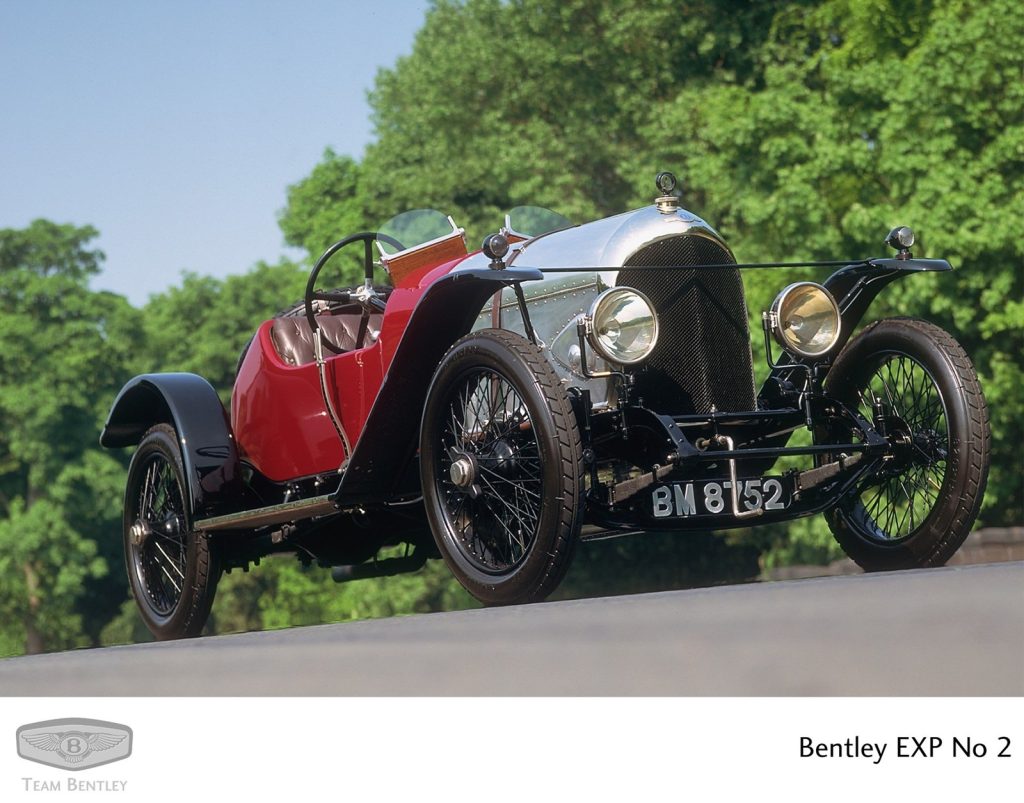
Start with the name EXP2 and registration BM8752, then examine the relationship between the body, radiator, wheels and exposed mechanical layout. These observations are useful prompts for comparing the photograph with Bentley’s specification, rather than a checklist that independently certifies authenticity. The image shows the car in its restored Heritage Collection appearance. It cannot establish internal engine condition, the age of every fitting or the exact arrangement used in 1919. For deeper study, organise images by date and configuration instead of arranging them as if they all show a single unchanging machine. An early two-seat display body and a later competition presentation may both belong to the same development history. Explaining why they differ is more informative than choosing one as the only legitimate appearance and overlooking the work between them.
Rarity, identity and documentation
This profile concerns one named experimental vehicle within a three-prototype development programme. That is an object identity, not a one-car customer production edition. The distinction matters when comparing EXP2 with the Blower production series or the 100-chassis 8 Litre model. A museum collection may own one example of a model; that ownership does not make the whole model unique. EXP2’s rarity is supported by its experimental designation and individual history, with Bentley identifying it as the oldest survivor. There is no need to invent a market price or a complete inventory of every component that once belonged to it. An effective documentation file would separate build history, engine changes, body changes, competition records and restoration records, allowing each claim to be traced to the evidence relevant to that particular stage.
EXP2 beside the other early Bentleys
The most useful comparison is with the 1924 Le Mans-winning 3 Litre. Both belong to Bentley’s early story, but one illustrates experimental development and the first racing victory, while the other illustrates a later endurance achievement. The Blower then introduces a different engineering direction through supercharging, and the 8 Litre shows the scale and refinement of the final W.O.-era flagship. These comparisons are about purpose and historical development, not a ranking based on modern acceleration figures. EXP2 remains compelling because its achievements are proportionate to its place in the timeline. Readers who begin with its precise identity can follow the later cars without confusing their chassis, engines or victories. That makes the little experimental Bentley an excellent starting point for understanding the broader collection of rare Bentley profiles.
Frequently asked questions
What year is Bentley EXP2?
Bentley’s Heritage Collection dates it to 1919. The supplied inventory says 1920; this profile records that correction and treats later development events separately.
Was EXP2 Bentley’s first car?
It was the second experimental Bentley and is the oldest surviving example. EXP1 preceded it, and the first customer production car was a different chassis.
What race did EXP2 win?
Frank Clement won the Junior Sprint Handicap at Brooklands on May 16, 1921, identified by Bentley as its first racing victory.
Is EXP2 completely untouched?
No. Bentley documents body and engine changes and a 1990s rebuild. Its current appearance should be read alongside that development and restoration history.
Explore related vehicle profiles
Sources
- Bentley Heritage Collection — EXP2, specification and development history
- Bentley — centenary heritage account and three experimental prototypes
- Bentley — centenary of its first customer car
Historical facts follow the linked manufacturer, race-organizer, institutional and specialist records. Visual comparisons and documentation priorities are editorial analysis. Dated specifications, restoration accounts and published estimates retain their original scope; they do not certify a car’s current condition.
Photography and credit
Bentley EXP2, registration BM8752, in its restored Heritage Collection appearance. This is the surviving second experimental Bentley, not EXP1. Photo: Bentley Motors (copyright credit) / Bentley Newsroom · Bentley Newsroom: free editorial reproduction. Resized proportionally where needed and saved as JPEG; no additional cropping or color alteration. Editorial vehicle-profile use only; the newsroom terms exclude advertising, marketing and sales use. Photographer not named on the supplied record.
Why this machine matters
Bentley EXP2 is the oldest surviving Bentley and the marque’s first race-winning car. Its importance lies in the connection between experimental engineering, the 3 Litre’s production development and Frank Clement’s Brooklands victory. This profile follows the named historic vehicle, BM8752, while distinguishing its original development life from its restored appearance.
Built in limited numbers
Factory dates EXP2 to 1919; inventory 1920 corrected. Named development chassis and restored survivor, not a customer one-car edition.
Gallery
Specifications
Factory specifications may vary by model year, market and configuration.
Identity & production
- Official model
- Bentley EXP2
- Base model
- 3 Litre
Powertrain & performance
- Engine
- 2,996 cc inline-four petrol