Bentley Blower Continuation Series
The Blower Continuation Series recreates Bentley’s Team Blower through a modern twelve-customer-car programme. Announced in 2019, it used the original UU 5872 as its engineering reference. Car Zero was completed in December 2020, and Bentley reported the customer series finished in December 2023. The new cars, their development prototype and the original pre-war Blowers remain separately identified.
The Blower Continuation Series recreates Bentley’s Team Blower through a modern twelve-customer-car programme. Announced in 2019, it used the original UU 5872 as its engineering reference. Car Zero was completed in December 2020, and Bentley reported the customer series finished in December 2023. The new cars, their development prototype and the original pre-war Blowers remain separately identified.
Bentley Blower Continuation Series at a glance
| Manufacturer | Bentley |
|---|---|
| Model / family | Blower |
| Profile scope | Factory continuation customer programme |
| Historical reference year | 2019 |
| Inventory reference | BEN-142 |
| Engine reference | 4½-litre supercharged inline four; recreated Team Blower configuration |
| Documented production scope | 12 — Completed customer Continuation Series; development Car Zero additional |
| Inventory date note | 2021 in supplied inventory; historical build or launch reference corrected above |
New cars based on an original Team Blower
The Blower Continuation Series is a modern manufacturing programme based on Bentley’s historic Team Car No. 2, UU 5872. The original vehicle provided a reference for the new cars; it did not become twelve original pre-war chassis. This is the essential identity distinction for the profile. A collector archive can link the series to the original while preserving separate histories. The modern cars are significant because of how they were recreated and commissioned, not because they acquire the original vehicle’s period race record. Their construction dates and programme identities remain part of the story, allowing readers to understand what continuation means in this particular Bentley project.
The programme chronology begins before customer delivery
Bentley’s April 2020 engineering account describes the project as announced the preceding year. The December 2020 release then records Car Zero completed, and the December 2023 account reports the customer series finished. These milestones establish announcement, development prototype and programme completion as separate events. The supplied inventory’s 2021 date does not describe the original announcement, so the profile uses 2019 and preserves that correction. An individual customer car has its own build and delivery history within the sequence. This matters because continuation cars are sometimes described mainly through the year of their historical inspiration, which can conceal when the actual modern vehicle was manufactured.
Twelve customer cars, plus Car Zero
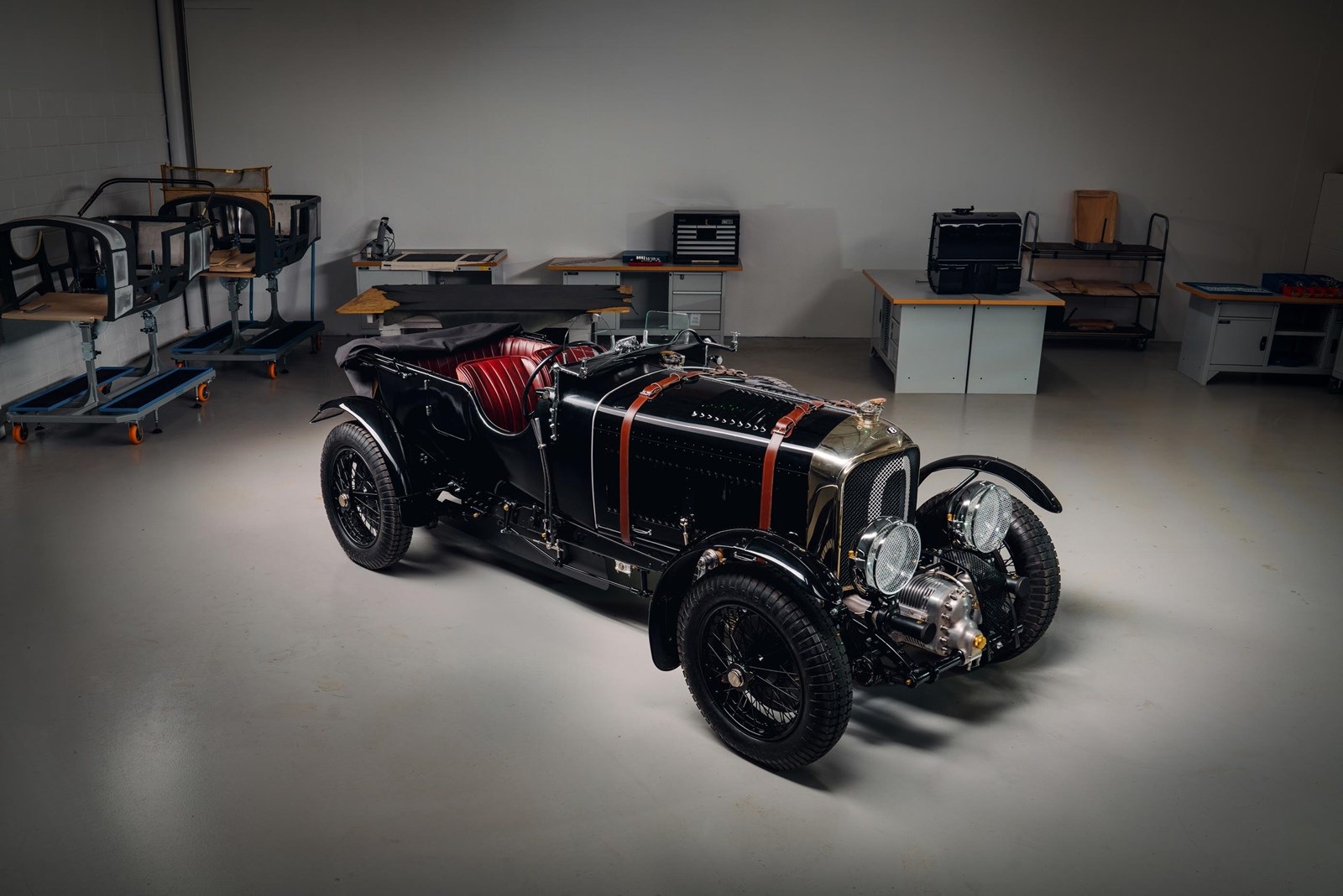
Bentley identifies twelve customer Continuation Blowers and separately describes Car Zero as the engineering prototype. The completed customer series is therefore recorded here as twelve, with the development car outside that customer population. The photograph illustrates Car Zero and labels it accordingly. The distinction is not a minor counting detail: it tells the reader what kind of vehicle is shown and why it exists. A programme file should keep customer cars, prototypes and original reference vehicles in separate categories. That makes the series easier to compare with Bacalar and Batur, whose small customer programmes also used development vehicles without treating every demonstrator as a customer allocation.
Digital measurement and traditional manufacture work together
Bentley’s engineering account describes laser scanning, careful measurement and a CAD model of the original reference car. Digital information supported the manufacture of new components, while the construction required skills appropriate to the historical design. This combination is worth examining because precise measurement and traditional workmanship answer different questions. Measurement establishes the form and dimensions to be reproduced; manufacture determines how the new physical parts are made and assembled. For an archive, photographs of the completed car should be accompanied by a clear account of that process. The resulting vehicle is more understandable when its modern engineering preparation is visible rather than hidden behind an undifferentiated claim of authenticity.
The supercharged four-cylinder reference
The programme recreates the 4½-litre supercharged engine configuration associated with the Team Blower. The visible front-mounted supercharger is an especially useful feature in the photograph because it reveals part of the engine’s arrangement outside the body. A technical profile can describe that layout without assuming every new component is a surviving pre-war part. Bentley’s project account identifies newly made components and an extensive development process. For a particular continuation car, the retained factory documentation should record its own engine and chassis identity. Those records give the vehicle a coherent modern history while preserving the historical design on which its mechanical arrangement is based.
Body, cabin and period form
The open body makes the chassis, wheels and passenger accommodation unusually legible. The credited Car Zero image shows the relationship between the radiator, long bonnet, separate wings and compact cabin. These proportions can be compared with the original reference car, while the caption prevents the two objects from being confused. Interior photographs would add the controls, seating and trim to that comparison. Customer choices remain important within the new series, so Car Zero’s black body and red interior should not become a rule for every completed customer car. The archive benefits from describing the programme’s historical form and each modern vehicle’s individual specification together.
Car Zero is a real prototype with its own role
The bundled factory photograph shows the black development Car Zero introduced in December 2020. Its role was to support testing before the customer series, and its identity is retained in the caption. This avoids a common archive problem: using a photograph of an original green Team Blower to illustrate a new programme without explaining the substitution. The actual new prototype provides a better visual basis for the continuation story. Readers can study the new car’s body and mechanical layout while understanding why it sits outside the twelve-customer-car count. The source and editorial-use terms remain visible beside the image.
Why the series is distinct from the existing Blower profiles
The original production Blowers, Birkin’s No. 1 single-seater and Team Blower UU 5872 are already separate historical subjects in the collection. The Continuation Series adds a later factory programme, with its own announcement and completion history. Number 1 and Number 9 Continental editions provide another kind of connection: modern road cars commemorating historic Blowers rather than recreating their designs. These relationships are useful internal links, but they are not duplicate identities. The Continuation Series deserves its own record because it documents a specific exercise in modern recreation, traditional manufacture and individual commissioning, with the historical reference and new physical cars clearly distinguished.
Frequently asked questions
How many customer Continuation Blowers were completed?
Bentley’s December 2023 account reports completion of the twelve-customer-car series.
Is Car Zero included in those twelve?
No. Bentley identifies it separately as the development prototype; the photograph shows that car.
Are they original pre-war Blowers?
They are newly manufactured continuation cars based on the historic Team Blower, with their own modern build identities.
Why is the reference year 2019?
The programme was announced in 2019. Car Zero followed in 2020 and the customer series was complete in 2023.
Explore related vehicle profiles
- Bentley Continental GT Convertible Number 1 Edition by Mulliner
- Bentley Continental GT Number 9 Edition by Mulliner
- Bentley Bacalar by Mulliner
Sources
- Bentley — Blower Continuation Car Zero completed, December 2020
- Bentley — Blower Continuation engineering programme, April 2020
- Bentley — twelve-customer-car Blower Continuation programme completed, December 2023
Facts are sourced to the linked manufacturer, institutional and specialist records. Design comparisons and documentation suggestions are editorial analysis. Announced limits and completed production populations are labelled separately.
Photography and credit
Blower Continuation Series Car Zero, the black development prototype introduced in December 2020; separate from the twelve customer cars and the original pre-war Team Blower. Photo: Bentley Motors / Bentley Newsroom · Editorial reproduction only. Resized and JPEG encoded without cropping or content changes. Bentley permits editorial reproduction only, excluding advertising, marketing and sales-related use. Copyright Bentley Motors; individual photographer not identified.
Why this machine matters
The Blower Continuation Series recreates Bentley’s Team Blower through a modern twelve-customer-car programme. Announced in 2019, it used the original UU 5872 as its engineering reference. Car Zero was completed in December 2020, and Bentley reported the customer series finished in December 2023. The new cars, their development prototype and the original pre-war Blowers remain separately identified.
Built in limited numbers
Inventory 2021 corrected to 2019 programme announcement; 2020 Car Zero and 2023 customer-series completion labelled separately. Twelve completed customer cars, Car Zero additional. Original BEN-013/BEN-014/BEN-017 identities are not duplicated.
Gallery
Specifications
Factory specifications may vary by model year, market and configuration.
Identity & production
- Official model
- Bentley Blower Continuation Series
- Base model
- Blower
- Worldwide production
- 12
Powertrain & performance
- Engine
- 4½-litre supercharged inline four; recreated Team Blower configuration