Bentley Continental GT Number 9 Edition by Mulliner
The Continental GT Number 9 Edition by Mulliner is Bentley’s 2019 centenary tribute to the Team Blower raced by Sir Tim Birkin. The announced 100-car coupé programme combines distinctive grille numbering with heritage cabin details and a small wood insert taken from the historic car’s seat during renovation. It is a modern commemorative edition, separate from the original No. 9 racing Bentley.
The Continental GT Number 9 Edition by Mulliner is Bentley’s 2019 centenary tribute to the Team Blower raced by Sir Tim Birkin. The announced 100-car coupé programme combines distinctive grille numbering with heritage cabin details and a small wood insert taken from the historic car’s seat during renovation. It is a modern commemorative edition, separate from the original No. 9 racing Bentley.
Bentley Continental GT Number 9 Edition by Mulliner at a glance
| Manufacturer | Bentley |
|---|---|
| Model / family | Continental GT |
| Profile scope | Limited centenary edition |
| Historical reference year | 2019 |
| Inventory reference | BEN-133 |
| Engine reference | 6.0-litre twin-turbocharged W12 |
| Announced edition limit | 100 — Announced Number 9 Edition coupé limit |
A centenary coupé with a named historical reference
Number 9 has a specific meaning in this profile: it refers to the historic Team Blower that inspired Bentley’s 2019 Continental edition. The modern coupé carries the theme through its exterior and cabin, while retaining the identity of a contemporary Continental GT. This is more precise than describing it simply as a racing edition. The source connection helps a reader follow the car back to a particular part of Bentley history, and the modern specification explains what the customer programme actually offered. A connected archive can therefore give the original racing car and the commemorative coupé separate records without losing the relationship between them.
The 100-car programme and its scope
Bentley’s March 2019 release announces 100 Number 9 Edition cars to be handbuilt by Mulliner. The figure belongs to this Continental GT coupé programme alone. Number 1 convertibles and W.O. Mulsannes have their own programmes, so their similarly sized limits should not be merged into a single population. Here, 100 is stored as an announced edition ceiling rather than a completed chassis census. For a specific example, the original order and build records establish edition membership. Keeping the count’s scope explicit makes the profile easier to compare with other centenary cars and prevents an anniversary badge from being treated as proof of a limited-edition identity.
Wood from the Team Blower’s seat
The rotating display incorporates a backlit wood piece taken from the historic car’s seat during renovation and set in resin. That material connection differs from the piston-metal spinner in Number 1 and the crankshaft slice in the W.O. Mulsanne. The three editions use different kinds of objects to bring history into a modern cabin. For Number 9, the insert’s value as a design feature comes from the stated provenance and the way it is displayed. A close photograph should include the setting so the reader can understand its scale and location. It should not suggest that the contemporary GT contains the complete original seat or shares the racer’s mechanical identity.
Viridian or Beluga and the visible numeral
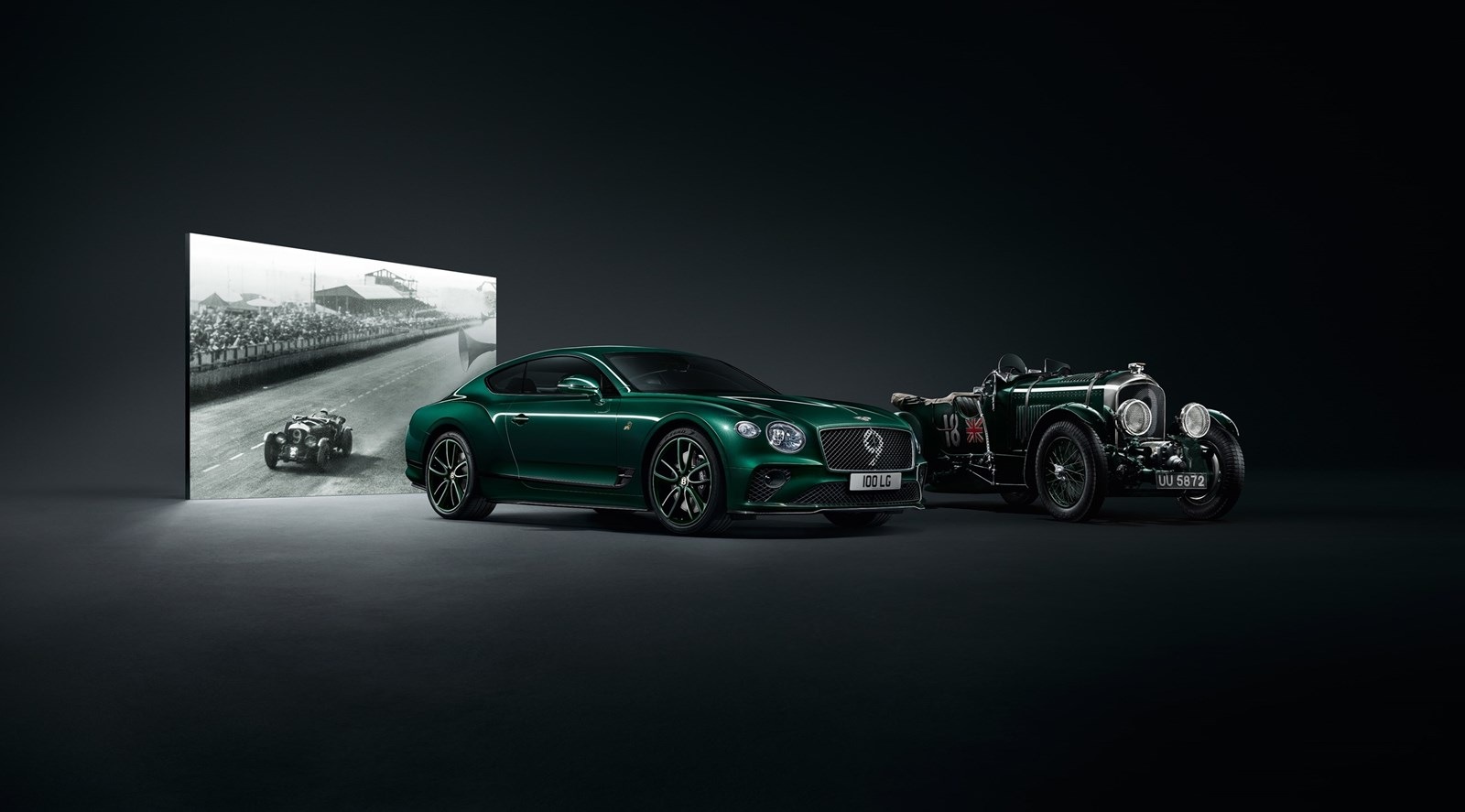
The manufacturer launch offers Viridian green or Beluga black, with a Number 9 grille graphic and matching badgework. The official studio photograph places the modern green coupé beside the historic car that inspired it. This juxtaposition explains the theme, but the cars remain visually and mechanically distinct. Look at how the numeral works within each grille and how the modern body encloses its passenger compartment. These are useful design comparisons because they show how a historical cue can be translated without copying an entire vehicle. A black customer example can belong to the same edition; the launch’s documented colour choices prevent one presentation image from becoming a universal colour rule.
Heritage trim inside a modern Continental
The release describes Cumbrian Green or Beluga heritage hides and debossed B details. Bentley’s later personalisation account also identifies Number 9 as an example of heritage trim references returning to a contemporary cabin. Such detailing can communicate an earlier period while the surrounding architecture remains modern. An archive entry benefits from interior views showing the seats, door panels and dashboard together. The effect depends on relationships between surfaces, rather than one isolated piece of trim. Record the original specification when available, because a cabin’s individual combination is part of the customer car’s history even within a defined edition programme.
The clock and turned-metal finish
The British Jaeger clock and Engine Spin centre-console finish make the dashboard a useful place to study Number 9’s theme. Patterned metal catches light differently from smooth veneers, while the clock gives the cabin a recognisable analogue object. The manufacturer links these choices to the period of the historic Blower. The reader can then examine how those references sit beside the rotating display and contemporary controls. A good photograph uses enough of the dashboard to show that arrangement. It explains how the edition balances heritage imagery with the functions of a modern grand tourer, rather than pretending the interior is a reconstruction of a racing cockpit.
The modern road-car foundation
Number 9 uses the W12 Continental GT as its road-car basis. The numbered grille should therefore be read as a commemorative treatment, not as evidence that the car is a competition GT3 or a continuation of the pre-war Blower. For an individual record, preserve the build date, powertrain specification and commissioned equipment alongside the edition identity. This makes comparisons with the Pikes Peak Continental and Bathurst GT S more useful. Those cars draw on different achievements and different underlying derivatives. The Number 9 profile has its own purpose: connecting a centenary coupé with a historic racing car through a defined set of finishing details.
Why the edition remains a separate collector subject
The original No. 9 Team Blower, the new Blower Continuation Series and the Number 9 Continental are three distinct subjects. One is a historical vehicle, one is a modern recreation programme, and one is a commemorative road-car edition. Their shared inspiration creates useful links, but it does not make their production totals interchangeable. The studio image and manufacturer account help establish Number 9’s place in that relationship. For an archive, its significance is the coordinated centenary specification and material connection to the past. Keeping the identity clear allows readers to explore the related vehicles without encountering duplicate profiles for the same car or confusing a theme with a chassis history.
Frequently asked questions
What does the number nine refer to?
It refers to the historic Team Blower used as the edition’s inspiration, rather than a new racing number assigned to each road car.
What was the announced limit?
100 Number 9 Edition Continental GT coupés. The count is separate from other centenary programmes.
What historical object is in the cabin?
A wood insert taken from the historic car’s seat during renovation, displayed in resin within the rotating display.
Is it the same as the Blower Continuation Series?
No. Number 9 is a modern Continental edition; the Continuation Series is a separately built recreation programme.
Explore related vehicle profiles
- Bentley Continental GT Convertible Number 1 Edition by Mulliner
- Bentley Continental GT Pikes Peak Edition by Mulliner
- Bentley Blower Continuation Series
Sources
- Bentley — Continental GT Number 9 Edition launch, 4 March 2019
- Bentley — heritage detailing and Mulliner personalisation, 2022
Facts are sourced to the linked manufacturer, institutional and specialist records. Design comparisons and documentation suggestions are editorial analysis. Announced limits and completed production populations are labelled separately.
Photography and credit
Official studio presentation of the 2019 Continental GT Number 9 Edition beside the historic Team Blower that inspired it. Photo: Bentley Motors / Bentley Newsroom · Editorial reproduction only. Resized and JPEG encoded without cropping or content changes. Bentley permits editorial reproduction only, excluding advertising, marketing and sales-related use. Copyright Bentley Motors; individual photographer not identified.
Why this machine matters
The Continental GT Number 9 Edition by Mulliner is Bentley’s 2019 centenary tribute to the Team Blower raced by Sir Tim Birkin. The announced 100-car coupé programme combines distinctive grille numbering with heritage cabin details and a small wood insert taken from the historic car’s seat during renovation. It is a modern commemorative edition, separate from the original No. 9 racing Bentley.
Built in limited numbers
Announced 100 coupé programme, not completed census. Original Team Blower BEN-017 and Continuation Series BEN-142 are distinct identities. No new profile for the same historic chassis implied.
Gallery
Specifications
Factory specifications may vary by model year, market and configuration.
Identity & production
- Official model
- Bentley Continental GT Number 9 Edition by Mulliner
- Base model
- Continental GT
Powertrain & performance
- Engine
- 6.0-litre twin-turbocharged W12