Audi Type C Alpensieger
The Audi Type C Alpensieger connects the brand’s earliest passenger cars with its Alpine competition reputation. Also known as the 14/35 PS and Alpine Champion, it belongs to a small prewar series rather than a modern numbered edition. Its rarity needs a carefully scoped production figure, while any surviving example needs its own body, chassis and competition history.
The Audi Type C Alpensieger connects the brand’s earliest passenger cars with its Alpine competition reputation. Also known as the 14/35 PS and Alpine Champion, it belongs to a small prewar series rather than a modern numbered edition. Its rarity needs a carefully scoped production figure, while any surviving example needs its own body, chassis and competition history.
Audi Type C Alpensieger at a glance
| Manufacturer | Audi |
|---|---|
| Archive connection | Audi |
| Model / programme | Type C |
| Profile scope | Early passenger-model heritage archive |
| Historical reference year | 1911 |
| Inventory reference | AUDI-001 |
| Historical engine reference | Inline four-cylinder |
| Manufacturer-reported passenger-car total | 1116 — Type C passenger cars reported by Audi Japan; commercial variants excluded |
| Separate commercial variants | 326; excluded from passenger-car total |
An early Audi with a lasting identity
Alpensieger means an Alpine winner, and the name explains why this early Audi remains an important archive subject. It connects the Type C with demanding mountain competition rather than a decorative specification. For a reader encountering the car for the first time, the useful distinction is between the production model, the cars entered in period events and the surviving vehicle pictured today. Those subjects overlap historically, but they are not interchangeable. A Type C can be significant without being the exact car that achieved a particular competition result.
Where the 1911 reference belongs
Audi’s present heritage page places the Type C within a 1911–1925 span, while the Japanese archive also gives those production years. The inventory’s 1911 reference is therefore retained as a model-history starting point. The supplied photograph is identified as a 1913 example. That later example date does not revise the programme’s beginning, and the beginning does not prove when every surviving car was built. A vehicle-specific profile should attach its date to a chassis record rather than making the earliest year serve all examples.
Rarity: passenger cars and commercial variants
Audi Japan lists 1,116 passenger cars and 326 commercial variants separately. This guide uses the passenger-car figure as its scoped manufacturer-reported total, with the commercial number retained as a separate reference. Neither number is a current survivor count. The distinction matters when catalogues reproduce a rounded whole-series figure or describe every Type C as a competition car. A reader can understand why the model meets a rare-vehicle threshold while still recognizing that its historical production includes a broader range of uses and bodies.
The Alpine successes that shaped its reputation
Audi links the Type C’s Alpine Champion nickname to success in the Austrian Alpine Rally between 1912 and 1914. The corporate history describes three successive winning years for Audi. These are programme-level achievements; a surviving passenger car needs separate evidence before it receives a particular entry, driver or victory. Period results and photographs can establish that connection much more precisely than a later commemorative plaque. In an archive, the model’s reputation should remain prominent without assigning the entire company record to one photographed chassis.
A four-cylinder engine in its historical context
The current Audi heritage page lists an inline four-cylinder engine, 3,562 cc and 35 PS. Audi Japan uses a slightly different rounded displacement and an alternative engine-speed reference. Rather than blending those figures into a synthetic specification, this guide identifies the current page’s data as its technical reference. An inspection of a surviving car can address the actual installed engine separately. Early-car specifications often pass through translations and summaries, making a source-labelled figure more useful than a decimal presented as unquestionable precision.
Why body style changes the description
Audi’s published dimensions and weight are attached to a Phaeton configuration. That qualification should travel with the figures wherever they are reused. It would be misleading to apply the same measurements automatically to every closed body or commercial variant. The car’s coachwork is also part of its history: photographs should show the passenger compartment, roof arrangement, doors and rear body, rather than treating the bonnet badge as sufficient identification. A documented replacement body can be well made while remaining a later chapter in the vehicle’s story.
Reading a survivor beyond its paintwork
A polished Type C exhibit is an invitation to investigate rather than the end of authentication. Relevant records include chassis identity, engine identity, body history and the dates of significant restoration work. Paint, upholstery and lamps should be described against their documented installation, especially where no original finish survives. The most valuable account makes clear which observations come from the car itself and which come from a museum or archive. Attractive presentation and historical continuity can both matter, but they answer different questions.
Competition provenance needs a separate chain
For a claimed Alpine entrant, begin with the period event, the named driver and a traceable vehicle reference. Then connect that reference through later custody and rebuilding. A familiar Type C silhouette or an Alpine Champion description establishes the model family, not a particular race entry. Even a period registration can require interpretation if components or bodies were exchanged. The objective is a coherent history of one physical object, with gaps explained, rather than a list of famous events copied from the general model story.
Not the Auto Union Type C
The later Auto Union Type C Grand Prix car shares the letter but belongs to a different manufacturer identity, date and engineering programme. This early Audi has an inline four-cylinder engine; the 1930s Grand Prix subject is associated with a supercharged V16. Keeping the full names in captions and searches prevents a common archive confusion. Their relationship is corporate heritage and the history of the four rings, not an uninterrupted Type C production line or a shared chassis designation that can establish mechanical equivalence.
What the museum photograph shows
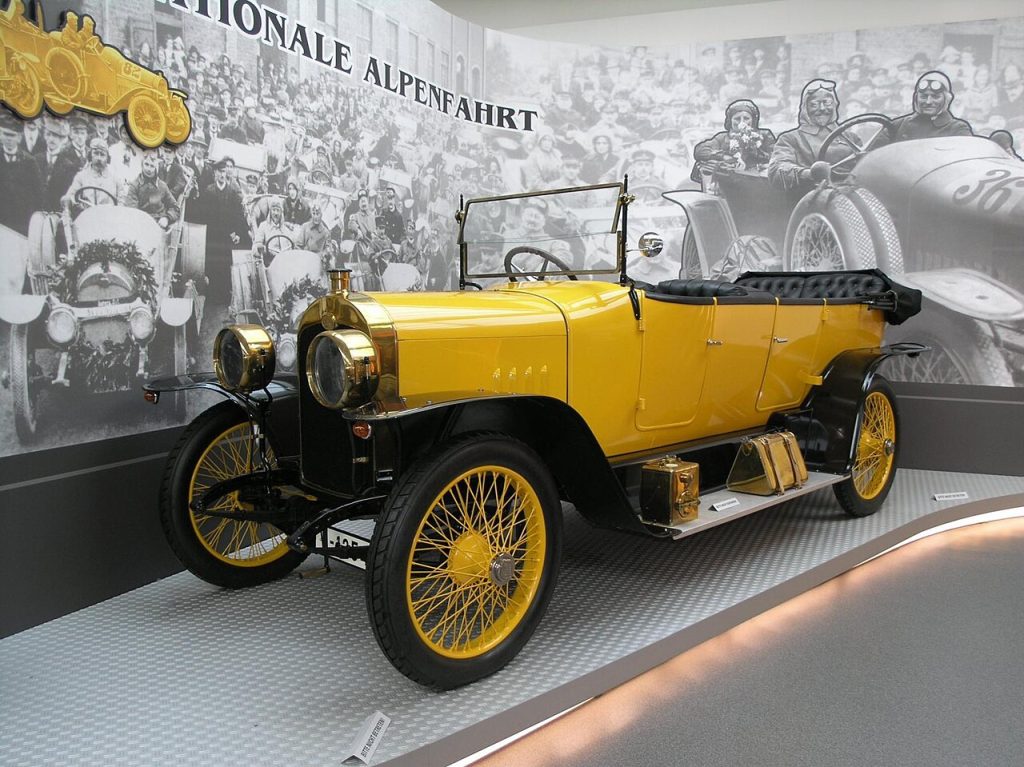
The licensed image identifies a 1913 Type C Alpensieger in the August Horch Museum in Zwickau. It gives readers a useful view of the early passenger car, while the caption leaves its individual competition identity unset. The photograph is a modern record of a museum presentation, not a scene from the Alpine Rally. Its photographer and reuse licence are shown alongside it. A fuller photographic record would add chassis details and documented restoration context, but the supplied view already grounds the model’s visual identity accurately.
A collector file built around the actual object
A useful file begins with the car’s identity and then separates original manufacture, body development, repairs and later exhibitions. Keep dated copies of archive correspondence and describe how each document was connected to the chassis. Where an attribution rests on a museum label, record that label as a source rather than silently upgrading it to a factory build ledger. This approach gives a later owner or curator something they can recheck. It also allows new evidence to improve the account without overturning an unnecessarily confident earlier claim.
Why the Type C belongs in a rare-car archive
The Type C offers a different kind of appeal from a recent supercar allocation: early manufacturing history, coachwork and the development of competitive endurance. Its modest output is informative because it shows what the programme achieved within its own period. Comparison with later Audi competition cars makes the evolution of purpose especially clear. The strongest profile therefore explains the object and its evidence, instead of assigning rarity solely through age or assuming that every old vehicle carries the same significance as a documented competition participant.
Frequently asked questions
How many Audi Type C passenger cars were produced?
Audi Japan reports 1,116 passenger cars, separately from 326 commercial variants. These are scoped historical production figures, not survivor totals.
What does Alpensieger mean?
It identifies an Alpine winner; Audi also uses Alpine Champion for the Type C’s competition reputation.
Is this the Auto Union Type C racing car?
No. The early Audi passenger car and the later Auto Union V16 Grand Prix type are separate subjects.
Does the photograph prove Alpine Rally participation?
No. It identifies a museum example of the model, not a particular period competition chassis.
Explore related vehicle profiles
Sources
Programme history and specifications follow the linked manufacturer and heritage records. Where figures or dates differ, their source contexts are retained. Collector-file and inspection guidance is editorial analysis; exact physical-car identity requires its own evidence.
Photography and credit
Source-identified 1913 Audi Type C Alpensieger at the August Horch Museum, Zwickau. Model illustration; no specific Alpine Rally participation assigned. Photo: Matěj Baťha / Wikimedia Commons · CC BY-SA 2.5. Wikimedia thumbnail resized from original; no cropping or color changes.
Why this machine matters
The Audi Type C Alpensieger connects the brand’s earliest passenger cars with its Alpine competition reputation. Also known as the 14/35 PS and Alpine Champion, it belongs to a small prewar series rather than a modern numbered edition. Its rarity needs a carefully scoped production figure, while any surviving example needs its own body, chassis and competition history.
Built in limited numbers
Audi Japan lists 1,116 passenger cars and 326 commercial variants separately. This guide uses the passenger-car figure as its scoped manufacturer-reported total, with the commercial number retained as a separate reference. Neither number is a current survivor count. The distinction matters when catalogues reproduce a rounded whole-series figure or describe every Type C as a competition car. A reader can understand why the model meets a rare-vehicle threshold while still recognizing that its historical production includes a broader range of uses and bodies.
Gallery
Specifications
Factory specifications may vary by model year, market and configuration.
Identity & production
- Official model
- Audi Type C Alpensieger
- Base model
- Type C
- Worldwide production
- 1116
Powertrain & performance
- Engine
- Inline four-cylinder