Aston Martin V8 Vantage AMR
The original V8 Vantage AMR marked a late chapter in the earlier Vantage family with motorsport-inspired themes and a bounded 200-car programme. Launched in 2017, it covered coupe and Roadster bodies with conventional manual or Sportshift II choices. Its collecting interest lies in documented factory edition identity, individual specification and its place in the first production wave of AMR.
The original V8 Vantage AMR marked a late chapter in the earlier Vantage family with motorsport-inspired themes and a bounded 200-car programme. Launched in 2017, it covered coupe and Roadster bodies with conventional manual or Sportshift II choices. Its collecting interest lies in documented factory edition identity, individual specification and its place in the first production wave of AMR.
Aston Martin V8 Vantage AMR at a glance
| Manufacturer | Aston Martin |
|---|---|
| Model / family | Vantage |
| Profile scope | Historic road-model archive |
| Historical reference year | 2017 |
| Inventory reference | AST-135 |
| Factory allocation limit | 200; completed census not independently certified |
| Specialist-reported completed coupes | 137; count scope discussed below |
| Combined parent allocation limit | 300; count scope discussed below |
| Historical engine reference | 4.7-liter naturally aspirated V8; period 430 bhp reference |
The original AMR road-car programme
The V8 Vantage AMR belongs to the 2017 introduction of Aston Martin’s performance sub-brand, on the road-car side of its two-tier strategy. That definition prevents confusion with AMR Pro projects and the later Vantage generation. The name alone is not enough to identify a car’s engine or architecture. Here it describes the naturally aspirated V8 derivative of the earlier family, not a newer twin-turbo model. Its interest comes partly from that position in the chronology: a new branding idea applied near the end of an established sports-car line, with an identifiable factory programme behind it.
Rarity: 200 V8 cars within a 300-car parent limit
The factory announcement divides the combined allocation into 200 V8 and 100 V12 cars. The inventory’s 300 entry for V8 therefore needs correction: it is the parent programme ceiling, not the V8-only allowance. The V8 limit includes coupe and Roadster together, rather than 200 of each. This profile keeps the corrected 200 with its body scope and leaves the exact completed worldwide census unset. That produces a clear rarity statement without confusing edition membership with the broader V8 Vantage population. The parent number remains useful context, provided it is not added to the V8 count.
What the reported 137-coupe subset means
Cottingham attributes a 137-coupe finding to Aston Martin Heritage Trust records within the 200-car V8 programme. That is a specialist-reported body subset, not a newly inspected factory ledger or an independent census performed for this profile. It is retained with that attribution rather than converted into an unqualified worldwide completed total. Nor is a Roadster count calculated by subtracting it from the ceiling: a programme limit and a reported body finding have different evidential meanings. For someone assessing a car, the body and original edition identity should be documented directly rather than inferred from those aggregate numbers.
Late-2017 production and later registration labels
The specialist records V8 AMR production beginning in the final quarter of 2017, consistent with the factory’s announced delivery schedule. An example registered or source-labeled in 2018 can therefore belong to the original programme without changing its debut year. Keep that individual date distinct from the model introduction. This becomes more than a clerical detail when later cars use the same AMR letters. Accurate chronology keeps a newer engine, gearbox or limit from drifting into an earlier vehicle record and makes comparisons between the two generations much easier to follow.
The established V8 rather than an assumed new engine
The specialist identifies the 4.7-liter V8 and 430 bhp reference shared with the V8 Vantage S. That means AMR identity should not be interpreted as evidence of an otherwise undocumented engine upgrade. A collector interested in engineering should distinguish the existing powertrain from the edition’s themes and equipment. An individual car’s calibration and retained parts still need their own record, especially after later work. The familiar engine lineage is part of the appeal, but it does not establish current output or condition, and it should not be confused with the different mechanical brief of the GT8.
Six-speed manual or Sportshift II
Cottingham describes six-speed conventional manual availability alongside Sportshift II automated-manual operation. Those alternatives deserve a clear entry in a chassis-specific record. The edition was not exclusively manual, and paddle controls do not make Sportshift a dual-clutch transmission. A prospective owner should compare the actual gearbox and its service documentation with the operating experience they want. The nominal edition count alone cannot answer that preference. Keeping transmission terminology precise also helps separate the V8 AMR from its V12 counterpart, whose conventional manual has a different number of ratios and whose automated gearbox belongs to the Sportshift III line.
Halo colors do not define every authentic car
The specialist describes the recognizable Stirling Green and Lime Halo presentation as one of several AMR themes. It provides a strong visual connection with racing, but edition authentication should begin with the factory record rather than color. A documented alternative scheme still belongs to the same programme. An owner preserving the car should compare current paint and graphics with the original order and early photographs, noting replaced or renewed material. This helps avoid two common archive errors: treating the publicity theme as mandatory, and treating a visually similar themed Vantage as automatically part of the original limited edition.
Accessories can be fitted to other Vantages
The specialist notes that AMR accessories were available beyond the original edition cars. A wing, exhaust, wheel or other relevant accessory can therefore describe present equipment without proving factory edition membership. A useful public record should name the original vehicle and then document later additions separately. This does not dismiss the interest of an upgraded car; it simply keeps the population claim attached to the right identity. For the AMR edition, order and delivery paperwork provide the starting point, while invoices explain how the car’s appearance and configuration developed after it entered use.
Coupe and Roadster within the same scope
The two bodies share the V8 programme but raise different practical questions for an owner. A Roadster assessment adds roof operation, seals and evidence of water ingress to the brief, while a coupe may appeal for its enclosed form. These are inspection and preference questions, not reported faults or a ranking of collectibility. An enthusiast can value either body without changing the total allocation. The individual specification and documented history should remain central. Separating those details from the overall ceiling keeps the profile useful to someone actually comparing cars instead of only collecting rarity numbers.
Comparison with the GT8 and V12 AMR
The GT8 explains an earlier, more visibly specialized V8 programme, while the V12 AMR provides the other engine branch of the 2017 allocation. Those related records let readers compare different factory approaches within the broader Vantage family. Ask whether the collecting interest is a particular gearbox, exterior form, AMR theme or closing-period chronology. Then compare the quality of the individual documentary trails. A smaller announced number is only one part of that decision. It does not automatically establish better condition, greater engineering change or a closer fit with an owner’s plans.
Building a useful inspection record
Begin with the original AMR identity, chassis and dealer documents. Establish body, gearbox, original theme and any later accessories before turning to condition. A specialist assessment can then address engine operation, cooling, brakes, tires, clutch or shift behavior, trim and body repairs as appropriate. These are areas to inspect, not a list of known failures assigned to every example. Preserve the evidence of servicing and storage rather than relying solely on an odometer. A clear record should allow a future owner to distinguish original edition details, maintained components and subsequent changes without reconstructing the history from scattered advertisements.
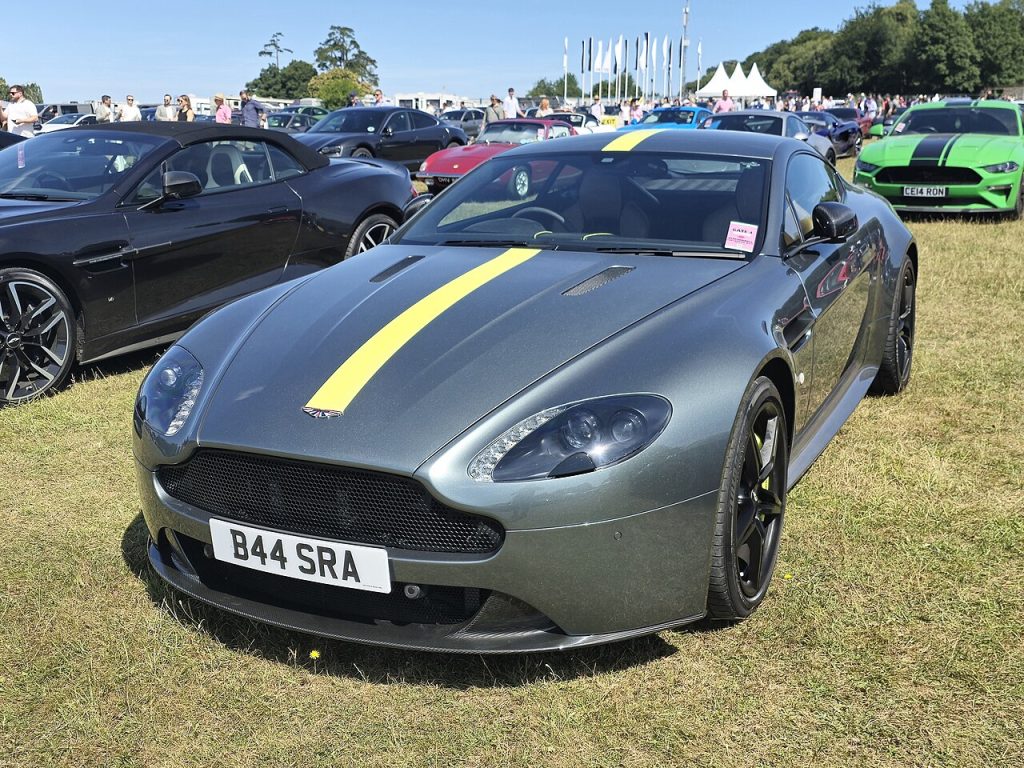
The credited photograph identifies the correct generation
The supplied Commons photograph is source-identified as an original-generation V8 Vantage AMR and was taken in July 2025. Its caption and credit record distinguish that image date from the 2017 programme introduction. It illustrates a real subject rather than a later-generation substitute, but does not certify a build number, gearbox or current condition. The photographer, original file page and license are linked visibly. Keep those links with the photograph when using it in a profile, and continue to support individual specification claims with documents rather than asking the image to establish details outside its view.
Frequently asked questions
Was the V8 AMR limited to 300 cars?
No. The original V8 allowance was 200, while 300 was the combined 200 V8 plus 100 V12 programme ceiling.
Does the 200 include Roadsters?
Yes. Coupe and Roadster share the V8 allocation. The profile does not assign 200 to each body.
What is the reported coupe count?
Cottingham attributes 137 coupes to Heritage Trust records. It remains an attributed subset, and no Roadster completion count is inferred by subtraction.
Can AMR accessories authenticate the edition?
Accessories alone cannot do so because they could be fitted to other Vantages. Original factory and delivery documents should establish edition identity.
Explore related Aston Martin profiles
Sources
- Aston Martin June 2017: Vantage AMR 100 V12/200 V8 limits, body/gearbox choices and optional accessories
- Tim Cottingham: original V8 Vantage AMR and Heritage Trust-attributed 137-coupe subset
- Aston Martin Vantage range brochure, hosted by Galpin Aston Martin: GT12 positioning and VH architecture
Historical claims follow the linked manufacturer, archive, specialist and catalogue records, with disputed findings retained. Inspection and collecting guidance is editorial analysis. Catalogue condition and custody statements remain dated to their sources.
Photography and credit
Source-identified original-generation V8 Vantage AMR photographed in July 2025. The image does not establish a worldwide gearbox/body breakdown or current condition. Photo: Calreyn88 / Wikimedia Commons · CC BY-SA 4.0. Wikimedia thumbnail resized from original; no cropping or colour changes.
Why this machine matters
The original V8 Vantage AMR marked a late chapter in the earlier Vantage family with motorsport-inspired themes and a bounded 200-car programme. Launched in 2017, it covered coupe and Roadster bodies with conventional manual or Sportshift II choices. Its collecting interest lies in documented factory edition identity, individual specification and its place in the first production wave of AMR.
Built in limited numbers
The factory announcement divides the combined allocation into 200 V8 and 100 V12 cars. The inventory’s 300 entry for V8 therefore needs correction: it is the parent programme ceiling, not the V8-only allowance. The V8 limit includes coupe and Roadster together, rather than 200 of each. This profile keeps the corrected 200 with its body scope and leaves the exact completed worldwide census unset. That produces a clear rarity statement without confusing edition membership with the broader V8 Vantage population. The parent number remains useful context, provided it is not added to the V8 count.
Gallery
Specifications
Factory specifications may vary by model year, market and configuration.
Identity & production
- Official model
- Aston Martin V8 Vantage AMR
- Base model
- Vantage
Powertrain & performance
- Engine
- 4.7-liter naturally aspirated V8; period 430 bhp reference