Aston Martin Vantage GT8
The Vantage GT8 brought Aston Martin’s lightweight, race-inspired road-car brief to the V8 Vantage in 2016. Its 150-car programme combined striking carbon bodywork with a choice of conventional manual or Sportshift II transmission. Production continued into 2017, while optional aero and lightweight equipment gave individual cars distinct specifications within the same limited series.
The Vantage GT8 brought Aston Martin’s lightweight, race-inspired road-car brief to the V8 Vantage in 2016. Its 150-car programme combined striking carbon bodywork with a choice of conventional manual or Sportshift II transmission. Production continued into 2017, while optional aero and lightweight equipment gave individual cars distinct specifications within the same limited series.
Aston Martin Vantage GT8 at a glance
| Manufacturer | Aston Martin |
|---|---|
| Model / family | Vantage |
| Profile scope | Historic road-model archive |
| Historical reference year | 2016 |
| Inventory reference | AST-132 |
| Factory allocation limit | 150; completed census not independently certified |
| Historical engine reference | 4.7-liter naturally aspirated V8; period 440 bhp reference |
The V8 counterpart with a separate brief
The GT8 followed the GT12, but it deserves more than a description as the smaller-engined alternative. The factory links it to the V8 Vantage GTE racing programme and its Advanced Operations team. That creates a clear historical context for the road series without turning every customer car into a race entrant. The different engine, transmission choices and body treatment give the GT8 its own collecting story. An enthusiast interested in that story should compare the complete specification and intended use, rather than assuming that cylinder count alone explains the relationship between the two models.
Rarity: a 150-car customer programme
The factory’s 2018 Registration Document states the 150-car GT8 limit and records production from October 2016 through June 2017. The model was therefore a defined customer series with a production span across two calendar years. This profile retains 150 as the programme ceiling, rather than claiming access to a completed chassis census that the retrieved statement does not enumerate. Show prototypes and competition-development cars should be documented on their own evidence. A number on a plaque can support an individual identity, but should be read alongside factory and delivery records when describing an example.
April 2016 launch and later production
The contemporary H.R. Owen account is dated April 15, 2016, while the factory’s later racing article confirms a 2016 launch. Production dates belong in a separate part of the chronology. A 2017 registration or source filename does not contradict the 2016 unveiling, and should not be used to shift the whole model into a different debut year. For a chassis-level account, record the build date, model-year description and first delivery independently. This is particularly helpful with limited programmes where customers ordered well before the finished cars entered use.
A 4.7-liter V8 with transmission choice
The launch dealer account gives a 440 bhp V8 reference. The reproduced factory release identifies the 4.7-liter engine and a choice of six-speed manual or seven-speed Sportshift II. The conventional manual provides a different operating proposition from the automated manual, despite both belonging to the GT8 programme. A collector should establish which transmission the actual car received and whether the original configuration survives. Describing every GT8 as a manual would erase a real factory choice. Describing Sportshift only as automatic would also obscure the transmission architecture that matters when comparing it with other Vantages.
Carbon bodywork and the cutaway wheel opening
The launch account describes carbon aero components around the body, and the specialist highlights the cutaway front wheelarch. That detail changes the visual relationship between tire and wing, giving the car a different stance from the regular Vantage. The importance is the integrated shape rather than an isolated trim piece. An exterior inspection should identify original components, replacements and repair evidence individually. A broad claim of carbon bodywork tells an enthusiast why the car is interesting, but does not answer whether a particular panel has been retained or how damage was addressed during its life.
The optional Aero Pack matters
The specialist describes an optional Aero Pack adding a large rear wing and additional front splitter elements. A car without that equipment should not automatically be dismissed as inauthentic. Conversely, a large wing on another Vantage cannot establish GT8 membership. Treat appearance as a starting point for checking the order and delivery specification. This is a useful reminder that a limited series can contain meaningful configuration differences. An owner preserving an individual car should know whether the present aero parts reflect its original order, a documented later addition or an unexplained change.
Lightweight claims depend on equipment
The dealer launch account discusses a substantial weight reduction, while both dealer and specialist describe additional lightweight options. That makes a single bare weight figure less helpful than a clear account of what is fitted. Roof, glazing, wheel and exhaust choices should be checked against the actual car before repeating the lightest-configuration headline. A photograph can illustrate some exterior choices but will not establish every material or hidden component. The collecting value of this research is practical: an equipment list allows a buyer or curator to compare like with like, instead of relying on a broadly advertised maximum saving.
A purposeful cabin with usable details
H.R. Owen describes carbon sports seats, carbon interior components and Alcantara trim. These choices connect the cabin with the lightweight brief while leaving the owner to assess fit and comfort personally. Compare the original specification with current seats, upholstery and controls, documenting renewed or altered material. A focused cabin is not an assurance that every driver will find it comfortable on the same journey. Nor should a single photograph be used to assign an unseen seat option. The best record explains what the individual car contains and how that relates to the owner’s intended use.
The competition GT8 is a separate historical subject
Aston Martin’s 2017 Nürburgring article discusses a GT8 used by the Advanced Operations team in endurance racing. It supplies meaningful context for the road model’s development, but its racing equipment and results do not become features of every retail GT8. That distinction is especially important when an image shows a numbered competition car. Keep the team entry, event and configuration attached to that particular vehicle. The customer-series profile can explain the relationship while preserving a boundary between a racing history and the specification of a car delivered for road use.
Choosing between GT8, GT12 and V8 AMR
The GT12 offers a related V12 interpretation, while the V8 Vantage AMR follows with another limited-series identity. A useful comparison asks how much of the interest lies in the GT8’s distinctive body, factory gearbox choices and configuration, then considers the documentary quality of the particular example. That is more informative than ranking the three purely by announced production number. Someone drawn to the GT8’s silhouette may reach a different conclusion from someone prioritizing a particular manual gearbox or an AMR theme. Related profiles give those choices historical context without predicting which car will suit every collector.
A documentation-led inspection brief
Begin with the chassis, factory order, delivery record and evidence of GT8 identity. Then assess aero components, carbon repairs, wheels, glazing, tires, braking hardware and transmission with a suitable specialist. Establish how circuit use, storage and maintenance appear in the invoices, without assuming that either low mileage or regular exercise settles the condition question. These are inspection priorities, not universal failure claims. A well-organized record should make it possible to distinguish original equipment from a repair or later upgrade, and to keep the next owner informed about the car’s actual history.
The credited image and its date
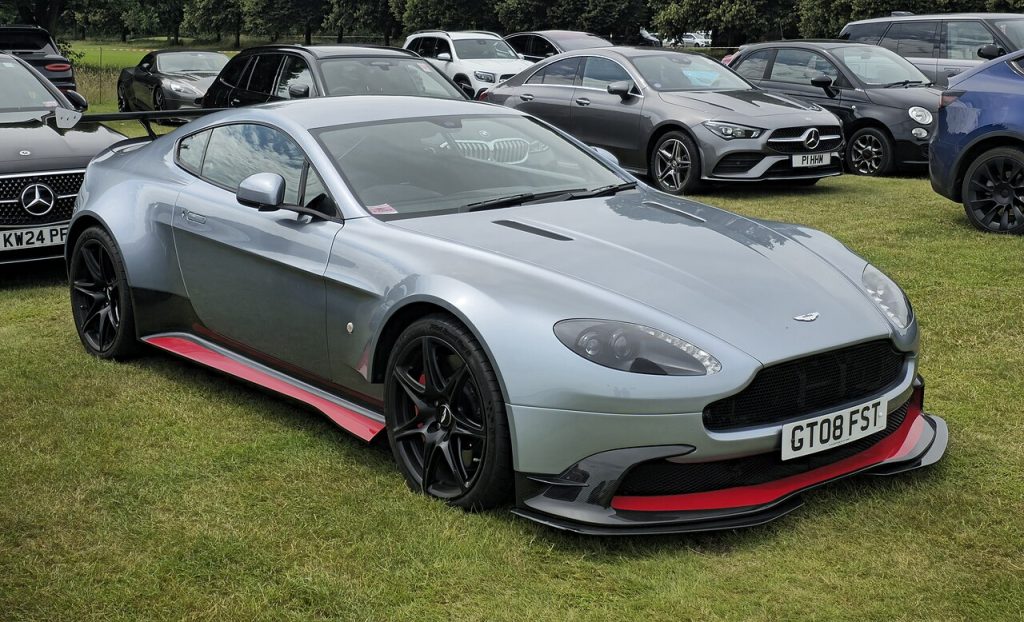
The bundled photograph is source-identified as a GT8 and shows the model’s distinctive exterior. Its later capture date is retained in the credit record, while the source’s 2017 label belongs to that photographed example. It is not a new debut date for the programme. The linked Commons file, photographer and reuse terms give the image a traceable source. The photograph illustrates the subject, but it does not establish a serial number, complete equipment list or present condition. Those details should continue to come from the individual car’s documents and a dated assessment.
Frequently asked questions
How many Vantage GT8s were planned?
The factory programme was limited to 150 cars. The retrieved corporate retrospective describes the limit and production period, not an individually enumerated completed census.
When was the GT8 built?
It launched in April 2016. Aston Martin’s 2018 Registration Document records production from October 2016 to June 2017.
Was a conventional manual offered?
Yes. The GT8 offered a six-speed conventional manual or seven-speed Sportshift II automated manual.
Did every GT8 have the large rear wing?
The specialist identifies the large wing as part of the optional Aero Pack. The original order should establish an individual car’s configuration.
Explore related Aston Martin profiles
Sources
- Aston Martin Lagonda 2018 Registration Document, pp. 49–50: GT12/GT8 production periods and continuation/Zagato delivery chronology
- H.R. Owen April 2016 launch account: GT8 construction, 440 bhp V8 and equipment options
- Aston Martin May 2017: GT8 150-unit road edition, Advanced Operations and separate competition car
- Aston Martin GT8 launch release reproduced in Supercars.net Press Release section: engine and transmission choices; separate site commentary/spec table not used
- Tim Cottingham: Vantage GT8 transmission choices, Aero Pack and optional lightweight components
Historical claims follow the linked manufacturer, archive, specialist and catalogue records, with disputed findings retained. Inspection and collecting guidance is editorial analysis. Catalogue condition and custody statements remain dated to their sources.
Photography and credit
Source-identified Vantage GT8 photographed in July 2024. The source’s 2017 example label is distinct from the programme’s 2016 debut. Complete equipment and build identity require documents. Photo: Calreyn88 / Wikimedia Commons · CC0. Wikimedia thumbnail resized from original; no cropping or colour changes.
Why this machine matters
The Vantage GT8 brought Aston Martin’s lightweight, race-inspired road-car brief to the V8 Vantage in 2016. Its 150-car programme combined striking carbon bodywork with a choice of conventional manual or Sportshift II transmission. Production continued into 2017, while optional aero and lightweight equipment gave individual cars distinct specifications within the same limited series.
Built in limited numbers
The factory’s 2018 Registration Document states the 150-car GT8 limit and records production from October 2016 through June 2017. The model was therefore a defined customer series with a production span across two calendar years. This profile retains 150 as the programme ceiling, rather than claiming access to a completed chassis census that the retrieved statement does not enumerate. Show prototypes and competition-development cars should be documented on their own evidence. A number on a plaque can support an individual identity, but should be read alongside factory and delivery records when describing an example.
Gallery
Specifications
Factory specifications may vary by model year, market and configuration.
Identity & production
- Official model
- Aston Martin Vantage GT8
- Base model
- Vantage
Powertrain & performance
- Engine
- 4.7-liter naturally aspirated V8; period 440 bhp reference