Aston Martin V12 Vantage AMR
The original V12 Vantage AMR joined Aston Martin’s new performance sub-brand in 2017 with a 100-car limit across coupe and Roadster bodies. Its V12 specification, manual and Sportshift choices, and optional themes place it within the closing chapter of the earlier Vantage family. It is distinct from both the extreme GT12 and later-generation Vantage AMR models.
The original V12 Vantage AMR joined Aston Martin’s new performance sub-brand in 2017 with a 100-car limit across coupe and Roadster bodies. Its V12 specification, manual and Sportshift choices, and optional themes place it within the closing chapter of the earlier Vantage family. It is distinct from both the extreme GT12 and later-generation Vantage AMR models.
Aston Martin V12 Vantage AMR at a glance
| Manufacturer | Aston Martin |
|---|---|
| Model / family | Vantage |
| Profile scope | Historic road-model archive |
| Historical reference year | 2017 |
| Inventory reference | AST-134 |
| Factory allocation limit | 100; completed census not independently certified |
| Combined parent allocation limit | 300; count scope discussed below |
| Historical engine reference | Naturally aspirated V12; market-specific output and calibration require original specification |
The first production chapter of AMR
Aston Martin introduced AMR as a race-inspired performance identity with series-production and more extreme Pro tiers. The original V12 Vantage AMR belongs to the series-production side of that story. The distinction is useful because the badge also appears on competition and later-generation subjects. Someone searching the name should first establish the generation, engine and year. Here the scope is the 2017 V12 derivative of the earlier Vantage family, a bounded road-car programme. Its significance comes from the way Aston Martin applied a new identity to an established car, rather than from treating every AMR badge as one model.
Rarity: 100 V12 cars across two bodies
The factory announced 100 V12 cars alongside 200 V8s, making 300 the combined AMR programme limit. The V12 allowance covers coupe and Roadster together. It is not 100 of each body, and it is not a number for every V12 Vantage built. This profile preserves the limit without inventing a complete body or gearbox census. A meaningful rarity record should identify the exact subset when discussing one. A car’s sill marking may help establish edition membership, but the worldwide allocation and an individual vehicle’s numbering still need to be read with their proper scope.
A 2017 introduction with late-year deliveries
The June 2017 factory announcement placed deliveries in the final quarter of the year, and the specialist records production beginning in that period. The announcement and build chronology belong together without being treated as the same event. A photographed car carrying a 2018 source label can still belong to this programme. An owner’s records should establish its own build and first registration. That clarity becomes especially helpful when a later Vantage generation adopts the AMR name. Keeping the original programme dated prevents newer specifications and production limits from being copied into this earlier V12 profile.
The V12 headline needs its market context
The factory release gives a footnoted 595 bhp V12 reference, increased from the V12 Vantage S figure cited in that announcement. The retrieved page does not preserve the explanatory footnote text, so the number is retained as an attributed launch reference rather than a universal verified output for every market or car. An individual description needs its original market specification and calibration evidence. This is more useful than silently treating a headline as a dynamometer result. The edition’s identity remains clear even where a bare worldwide power field would erase an important qualification in the source.
Manual and Sportshift are separate choices
The announcement offers a seven-speed conventional manual alongside automated paddle-shift operation for the V12. Cottingham identifies Sportshift III in the model account. These options create different operating experiences within the same 100-car programme. The presence of paddles should not be used to call a car dual-clutch, and the existence of manual examples should not turn the whole series into a manual-only edition. When comparing cars, establish the original transmission and document any subsequent work. Gearbox preference can materially change a collector’s shortlist even before color, accessories or production numbering enter the discussion.
The Halo theme is one route into the edition
The factory links the optional Stirling Green and Lime Halo treatment to its championship-winning GTE context. It also offered other exterior schemes. That means a genuine AMR need not carry the best-known green-and-lime presentation. Use the actual order and delivery record to establish a car’s original combination. A distinctive color can be a useful visual clue, but cannot independently authenticate the edition. For an owner, preserving a less familiar documented factory choice can be just as meaningful as retaining the recognizable publicity theme. The archive should make that variety understandable rather than flattening it into one standard photograph.
Factory edition versus retrofitted accessories
Cottingham notes that the V12 Performance Pack could be fitted to earlier V12 Vantage S cars. That is a crucial distinction for authentication: a car can contain relevant factory-approved upgrades without becoming one of the original AMR edition cars. Describe its identity and later equipment separately. An attractive conversion may have its own interest, but it belongs to a different population unless original edition membership is documented. The same discipline should be applied to wheels, aero and trim. A parts list explains what is fitted now; an original factory record explains what the vehicle was built and supplied as.
Cabin specification should follow the individual order
The launch programme included coupe and Roadster interiors and a range of optional carbon details. That variety makes a chassis-specific equipment record especially valuable. Compare original upholstery, seats, panels and controls with early images and retained invoices before describing the cabin as unchanged. Restored or renewed material should be documented clearly without assuming it automatically invalidates the edition. A prospective owner should also assess fit and usability personally. Edition rarity can explain why the car interests a collector, but it cannot tell that collector whether a particular seat or interior configuration suits the way they intend to use it.
How the GT12 comparison helps
The GT12 offers an earlier, more visually extreme expression of the V12 Vantage idea, with a separate body programme and transmission brief. The AMR provides another way to collect the same broader family through a named performance edition and its own choices. Comparing them should involve configuration and documentary quality as well as the shared cylinder count. A collector looking for a conventional manual has a different enquiry from one focused on the GT12’s exterior form. Related profiles make those distinctions accessible without suggesting that every 100-car programme represents the same engineering intervention or collecting purpose.
The V8 AMR is a connected but distinct subset
The V8 model forms the other part of the original AMR allocation and has its own 200-car limit. It should not inherit the V12’s engine reference, gearbox terminology or count. The two profiles can explain a shared branding idea while retaining different specifications. This is also why the combined 300 number needs a parent-programme label rather than a worldwide V12 production badge. For someone comparing the pair, body, transmission, original theme and individual history can matter as much as the engine. Separate records support that comparison instead of hiding it inside a single mixed description.
Documentation and inspection before collecting
Begin with the original factory identity, chassis record, supplying dealer paperwork and service history. Then establish the body, transmission, market specification and any installed accessories. Ask a knowledgeable specialist to explain discrepancies between the order and current car, especially where retrofittable performance equipment is involved. Include brakes, tires, cooling, clutch operation and retained trim in the condition assessment as appropriate. These are inspection priorities, not reported universal defects. The aim is a clear account of an actual vehicle, so a future curator can distinguish original AMR identity from later changes made for appearance or use.
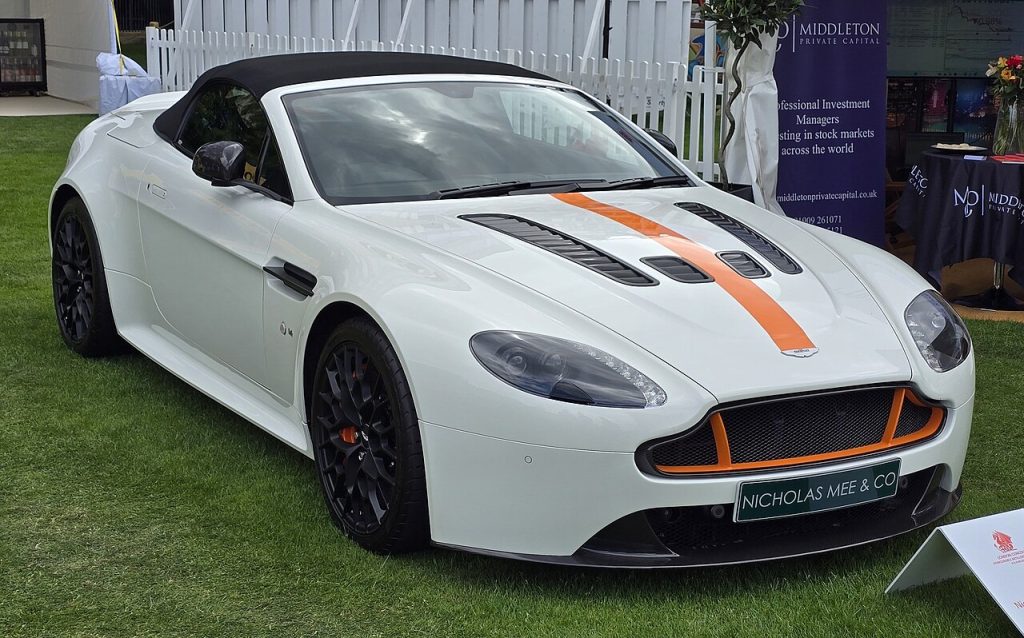
The photograph shows an original-generation V12 AMR
The bundled image identifies a V12 Vantage AMR at London Concours in 2024. It provides a real model photograph, with linked photographer, Commons source and license details, without asking a publicity-colored car to stand in for every original specification. Its appearance belongs to the dated image, not to a newly verified build sheet or current condition report. The photograph also does not establish a worldwide body or gearbox breakdown. A complete vehicle entry should keep those documentary matters separate while using the image to help readers recognize the correct Vantage generation and subject.
Frequently asked questions
What is the V12 Vantage AMR limit?
The 2017 programme allowed 100 V12 cars across coupe and Roadster bodies, within a combined 300-car V8/V12 allocation.
Was a conventional manual available?
Yes. The original V12 AMR offered a seven-speed manual as well as Sportshift III automated-manual operation.
Does an AMR Performance Pack make an earlier car an AMR edition?
No. Retrofitted equipment should be recorded separately from factory edition identity, which requires original documentation.
Is 595 bhp verified for every market?
It is the footnoted factory launch reference. The retrieved page omits the explanatory footnote, so individual market and calibration records remain necessary.
Explore related Aston Martin profiles
- Aston Martin V8 Vantage AMR
- Aston Martin Vantage GT12
- Aston Martin V12 Vantage S Spitfire 80 Edition
Sources
- Aston Martin June 2017: Vantage AMR 100 V12/200 V8 limits, body/gearbox choices and optional accessories
- Tim Cottingham: original V12 Vantage AMR, late-2017 production and retrofittable Performance Pack
- Aston Martin March 2017: Q Commission capabilities and the one-off GT12 Roadster
Historical claims follow the linked manufacturer, archive, specialist and catalogue records, with disputed findings retained. Inspection and collecting guidance is editorial analysis. Catalogue condition and custody statements remain dated to their sources.
Photography and credit
Source-identified original-generation V12 Vantage AMR at London Concours in June 2024. No build serial, original gearbox or market calibration is assigned from the photograph. Photo: MrWalkr / Wikimedia Commons · CC BY-SA 4.0. Wikimedia thumbnail resized from original; no cropping or colour changes.
Why this machine matters
The original V12 Vantage AMR joined Aston Martin’s new performance sub-brand in 2017 with a 100-car limit across coupe and Roadster bodies. Its V12 specification, manual and Sportshift choices, and optional themes place it within the closing chapter of the earlier Vantage family. It is distinct from both the extreme GT12 and later-generation Vantage AMR models.
Built in limited numbers
The factory announced 100 V12 cars alongside 200 V8s, making 300 the combined AMR programme limit. The V12 allowance covers coupe and Roadster together. It is not 100 of each body, and it is not a number for every V12 Vantage built. This profile preserves the limit without inventing a complete body or gearbox census. A meaningful rarity record should identify the exact subset when discussing one. A car’s sill marking may help establish edition membership, but the worldwide allocation and an individual vehicle’s numbering still need to be read with their proper scope.
Gallery
Specifications
Factory specifications may vary by model year, market and configuration.
Identity & production
- Official model
- Aston Martin V12 Vantage AMR
- Base model
- Vantage
Powertrain & performance
- Engine
- Naturally aspirated V12; market-specific output and calibration require original specification