Alfa Romeo Disco Volante by Touring prototype
Touring’s 2012 Disco Volante styling study, distinguished from the functioning customer-built cars introduced in 2013.
The 2012 styling study
This profile follows Touring Superleggera’s Disco Volante 2012 presentation study. Touring’s own history records the unveiling as a tribute to the 1952 C52’s sixtieth anniversary. The manufacturer’s 2013 release, reproduced in contemporary coverage, distinguishes the earlier full-scale styling model from the first production example. That separation is fundamental: a physical design study and a completed customer car can share a shape without sharing the same operating status. Read the cited reference for its documented context.
The Geneva object and its role
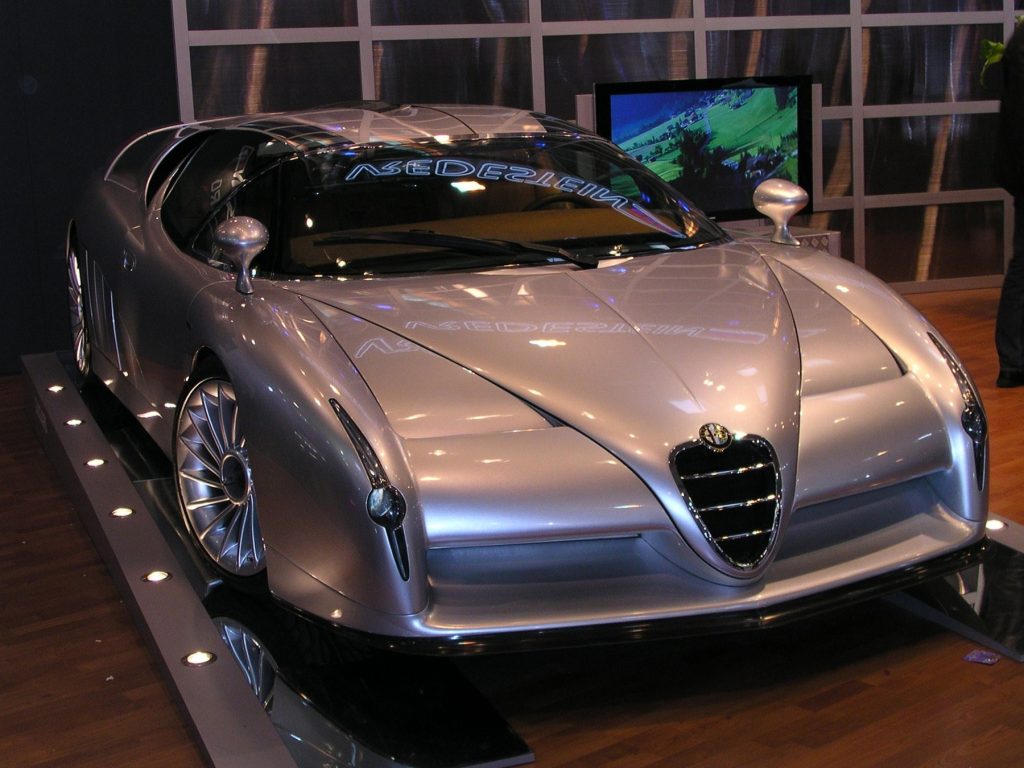
The 2012 Geneva photograph shows the source-identified styling study. Its value in the archive is the visible proposal and its place in the development chronology. This draft does not describe the object as a verified running production prototype or attach acceleration figures to it. When an inventory uses prototype broadly, the article should explain whether the documented object served as a styling model, an engineering vehicle or a customer-ready car.
A later car on 8C foundations
Alfa Romeo’s 2013 release describes the later Disco Volante as a hand-built two-seat Gran Turismo on 8C Competizione foundations, with the donor’s 4.7-litre V8 and rear transaxle architecture. That later mechanical account provides relationship context here. It does not independently establish that the 2012 styling model had a complete installed and functioning equivalent powertrain. The engineering fields for the original study therefore remain qualified.
The original study’s count
The count of one concerns the original named 2012 styling study identified in the Verified inventory. It is not a verified production total for later bespoke Disco Volante coupes. Those cars require a separate series profile and its own source review. This prevents the early presentation object from being combined with subsequent customer builds, or from inheriting their production count and performance figures without a clearly stated change of scope.
An old name in a new proposal
The historical connection to theC52 gives readers a useful comparison across eras, but it does not make the modern study a continuation of the 1950 s construction run. Its body language can be considered as a visual reinterpretation of the earlier idea. A collector archive should keep the original historical cars, the 2012 styling proposal and the later coachbuilt road cars distinct so each object’s rarity and purpose remain readable.
The credited Geneva photograph
NRMA Motoring and Services photographed the Disco Volante at the 2012 Geneva show. The photograph’s attribution licence was reviewed when it was transferred to Commons, and its author, source and web-resizing notice accompany the image. This is a matched period illustration of the styling study. A later 2013 production car or 2016 Spyder photograph would tell a different story and is not substituted for it.
Preserving a prototype’s identity
A prototype record needs more than a model name and an attractive photograph. Establish the chassis, the coachbuilder’s records and the dated sequence of show appearances. Record changes to paint, glazing, interior and mechanical equipment when evidence permits. A later alteration can be an important part of a show car’s working life. Keeping those stages separate allows the archive to explain the object as it developed rather than inventing a single specification that supposedly remained unchanged from its first presentation.
Restoration evidence and interpretation
For a unique design study, conservation and reconstruction are central to its historical account. Keep photographs of the earliest known form alongside records of later repairs and the reasoning behind restored details. Identify what was retained, repaired or recreated wherever the evidence is available. Museum display and concours presentation can provide useful context, but neither alone documents every component. A photograph illustrates one moment in the car’s life; its caption should identify that moment, leaving detailed material authenticity to the accompanying chassis and restoration record.
Frequently asked questions
What object does this entry cover?
The original 2012 full-scale styling study.
Is it the later customer-built production series?
No. The 2013 manufacturer release distinguishes the first production model from the earlier study.
Are production performance figures assigned to the 2012 model?
No. Its operating specification is not established by the later road-car release.
What does the one-object count mean?
The original styling-study identity, not a total for later bespoke coupes.
Related vehicle profiles
Sources and further reading
- Touring Superleggera: own historical account of 2012 Disco Volante unveiling
- Touring Superleggera:2013 manufacturer release reproduced by egmCarTech; distinguishes 2012 full-scale styling model
- Alfa Romeo: official endorsement and mechanical description of later 2013 model
Photo and credit
Touring Superleggera Disco Volante 2012 full-scale styling study at the Geneva motor show, March 2012; distinct from the 2013 customer-built cars. Photo: NRMA Motoring and Services / Wikimedia Commons · CC BY 2.0. Resized and JPEG-compressed for web display; no content retouching. Website layouts may crop the image.
Why this machine matters
This profile follows Touring Superleggera’s Disco Volante 2012 presentation study. Touring’s own history records the unveiling as a tribute to the 1952 C52’s sixtieth anniversary. The manufacturer’s 2013 release, reproduced in contemporary coverage, distinguishes the earlier full-scale styling model from the first production example. That separation is fundamental: a physical design study and a completed customer car can share a shape without sharing the same operating status.
Built in limited numbers
1; original 2012 Disco Volante styling-study identity
Gallery
Specifications
Factory specifications may vary by model year, market and configuration.
Identity & production
- Official model
- Alfa Romeo Disco Volante by Touring prototype
- Country of manufacture
- Italy
Powertrain & performance
- Engine
- Full-scale styling study; functioning installed powertrain not independently verified