
Alfa Romeo 8C Competizione Concept
The original Frankfurt 2003 8C concept, with a supercharged 4244 cc V8, precedes the production coupe.
The original 8C concept
Alfa Romeo unveiled the 8C Competizione concept at Frankfurt in September 2003. The original manufacturer release identifies a prototype designed and developed at Centro Stile. This profile records that presentation study, separate from the later 500-car production coupe. The distinction is essential because the concept and production model share a name and a recognisable body language while their documented mechanical specifications differ. Read the cited reference for its documented context.
The concept’s own V8 specification
The 2003 technical sheet records a 4244 cc 90-degree V8 with a volumetric compressor, a six-speed manual gearbox at the rear axle and rear-wheel drive. Those are the figures used here. The later production car’s 4.7-litre naturally aspirated engine and robotic transmission belong to its own profile. Treating the concept as mechanically identical to a customer car would erase a clear difference in the primary launch documentation.
Body and design context
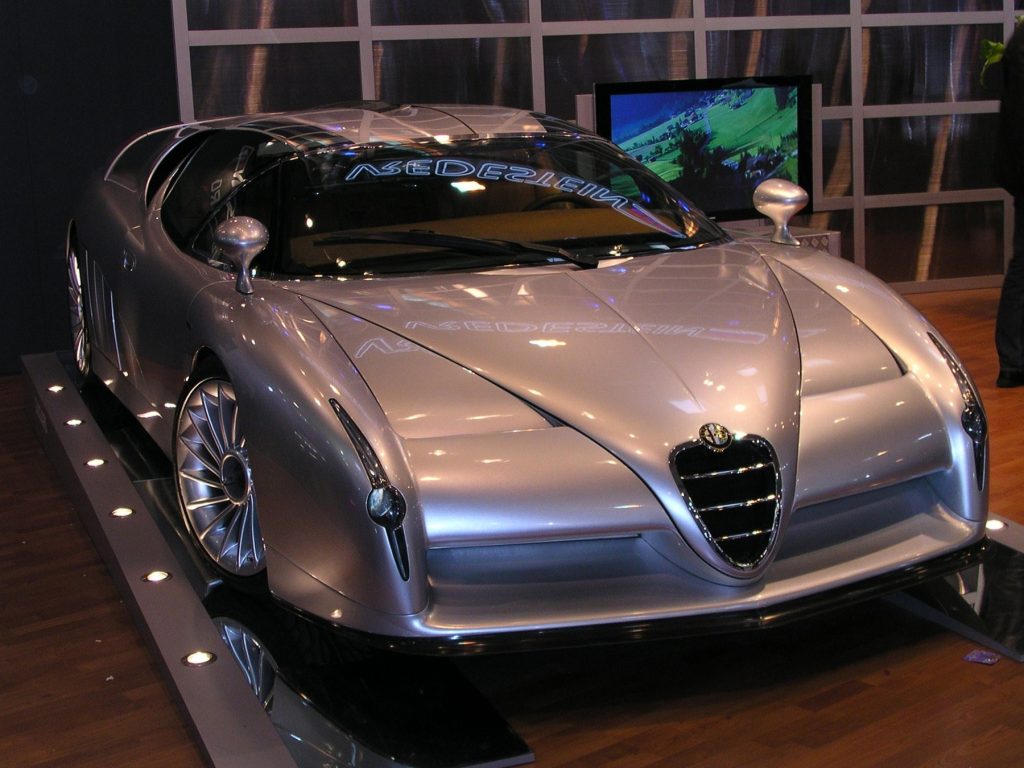
The original release describes a carbon-fibre two-seat body. Visually, the concept establishes the low coupe form and rounded surfaces familiar from the later model, but the photograph should be read as a view of a show proposal. A shared design theme does not prove that panels, lighting, cabin equipment and manufacturing processes were carried unchanged into series production. Development documentation is needed to establish those relationships precisely.
From presentation to industrialisation
Alfa Romeo’s Heritage history dates the industrialisation decision to early 2006, following the reception of the 2003 concept. The production story therefore has several distinct stages: public presentation, approval for industrial development and delivery of customer cars. This profile stops at the original concept identity. Linking it to the production article gives the reader the progression without assigning the later series count to the earlier show study.
What the concept count means
The one-car scope concerns the original named presentation concept identified in the Verified inventory and launch release. It is not a total for every subsequent mule, prototype or production development car carrying the 8C name. A one-off show identity can remain a useful archive subject without pretending that every engineering vehicle used during development has been enumerated. The production coupe and Spider totals stay in their separate records.
A period Frankfurt photograph
Axel Schwenke photographed the concept at the 2003 Frankfurt show. This provides a period image matched to the presentation discussed here, with a verified ShareAlike licence and author credit. The caption does not call it a 2007 production car. Preserving the date and original source helps reviewers check the body details against the manufacturer’s contemporary launch description instead of relying on a later model photograph.
Preserving a prototype’s identity
A prototype record needs more than a model name and an attractive photograph. Establish the chassis, the coachbuilder’s records and the dated sequence of show appearances. Record changes to paint, glazing, interior and mechanical equipment when evidence permits. A later alteration can be an important part of a show car’s working life. Keeping those stages separate allows the archive to explain the object as it developed rather than inventing a single specification that supposedly remained unchanged from its first presentation.
Restoration evidence and interpretation
For a unique design study, conservation and reconstruction are central to its historical account. Keep photographs of the earliest known form alongside records of later repairs and the reasoning behind restored details. Identify what was retained, repaired or recreated wherever the evidence is available. Museum display and concours presentation can provide useful context, but neither alone documents every component. A photograph illustrates one moment in the car’s life; its caption should identify that moment, leaving detailed material authenticity to the accompanying chassis and restoration record.
Frequently asked questions
Where and when was the concept unveiled?
At Frankfurt inSeptember 2003.
What displacement is in the original technical sheet?
4244 cc, with a volumetric compressor.
Did the concept use the production car’s robotic gearbox?
The 2003 release specifies a six-speed manual rear transmission.
Does the 500-car count apply to this concept?
No. It belongs to the later production coupe.
Related vehicle profiles
Sources and further reading
- Alfa Romeo: original 9 September 2003 concept launch and technical sheet
- Alfa Romeo Heritage: concept to series-production chronology
Photo and credit
Alfa Romeo 8C Competizione concept at the 2003 Frankfurt motor show, photographed in September 2003; distinct from the later production coupe. Photo: Axel Schwenke / Wikimedia Commons · CC BY-SA 2.0. Resized and JPEG-compressed for web display; no content retouching. Website layouts may crop the image.
Why this machine matters
Alfa Romeo unveiled the 8C Competizione concept at Frankfurt in September 2003. The original manufacturer release identifies a prototype designed and developed at Centro Stile. This profile records that presentation study, separate from the later 500-car production coupe. The distinction is essential because the concept and production model share a name and a recognisable body language while their documented mechanical specifications differ.
Built in limited numbers
1; original 2003 presentation concept identity
Gallery
Specifications
Factory specifications may vary by model year, market and configuration.
Identity & production
- Official model
- Alfa Romeo 8C Competizione Concept
- Country of manufacture
- Italy
Powertrain & performance
- Engine
- 4244 cc supercharged V8;2003 concept technical sheet
- Drivetrain
- Rear-wheel drive
.jpg)