2016 Citroën E-Méhari Courrèges Concept
Explore the 2016 Citroën E-Méhari Courrèges Concept: sourced history, design, specifications and rarity evidence, with credited documentary photos.
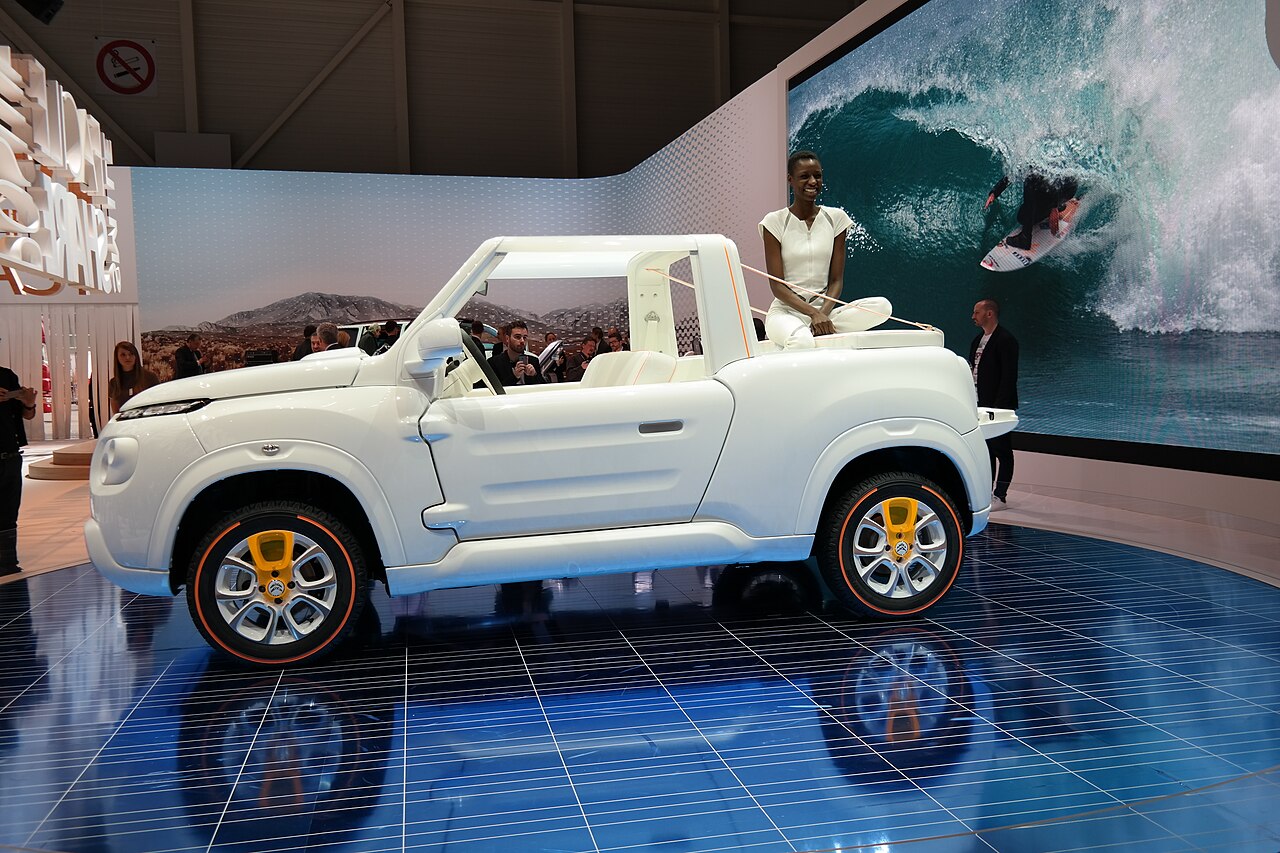
The 2016 Citroën E-Méhari Courrèges Concept brings fashion-house restraint to a deliberately informal electric open car. White bodywork and carefully placed orange accents give the Geneva show vehicle a distinct identity that should never be confused with the later black limited edition.
The concept came first
Citroën’s February 2016 announcement places this white Courrèges concept at the Geneva show. The fashion collaboration used the electric E-Méhari as its foundation, with white wheels, orange detailing and a frosted roof treatment. The rear hoop arrangement was reconsidered, and coordinated luggage formed part of the proposal. The inventory’s 2017 date has therefore been corrected to the documented 2016 debut.
Chronology matters here because the collaboration later produced a separate limited edition. A common designer name does not make both vehicles the same object. The white Geneva concept is a physical design project; the black hardtop production cars belong to a numbered commercial series. Maintaining separate titles, years and photos preserves a much clearer history of how the collaboration developed.
What the Geneva photograph shows
The credited image shows a white open-bodied vehicle with bright orange accents around the cabin and central structure. The white wheel treatment reduces visual contrast between the body and its running gear. The open passenger space is prominent, while the small body retains the purposeful simplicity of a leisure vehicle.
The limited colour vocabulary is the most immediate design feature. White creates a continuous field, and orange identifies particular points within it. That makes the cabin read as a composed interior rather than an accumulation of separate fittings. It is reasonable to interpret the arrangement as fashion-led styling, but the photograph cannot establish an occupant’s experience of materials or the actual effectiveness of the roof in changing weather.
An electric leisure car as a fashion object
The launch material identifies the electric base and its lithium-metal-polymer battery technology. Those details describe the platform used for the project. This profile does not substitute specifications from a later E-Méhari revision, or use a period urban-cycle range claim as a modern ownership prediction.
The design interest comes from taking a casual, open vehicle and giving it a stricter visual discipline. A small leisure car has relatively little uninterrupted surface area, so details around the seats, hoops and wheels carry considerable weight. The Courrèges treatment uses those areas to make a recognisable composition. Looking at the image closely is more revealing than treating the designer’s name as proof of a particular production rarity.
Preserving the boundary between concept and edition
The concept’s exact fabrication tally has not been established. Its archive identity is verified, and the numerical manufacturing field remains blank. The later 61-car series has its own profile with its own source-supported count; that figure must not be attached to this white show vehicle.
An appropriate archive record would keep Geneva-period photographs, the original collaboration announcement and subsequent custodial evidence together. If another display configuration is documented, it should be dated and explained rather than silently substituted for the debut appearance. The concept is valuable as a complete styling proposition: a white and orange electric open car whose fashion-house identity is visible in the object itself, beyond the badge or the accompanying publicity.
Specifications and verified rarity
| Reference year | 2016 |
|---|---|
| Model / project | E-Méhari Courrèges Concept |
| Body / role | Electric open-car fashion concept |
| Debut | Geneva, 2016 |
| Seating | Four-seat concept |
| Powertrain | Electric E-Méhari platform |
| Roof treatment | Frosted Plexiglas concept roof |
| Rarity scope | Documented white 2016 Courrèges concept; separate from the 61-car black production edition. Exact concept fabrication tally not established. |
| Exact manufacturing tally | Not established |
| Inventory reference | CIT-155 — Verified |
Frequently asked questions
Why is the profile dated 2016?
Citroën’s original release announced the concept for Geneva in 2016; the workbook year was corrected.
Is this one of the 61 black Courrèges edition cars?
No. The white concept and the numbered black production series are separate subjects.
What identifies the supplied concept image?
Its Geneva 2016 context and white body with orange accents match the original announcement.
Are exactly one or 61 concepts documented?
Neither total is established for this concept project.
What rarity or archive scope is verified?
Documented white 2016 Courrèges concept; separate from the 61-car black production edition. Exact concept fabrication tally not established.
Who took the supplied photograph?
Norbert Aepli, Switzerland (User:Noebu) via Wikimedia Commons, under CC BY 4.0. Keep the photographer, original-file link and licence credit with the image.
Related Citroën profiles
- 2017 Citroën E-Méhari styled by Courrèges
- 2018 Citroën E-Méhari Art Car by Jean-Charles de Castelbajac
Sources and photo credits
Photograph: Norbert Aepli, Switzerland (User:Noebu) via Wikimedia Commons original file, CC BY 4.0. Source photograph supplied without local cropping, retouching or text removal. A source-provided thumbnail is used where available. White E-Méhari Courrèges concept at Geneva on 1 March 2016. Separate from the black 61-car production edition.
Built in limited numbers
Documented white 2016 Courrèges concept; separate from the 61-car black production edition. Exact concept fabrication tally not established.
Gallery
Specifications
Factory specifications may vary by model year, market and configuration.
Identity & production
- Official model
- E-Méhari Courrèges Concept