2011 Citroën Tubik
Explore the 2011 Citroën Tubik: sourced history, design, specifications and rarity evidence, with credited documentary photos.
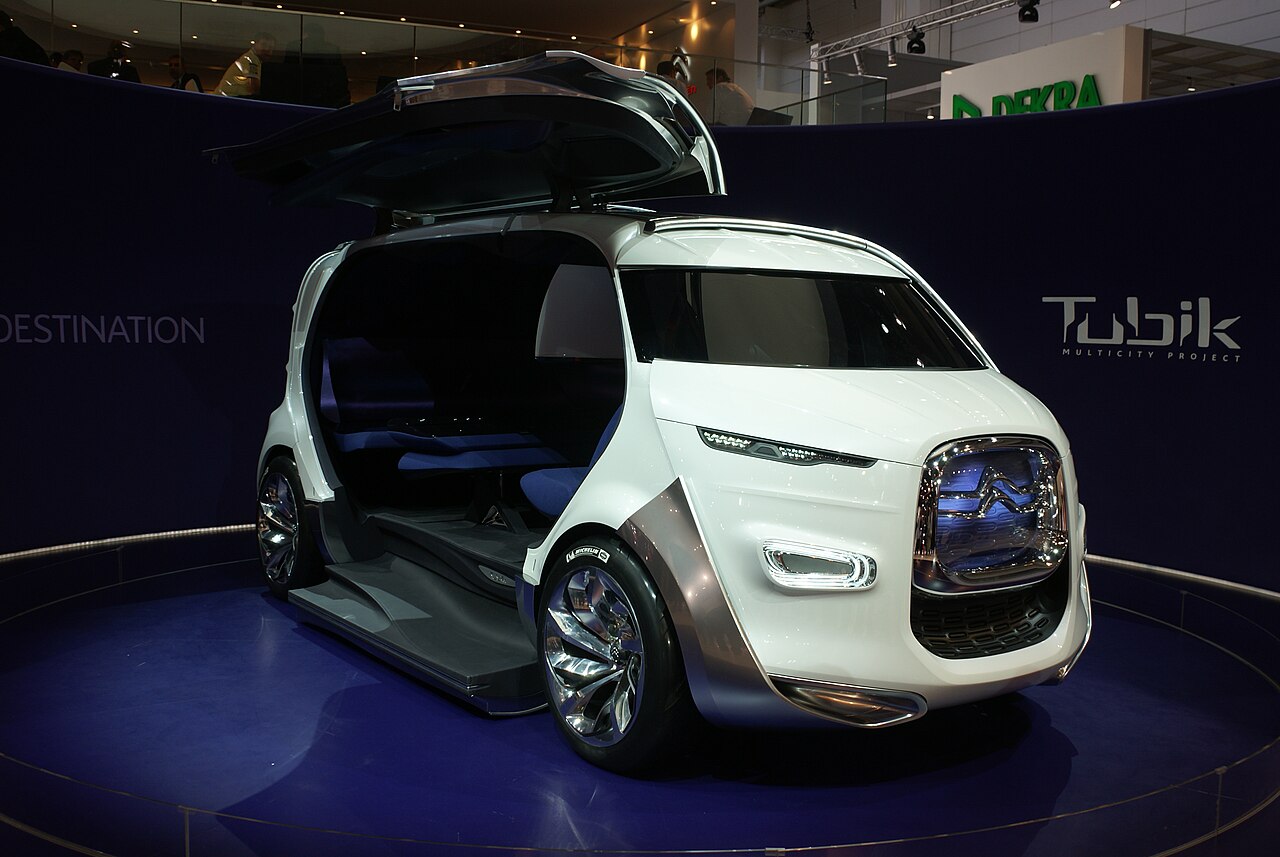
The 2011 Citroën Tubik treats a shared journey as an occasion in its own right. Its unusual van-like body makes room for a social interior, while the supplied motor-show photograph reveals an entrance that turns much of the side into a stage.
A shuttle conceived around the journey
Citroën introduced Tubik for Frankfurt in 2011, drawing on the visual memory of the TUB and Type H utility vehicles. The proposed nine-seat cabin used flexible seating arrangements, including seats facing one another and a lounge configuration. A HYbrid4 diesel-electric system and Hydractive suspension belonged to the announced technical package. These are project specifications rather than a retail vehicle configuration.
What makes the project worth revisiting is the choice of subject. A shuttle is ordinarily assessed through the efficiency of getting people somewhere. Tubik asks what happens between departure and arrival. Facing passengers toward one another changes the social structure of the vehicle: the interior can become a place to talk, share an activity or watch the passing landscape together. That reading follows the documented seating idea, without assuming that a passenger study proved any particular result.
Reading the open side of the show vehicle
The photograph shows a pale body with a broad, dark central band and an enormous side opening. The raised panel exposes the cabin rather than leaving it behind a conventional small door. Rounded ends and relatively smooth surfaces make the overall volume look like a single enclosure. The wheels remain visually secondary to the passenger space.
From this angle, the high body does not try to disguise its capacity with sporting proportions. It makes the enclosure itself the main design feature. The contrast between the white outer surfaces and the shaded opening gives the interior an almost theatrical presence. This is visual interpretation of the supplied exhibition photograph; it is not a measurement of cabin light or an assertion about production door mechanisms.
The driver as a separate organising element
The manufacturer described a concentrated driving station called the cyclotron, grouping the driver’s controls and information into a distinctive ring-like environment. This was a different visual and spatial proposition from arranging a conventional dashboard across the whole front of the cabin.
For an archive profile, that idea is more useful than an unsupported headline about futuristic technology. It describes the relationship between two spaces: a focused position for controlling the vehicle, and a broader communal area for passengers. The driver remains part of the journey but occupies a clearly defined place within it. An interior diagram or a separate authenticated cabin photograph would explain that relationship more completely than the exterior view alone.
Why Tubik has its own collector identity
Tubik is recorded here as the physical concept project. It does not represent all Citroën vans, and the historical styling reference does not make it a Type H derivative with interchangeable production specifications. The exact number of constructed examples has not been established, so the manufacturing-total field is left blank.
The most useful record would retain the debut announcement, dated exhibition photographs and any later custodial history alongside the project name. That keeps a physical show vehicle connected to its original purpose even when its display setting changes. Tubik’s interest lies in the completeness of its spatial argument: utility, passenger comfort and public presentation all become visible in the same unusually generous body.
Specifications and verified rarity
| Reference year | 2011 |
|---|---|
| Model / project | Tubik |
| Body / role | Nine-seat concept shuttle |
| Layout | Nine-seat concept shuttle |
| Powertrain proposal | HYbrid4 diesel-electric hybrid |
| Dimensions | 4.80 m long × 2.08 m wide × 2.05 m high |
| Rarity scope | Documented physical 2011 Tubik concept project; exact fabrication tally not established. |
| Exact manufacturing tally | Not established |
| Inventory reference | CIT-140 — Verified |
Frequently asked questions
When did Tubik debut?
Citroën presented the project for the 2011 Frankfurt show.
Was Tubik a production passenger van?
The subject is the documented concept shuttle, rather than a retail van series.
Does the exterior photograph show every seating arrangement?
No. It documents the show vehicle and its open side; the alternative layouts are described in the manufacturer’s release.
Is there a verified one-car build count?
No exact fabrication total is established in the cited material.
What rarity or archive scope is verified?
Documented physical 2011 Tubik concept project; exact fabrication tally not established.
Who took the supplied photograph?
Matti Blume via Wikimedia Commons, under CC BY-SA 4.0. Keep the photographer, original-file link and licence credit with the image.
Related Citroën profiles
Sources and photo credits
Photograph: Matti Blume via Wikimedia Commons original file, CC BY-SA 4.0. Source photograph supplied without local cropping, retouching or text removal. A source-provided thumbnail is used where available. Tubik at IAA Frankfurt 2011 with the broad side entrance open.
Built in limited numbers
Documented physical 2011 Tubik concept project; exact fabrication tally not established.
Gallery
Specifications
Factory specifications may vary by model year, market and configuration.
Identity & production
- Official model
- Tubik