2006 Renault R26 Formula One
Explore the Renault R26 Formula One: history, verified identity, specification references, rarity evidence and real credited photos.
The Renault R26 repeated the works team’s championship double while adapting to the new 2.4-litre V8 rules. It is a programme defined by successful change rather than a simple continuation of the R25. Its model name must also be separated from the road-going Mégane F1 Team R26 and R26.R.
Programme history and its place in Formula One
Following the 2005 titles, Renault faced a new powertrain formula in 2006. Alonso and Fisichella remained the race pairing, with the R26 chassis built around the new RS26 V8. The factory museum’s R26-03 exhibit offers a specific physical reference, while this article deliberately covers the wider works programme. The suffix on the museum car is retained as evidence of that object’s identity, not adopted as the identity of every photographed R26.
Engineering in its regulatory setting
Renault’s museum describes a naturally aspirated 2,400 cc V8 and an 800 hp historical reference. Its forty-year account records the move to a seven-speed gearbox. These details explain how the car differed from the previous V10 design. They should not be applied to a modern demonstration without checking its actual components and operating setup. A historic performance reference is useful context, not a present-day certification.
Competition results need a season and a chassis
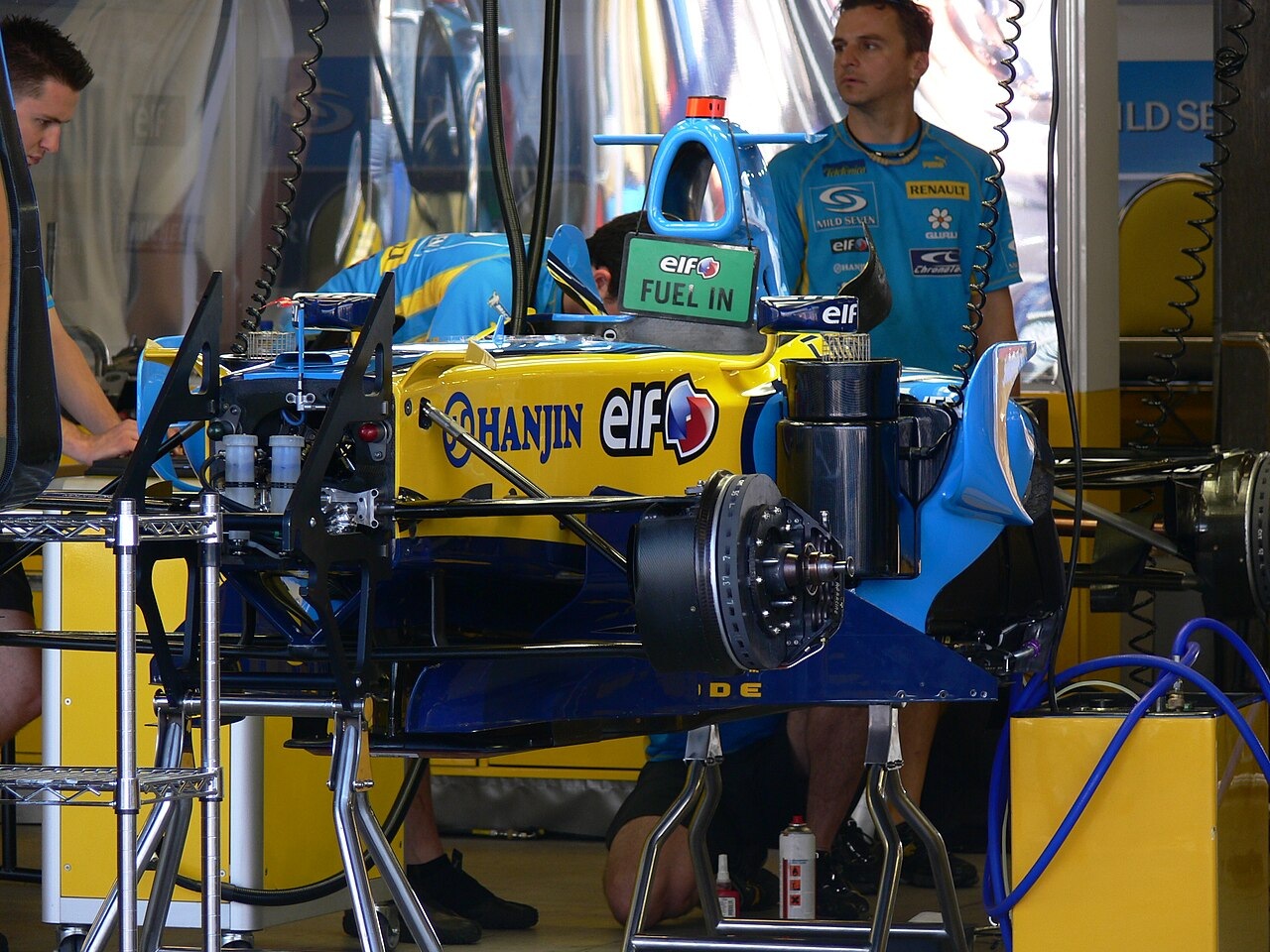
The factory account records eight team victories, seven by Alonso and one by Fisichella, with both world titles retained. Those are programme achievements across the season. They are not all achievements of museum chassis R26-03. The supplied period United States Grand Prix image illustrates the R26 in the working environment of the team, with no unsupported assertion about its chassis suffix or its participation in a particular victory elsewhere.
What makes the programme collectible
The R26’s collector significance includes the speed with which Renault adapted a championship organisation to a different engine architecture. The object history can be equally interesting: development work, driver use, later tests and demonstrations all leave evidence. A well-documented car need not be described as unchanged to be important. What matters is a clear account of what survives, what was replaced and which claims are supported by the works record.
Renault: thirty years of Formula One
Identification and provenance
Check the R26 chassis number, engine history and dated component records before attaching a race narrative. Keep F1 and road-car terminology explicit when indexing the vehicle. The Mégane R26 and R26.R commemorated or drew upon Renault Sport’s wider story, but they are not Formula One chassis derivatives. Photographs should be matched by body type and year as well as the shared R26 lettering, which can otherwise create misleading search results.
Specifications and identity reference
| Season | 2006 |
|---|---|
| Engine | Renault RS26; 2.4-litre naturally aspirated V8 |
| Transmission reference | Seven-speed racing gearbox |
| Works drivers | Fernando Alonso; Giancarlo Fisichella |
| Identity boundary | F1 programme, separate from Mégane R26/R26.R |
Rarity and production scope
This Archive profile covers the R26 works programme. The museum’s R26-03 is a specifically identified exhibit, not proof that every image depicts chassis 03. No complete chassis census is asserted and championship results are not treated as production. Road-going Mégane F1 Team R26 and R26.R identities remain separate profiles or research entries.
This is an Archive record. Concepts, restored heritage vehicles, works cars and competition programmes are not added to customer road-production totals. A programme profile does not establish how many physical chassis were made, and repeated exhibition appearances do not create additional vehicles.
What the photograph represents
A Renault R26 during the 2006 United States Grand Prix weekend. Period programme illustration; the photograph is not assigned the museum exhibit’s R26-03 chassis identity without further evidence.
Related Renault heritage profiles
Frequently asked questions
Is this the Mégane R26 road car?
No. This is the Formula One single-seater programme. The road Mégane uses the name in a different vehicle context.
Does the R26-03 museum page authenticate the chassis in the photograph?
No. It supports the model history and one exhibit identity; the period photo is not assigned that suffix without evidence.
What is the production-count boundary for this profile?
This Archive profile covers the R26 works programme. The museum’s R26-03 is a specifically identified exhibit, not proof that every image depicts chassis 03. No complete chassis census is asserted and championship results are not treated as production. Road-going Mégane F1 Team R26 and R26.R identities remain separate profiles or research entries.
Sources and further reading
- Renault museum: R26-03
- Renault: thirty years of Formula One
- Renault forty-year history: the 2006 V8 campaign
Research checked 17 October 2026. Linked factory announcements and heritage records support the specifically attributed claims. Photographic descriptions identify the illustrated subject. Design analysis and suggested authentication steps are editorial interpretation.
Built in limited numbers
This Archive profile covers the R26 works programme. The museum’s R26-03 is a specifically identified exhibit, not proof that every image depicts chassis 03. No complete chassis census is asserted and championship results are not treated as production. Road-going Mégane F1 Team R26 and R26.R identities remain separate profiles or research entries.
Gallery
Specifications
Factory specifications may vary by model year, market and configuration.
Identity & production
- Official model
- Renault R26 Formula One
Sources and verification
Source citations are being prepared for this profile.