2010 Renault R30 Formula One
Explore the Renault R30 Formula One: history, verified identity, specification references, rarity evidence and real credited photos.
The Renault R30 introduced a new driver pairing and a revised Formula One architecture for 2010. Its yellow-and-black appearance recalled Renault’s earlier works cars, while the refuelling ban demanded changes beneath the bodywork. This is the Grand Prix single-seater, distinct from the road-going Renault 30 saloon.
Programme history and its place in Formula One
Renault’s contemporary launch account presents Robert Kubica and Vitaly Petrov as the R30 race pairing. The team was entering a new organisational phase, but the vehicle identity remains the 2010 R30 programme. Its name can be confused with Renault’s much earlier executive saloon in loosely indexed collections. A useful catalogue therefore includes Formula One in the title and keeps the season explicit throughout the description and image record.
Renault Germany: R30 launch and technical specification
Engineering in its regulatory setting
The launch document explains the effect of the 2010 ban on refuelling during a Grand Prix. A larger fuel reservoir required changes to the car’s architecture, while aerodynamic development reshaped the rear bodywork. These are useful reasons for the R30’s proportions, rather than styling observations alone. They also explain why a comparison with the preceding R29 needs more detail than a similar colour scheme or a shared engine designation.
Competition results need a season and a chassis
Renault specifies its RS27 as a 2.4-litre 90-degree V8, with a seven-speed semi-automatic gearbox for the car. The launch account also discusses the removal of KERS in the comparison with the previous season. Those are dated programme specifications. They should not be transferred to a later demonstration chassis without checking its actual installation, and they do not supply a verified present-day power output or safe operating limit.
Renault Germany: R30 launch and technical specification
What makes the programme collectible
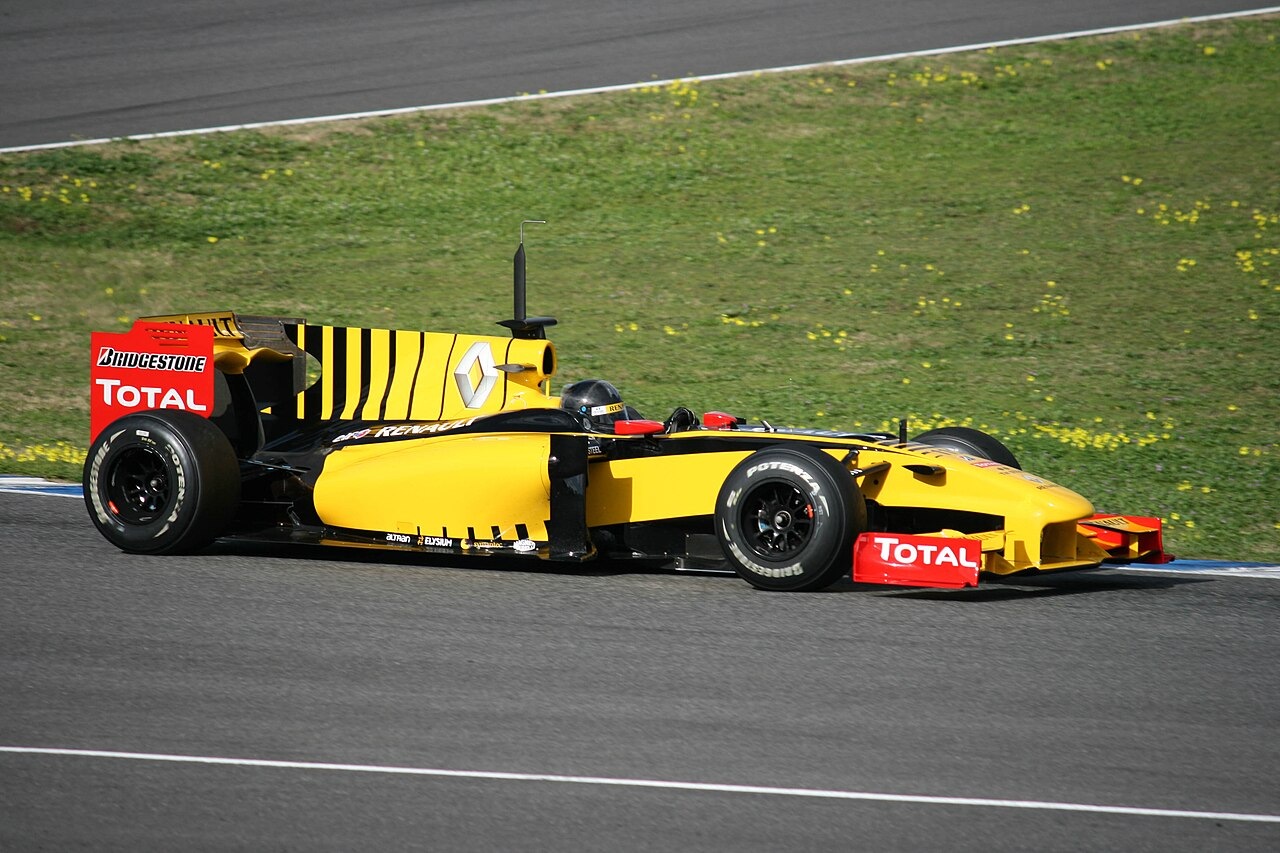
The R30 is collectible as a physical record of a regulation change and a transitional works campaign. A clear provenance file can explain testing, racing and later display use without requiring every appearance to represent the same mechanical specification. A car shown in a later team livery needs an explicit caption. The supplied period photograph shows Kubica testing at Jerez in 2010. It anchors the model in its original development setting without authenticating an individual chassis number or a particular installed race engine.
Renault Germany: R30 launch and technical specification
Identification and provenance
Check the works chassis number, Kubica or Petrov allocation history, logbook and subsequent use. Identify whether the object is an original race tub, a reconstructed demonstrator or a display assembly. Bodywork and livery can change independently of the main structure, so a driver number is a starting point rather than a conclusion. Keep any later running or repainting dated and separate from the original 2010 competition narrative.
Specifications and identity reference
| Season | 2010 |
|---|---|
| Engine reference | Renault RS27; 2.4-litre 90-degree V8 |
| Transmission | Seven-speed semi-automatic racing gearbox |
| Race drivers | Robert Kubica; Vitaly Petrov |
| Regulatory context | In-race refuelling prohibited for 2010 |
Rarity and production scope
The contemporary Renault launch verifies the R30 programme and specification but does not establish a complete chassis census. This Archive record therefore carries no exact production or survivor total. It excludes the road Renault 30 saloon, and a later display appearance is not treated as an additional original race car or proof of current operating condition.
This is an Archive record. Concepts, restored heritage vehicles, works cars and competition programmes are not added to customer road-production totals. A programme profile does not establish how many physical chassis were made, and repeated exhibition appearances do not create additional vehicles.
What the photograph represents
Robert Kubica testing a Renault R30 at Jerez in February 2010. Period programme illustration; no exact chassis number or subsequent ownership history is inferred. Repainted earlier Renault display cars are not substituted for the R30.
Related Renault heritage profiles
Frequently asked questions
Is this the Renault 30 road saloon?
No. The R30 in this profile is Renault’s 2010 Formula One single-seater.
Why did the 2010 rule change affect the car’s architecture?
The prohibition on refuelling during races required a larger fuel reservoir, which Renault identifies as a major packaging change.
What is the production-count boundary for this profile?
The contemporary Renault launch verifies the R30 programme and specification but does not establish a complete chassis census. This Archive record therefore carries no exact production or survivor total. It excludes the road Renault 30 saloon, and a later display appearance is not treated as an additional original race car or proof of current operating condition.
Sources and further reading
Research checked 17 October 2026. Linked factory announcements and heritage records support the specifically attributed claims. Photographic descriptions identify the illustrated subject. Design analysis and suggested authentication steps are editorial interpretation.
Built in limited numbers
The contemporary Renault launch verifies the R30 programme and specification but does not establish a complete chassis census. This Archive record therefore carries no exact production or survivor total. It excludes the road Renault 30 saloon, and a later display appearance is not treated as an additional original race car or proof of current operating condition.
Gallery
Specifications
Factory specifications may vary by model year, market and configuration.
Identity & production
- Official model
- Renault R30 Formula One
Sources and verification
Source citations are being prepared for this profile.