2005 Nissan Pivo
Explore the Pivo: history, verified identity, specification references, rarity evidence and real credited photos.
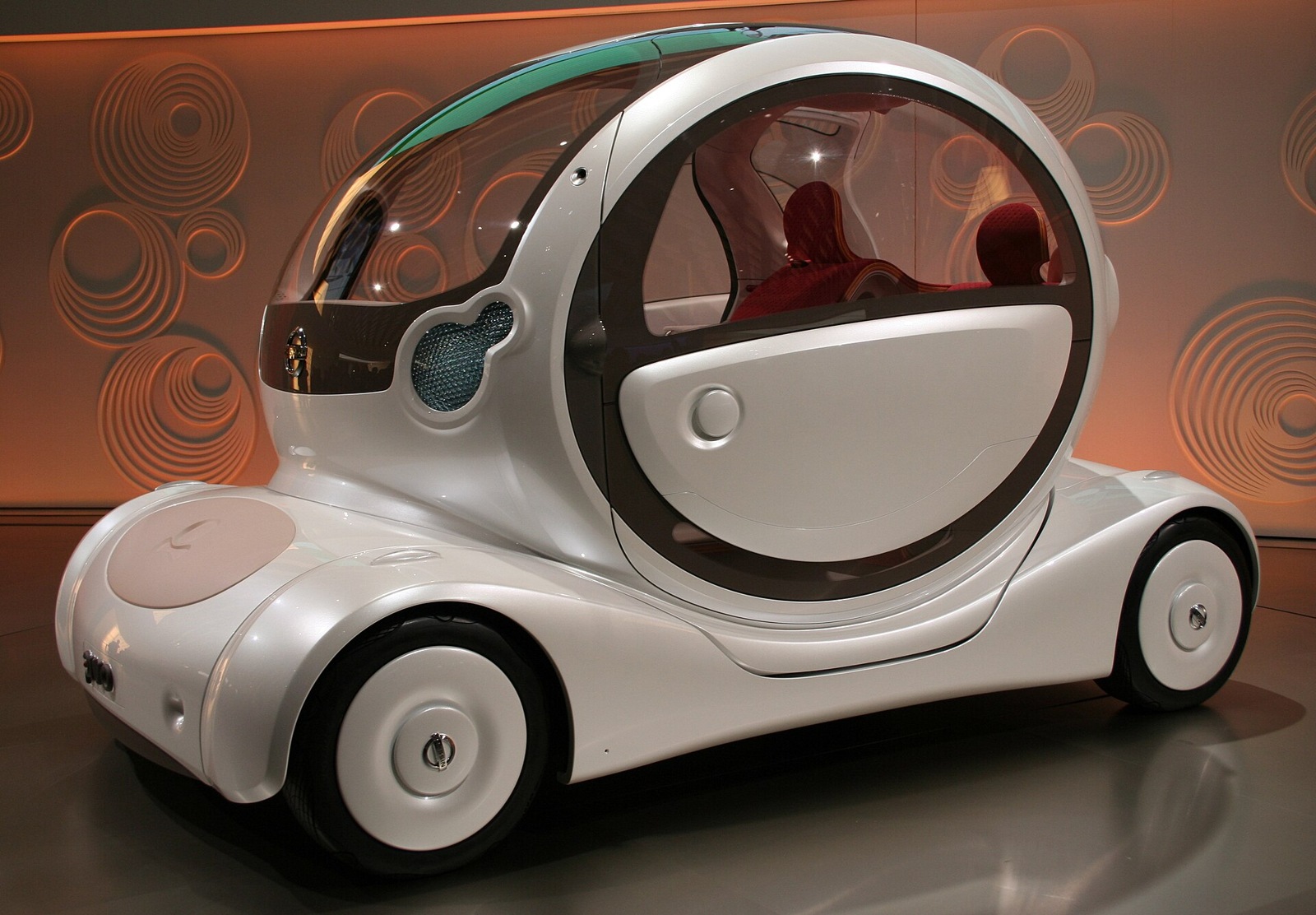
The original Nissan Pivo proposed a different answer to city driving: rotate the cabin instead of making the driver reverse. Shown in 2005, the three-seat electric concept combined a 360-degree rotating passenger compartment with drive-by-wire technology and a compact electric powertrain. This profile follows that first Pivo, keeping the Pivo 2's robotic companion and ninety-degree wheel steering in their later, separate story.
Urban mobility before the production LEAF
Nissan's 2005 Tokyo show announcement lists Pivo among five concepts exploring driving enjoyment, cabin design and technology. Its purpose was not to introduce a new trim grade or a limited retail hatchback. It examined how electric propulsion and electronic controls could change the basic package of a small commuter. That makes the physical exhibit relevant to Nissan's EV development history even though it never became an ordinary customer production model.
Nissan: 2005 Tokyo show announcement and Pivo overview
The rotating cabin
The headline feature was a passenger compartment capable of turning through a full circle. Nissan explained that drive-by-wire systems allowed this arrangement to eliminate the need for reversing in the conventional sense. The idea separated the direction the occupants faced from the fixed orientation of a normal car body. It is a concept's engineering proposition, not evidence that a customer vehicle with the same function was homologated or offered for sale.
Three seats and compact electric packaging
The manufacturer described Pivo as a three-seat commuter using a Nissan-developed compact lithium-ion battery and Super Motor. The electric package supported a different arrangement of cabin and chassis components from a conventional engine-driven small car. The selected release does not provide a customer range certification or a completed production specification, so neither is invented here. Its documented value lies in the packaging experiment and the physical demonstration of that idea.
Nissan: 2005 Tokyo show announcement and Pivo overview
Visibility and the human interface
Nissan also identified See-through Pillars and an Around View Monitor as approaches to reducing blind spots. An infrared-camera interface allowed gestures to control cabin functions. These features show that Pivo explored the driver's relationship with the whole vehicle, rather than relying on the rotating cabin as a single spectacle. Their appearance in a concept should still be distinguished from the timing and specification of later production implementations with similar names.
Nissan: 2005 Tokyo show announcement and Pivo overview
Keeping the Pivo generations separate
Identify the original vehicle using dated 2005 photographs and Nissan's own description. Pivo 2 followed in 2007 with a robotic agent and additional wheel-steering capability, while Pivo 3 is another later design. Those developments belong in linked profiles or a programme history, not silently added to the first car's equipment list. A later exhibition photograph should also retain its actual display date rather than being described as the original show appearance.
Specifications and identity reference
| Public show reference | 2005 Tokyo Motor Show |
|---|---|
| Seats | Three |
| Propulsion | Electric; compact lithium-ion battery |
| Motor description | Nissan-developed Super Motor |
| Cabin movement | 360-degree rotation |
| Control architecture | Drive-by-wire |
| Visibility concepts | See-through Pillars; Around View Monitor |
| Retail / completed total | No customer production or audited exhibit total assigned |
Rarity and production scope
Verified physical first-generation Pivo concept. This Archive record excludes Pivo 2 and Pivo 3 and does not create a road-production count from exhibition appearances.
This is an Archive record. Concepts, restored heritage vehicles, works cars and competition programmes are not added to customer road-production totals. A programme profile does not establish how many physical chassis were made, and repeated exhibition appearances do not create additional vehicles.
What the photograph represents
First-generation Nissan Pivo at the 2005 Tokyo Motor Show. The image is not the later Pivo 2 or Pivo 3.
Related Nissan heritage profiles
Frequently asked questions
Does this Pivo have the Pivo 2 robotic agent?
That feature belongs to the separate 2007 Pivo 2 record.
Was Pivo a three-seat production hatchback?
Nissan described a three-seat electric concept; this is not a customer production profile.
What is the production-count boundary for this profile?
Verified physical first-generation Pivo concept. This Archive record excludes Pivo 2 and Pivo 3 and does not create a road-production count from exhibition appearances.
Sources and further reading
Research checked 16 October 2026. Manufacturer records support identity and the specifically attributed historical figures. Photographic descriptions identify the illustrated subject. Design analysis and suggested authentication steps are editorial interpretation.
Built in limited numbers
Verified physical first-generation Pivo concept. This Archive record excludes Pivo 2 and Pivo 3 and does not create a road-production count from exhibition appearances.
Gallery
Specifications
Factory specifications may vary by model year, market and configuration.
Identity & production
- Official model
- Nissan Pivo
Sources and verification
Source citations are being prepared for this profile.