2005 Honda Sports 4 Concept
Honda Sports 4 Concept: four-seat design, manufacturer-described SH-AWD and credited concept photography.
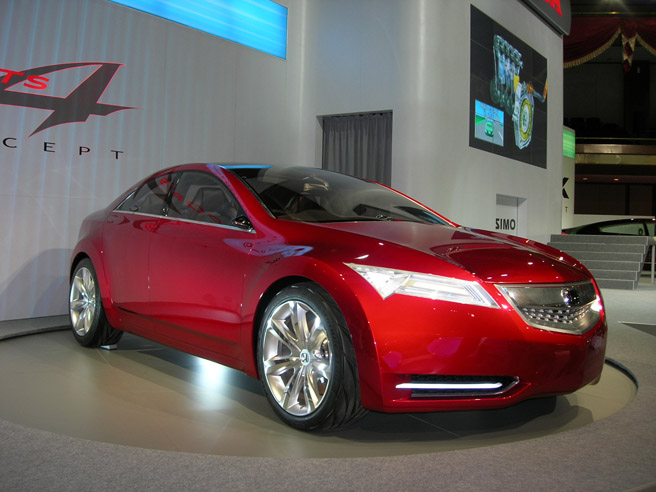
The Honda Sports 4 Concept proposed a sports-car experience for four occupants at the 2005 Tokyo Motor Show.
History and purpose
The Honda Sports 4 Concept proposed a sports-car experience for four occupants at the 2005 Tokyo Motor Show. Honda’s model-specific factbook confirms that the idea involved the whole passenger compartment, rather than simply giving a saloon a performance badge. The manufacturer’s account and the later documentary photograph establish a physical concept archive subject. They do not identify a finite retail edition or a complete construction count. The reference year follows the original Tokyo presentation; the supplied image records the concept at Kuala Lumpur in 2006. Keeping those dates separate preserves the car’s introduction and its exhibition history without creating two profiles.
Design and engineering
Honda’s factbook explicitly assigns SH-AWD to Sports 4 and describes four separate bucket seats and independently opening roof sections. It does not establish an engine rating in the cited model-specific text. The red display car’s photograph shows a long, low cabin, a broad front face and sharply defined lamp treatment. These visible features make the sports-saloon theme intelligible without a performance claim. The body appears more integrated than a conventional upright utility vehicle, with the roof and side glazing forming one continuous movement. The supplied exterior view cannot demonstrate the operation of the roof, the all-wheel-drive system or the show car’s mechanical condition.
Identifying the original configuration
Use the complete Sports 4 Concept name when recording this subject. A production Honda saloon with related styling is not a substitute for the original concept, and specifications from another car on the same show stand should not be transferred to it. The selected photographer names Sports 4 and identifies the 2006 Kuala Lumpur International Motor Show setting. That event context supports the match together with the recognizable body configuration. A more complete custodial file could document interior seating, roof mechanisms, chassis markings and any changes between exhibitions. Such evidence would describe the individual show object without turning an exhibition itinerary into a fabrication census.
Collector context and preservation
Sports 4 is useful beside the compact Small Hybrid Sports Concept because the two presentations ask different packaging questions. One organizes sporting intent around four occupants and a long saloon cabin; the other uses a smaller, more compressed sports shape. Compare roofline, wheel placement and the way the front body meets the glazing rather than assuming a shared drivetrain. A collection display could pair the exterior image with a properly dated cabin photograph to explain the four-seat idea. Preserve the original Tokyo factbook, later exhibit evidence and component records as separate layers, allowing the archive to describe both design intent and the physical car’s subsequent life.
Reading the evidence for this profile
The original source links below identify the programme and the historical statements used in this article. The photograph has its own creator and licence record, separate from the manufacturer’s vehicle history. Keep both when transferring this profile into a collection catalogue. A manufacturing tally describes how many cars belong to a defined original programme; it does not measure how many survive, how many are publicly visible, or how many retain all their original components. Those individual questions require dated chassis and restoration evidence. The reference year likewise describes the programme’s introduction or named historic configuration, while the supplied caption states the photographed setting and any established individual identity. This lets future research expand the car’s history without blurring the scope of the record already assembled here.
Specifications and verified rarity
| Reference year | 2005 |
|---|---|
| Model / programme | Sports 4 Concept |
| Body / role | Four-door, four-seat sports-saloon concept |
| Power unit / proposal | Engine displacement and output not established in the cited model-specific description |
| Layout / transmission | Honda describes SH-AWD, four independent bucket seats and individually opening roof sections |
| Exact manufacturing tally | Not established |
| Rarity evidence | Physical concept archive scope; tally unknown |
| Rarity scope | Physical Honda Sports 4 Concept presented at Tokyo Motor Show 2005 and photographed at a later 2006 display. Complete fabrication tally unknown; no ordinary Accord or Legend production count assigned. |
| Inventory reference | HON-066 — Verified |
Frequently asked questions
What is the Honda Sports 4 Concept?
Honda’s four-occupant Sports 4 Concept, with manufacturer-described SH-AWD and a physical show history beginning in 2005.
What engineering defines this vehicle?
Engine displacement and output not established in the cited model-specific description. Honda describes SH-AWD, four independent bucket seats and individually opening roof sections. The specifications describe the original programme or published concept proposal. An individual example’s installed equipment and any later changes need their own dated evidence.
Why does this profile use 2005?
This is the documented introduction or original configuration year. Photograph dates and market model years can differ. Keeping those dates separate makes it possible to follow the car’s development without creating a second identity for the same programme.
How should an individual Sports 4 Concept be authenticated?
Connect the chassis identifier to original delivery, edition or custodial records. Compare period exterior, cabin and mechanical photographs with the documented configuration. Record replacement parts, paint changes and restoration work as dated events. A badge or colour alone cannot establish that a car belongs to this original programme.
What rarity or archive scope is verified?
Physical Honda Sports 4 Concept presented at Tokyo Motor Show 2005 and photographed at a later 2006 display. Complete fabrication tally unknown; no ordinary Accord or Legend production count assigned.
Who took the supplied photograph?
vernieman via Wikimedia Commons, under CC BY 2.0. The original file and licence links accompany the image. Retain that credit when the photograph is uploaded, exported or reused.
Related Honda family profiles
Sources and photo credits
Photograph: vernieman via Wikimedia Commons original file, CC BY 2.0. Source-provided photograph supplied without local cropping, retouching or text removal. A source thumbnail is used where available. Honda Sports 4 Concept at the Kuala Lumpur International Motor Show on 1 June 2006, following its original 2005 Tokyo presentation.
Built in limited numbers
Physical Honda Sports 4 Concept presented at Tokyo Motor Show 2005 and photographed at a later 2006 display. Complete fabrication tally unknown; no ordinary Accord or Legend production count assigned.
Gallery
Specifications
Factory specifications may vary by model year, market and configuration.
Identity & production
- Official model
- Sports 4 Concept