1968 Ford GT40 Mk I P/1075
Explore 1968 Ford GT40 Mk I P/1075: sourced history, design, specifications, rarity evidence and a real photograph with creator credits.
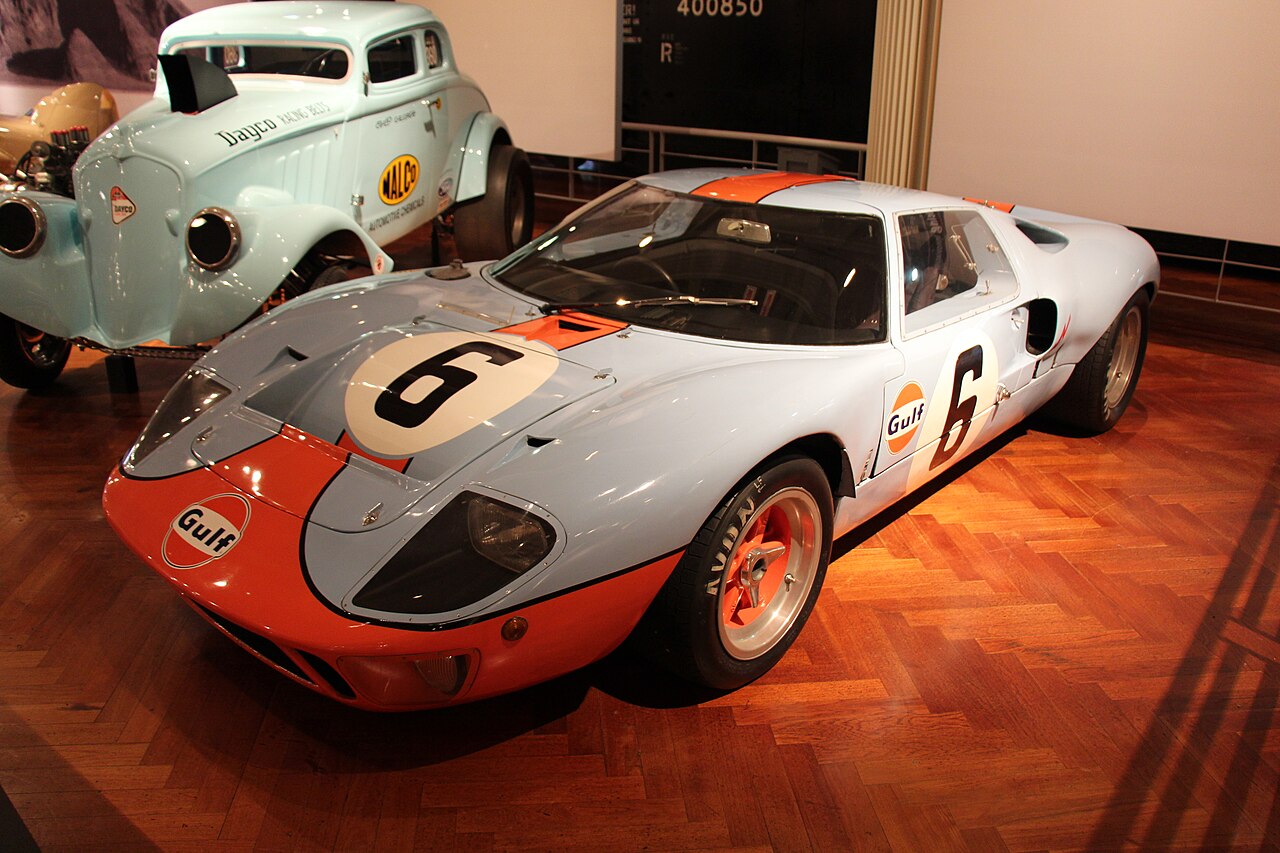
Ford GT40 chassis P/1075 won the 24 Hours of Le Mans in both 1968 and 1969.
History and purpose
Ford GT40 chassis P/1075 won the 24 Hours of Le Mans in both 1968 and 1969. The Henry Ford’s original collection history connects the first win to Pedro Rodriguez and Lucien Bianchi and the second to Jacky Ickx and Jackie Oliver. Those two results make this particular Mk I a strong individual archive subject. The museum specification identifies a 302-cubic-inch Ford V8 with Gurney-Weslake heads and a five-speed manual transmission. This biography follows P/1075, using 1968 as the first winning configuration’s reference year. It does not create an additional manufactured programme beside the generic original GT40 Mk I article.
Design and engineering
The museum photograph shows the car in Gulf blue and orange, with a large number 6 on the nose and orange wheels beneath the low body. The colours emphasise the car’s width and separate the passenger cell from the lower surfaces. The compact glass area and deep openings behind the doors remain key visual features of the Mk I architecture. The photograph records the preserved car’s later museum display, while the source history establishes its competition identity. Keeping those two dates separate prevents the current number and livery from being treated automatically as the precise appearance at every race the chassis entered.
Identifying the original configuration
The chassis reference P/1075 carries more identifying information than Gulf GT40 or Le Mans winner. Similar liveries appear on later replicas and other original cars, so colour cannot establish the biography by itself. Here the photographer’s identified museum subject matches The Henry Ford’s custodial history. Keep both winning driver pairings and both event years in the record, because reducing the car to a single victory loses the distinctive achievement. Mechanical and body details should remain attached to the documented configuration in which they were recorded. The profile’s manufacturing field remains unknown because an individual-chassis article is not a claim that the entire Mk I series consisted of one vehicle.
Collector context and preservation
A collection presentation can use P/1075 to show why individual-car history adds something that a model overview cannot. The generic Mk I article explains architecture and programme scope; this biography follows one chassis through two major results. A useful vehicle file can link period race material, subsequent custody and later preservation photographs in chronological order. Record engine work, body repairs and livery changes when documentation becomes available. That provides a continuous account of the physical subject without confusing preserved appearance with every earlier competition state. The original family estimate remains a separate parent-scale reference and must never be increased by adding this biography to it.
Reading the evidence for this profile
The original source links below identify the programme and the historical statements used in this article. The photograph has its own creator and licence record, separate from the manufacturer’s vehicle history. Keep both when transferring this profile into a collection catalogue. A manufacturing tally describes how many cars belong to a defined original programme; it does not measure how many survive, how many are publicly visible, or how many retain all their original components. Those individual questions require dated chassis and restoration evidence. The reference year likewise describes the programme’s introduction or named historic configuration, while the supplied caption states the photographed setting and any established individual identity. This lets future research expand the car’s history without blurring the scope of the record already assembled here.
Specifications and verified rarity
| Reference year | 1968 |
|---|---|
| Model / programme | GT40 Mk I P/1075 |
| Body / role | Original twice-winning Le Mans chassis |
| Documented engine | Ford 302 cu in V8 with Gurney-Weslake heads in the museum specification |
| Architecture / transmission | Mid-engine sports-racing chassis; five-speed manual |
| Exact manufacturing tally | Not established |
| Eligibility bound | 133 for the documented scope or parent programme |
| Rarity scope | Archival biography of original GT40 Mk I chassis P/1075. One identified physical subject within the original GT40 family, whose approximately 133-car scale is an estimate. The chassis is included in FRD-086’s parent programme and is not additional manufacturing. |
| Inventory reference | FRD-122 — Verified |
Frequently asked questions
What is the Ford GT40 Mk I P/1075?
The original GT40 Mk I chassis P/1075, winner at Le Mans in 1968 and 1969 with two different driver pairings.
What engineering defines this Ford?
Ford 302 cu in V8 with Gurney-Weslake heads in the museum specification. Mid-engine sports-racing chassis; five-speed manual. These are the documented programme or preserved-concept specifications. Connect an individual vehicle’s installed components to its own dated records before assigning a factory configuration to that particular example.
Why is 1968 the reference year?
It identifies the introduction or original historical configuration described in this article. The photograph can show a later example or a later display of the original subject. The source inventory’s original heading remains an identity alias wherever the date or model name has been corrected.
How should an individual GT40 Mk I P/1075 be documented?
Start with the chassis identity and connect it to dated construction, registration or custodial records. Keep exterior, interior, engine and underbody photographs together. Record changes to finish, equipment and mechanical specification as separate events, so the physical car’s history can grow without changing the definition of the original programme.
What rarity or archive scope is verified?
Archival biography of original GT40 Mk I chassis P/1075. One identified physical subject within the original GT40 family, whose approximately 133-car scale is an estimate. The chassis is included in FRD-086’s parent programme and is not additional manufacturing.
Who took the supplied photograph?
Sicnag via Wikimedia Commons, under CC BY 2.0. The original file and licence links accompany the image. Retain that credit when the photograph is uploaded, exported or reused.
Related Ford profiles
Sources and photo credits
- Manufacturer, institutional or original custodial record
- Original GT40 family scale and scope, approximate
Photograph: Sicnag via Wikimedia Commons original file, CC BY 2.0. Source-provided photograph supplied without local cropping, retouching or text removal. A source thumbnail is used where available. Original GT40 P/1075 preserved at The Henry Ford, in Gulf colours and number 6 museum presentation; later display photograph.
Built in limited numbers
Archival biography of original GT40 Mk I chassis P/1075. One identified physical subject within the original GT40 family, whose approximately 133-car scale is an estimate. The chassis is included in FRD-086’s parent programme and is not additional manufacturing.
Gallery
Specifications
Factory specifications may vary by model year, market and configuration.
Identity & production
- Official model
- GT40 Mk I P/1075