1966 Ford GT40 Mk II P/1016
Explore 1966 Ford GT40 Mk II P/1016: sourced history, design, specifications, rarity evidence and a real photograph with creator credits.
Ford GT40 Mk II chassis P/1016 earned its place in history as the third-place car in Ford’s 1966 Le Mans sweep.
History and purpose
Ford GT40 Mk II chassis P/1016 earned its place in history as the third-place car in Ford’s 1966 Le Mans sweep. The Shelby American Collection and RM Sotheby’s custodial account connect the original chassis to Ronnie Bucknum and Dick Hutcherson and the number 5 competition identity. This is an individual car biography, rather than another generic Mk II production article. Its rarity scope follows one named original chassis within the original GT40 family. The manufacturing-total field is empty because a single archival subject is not evidence that only one Mk II was constructed. The wider family’s approximate 133-car scale is retained separately.
Design and engineering
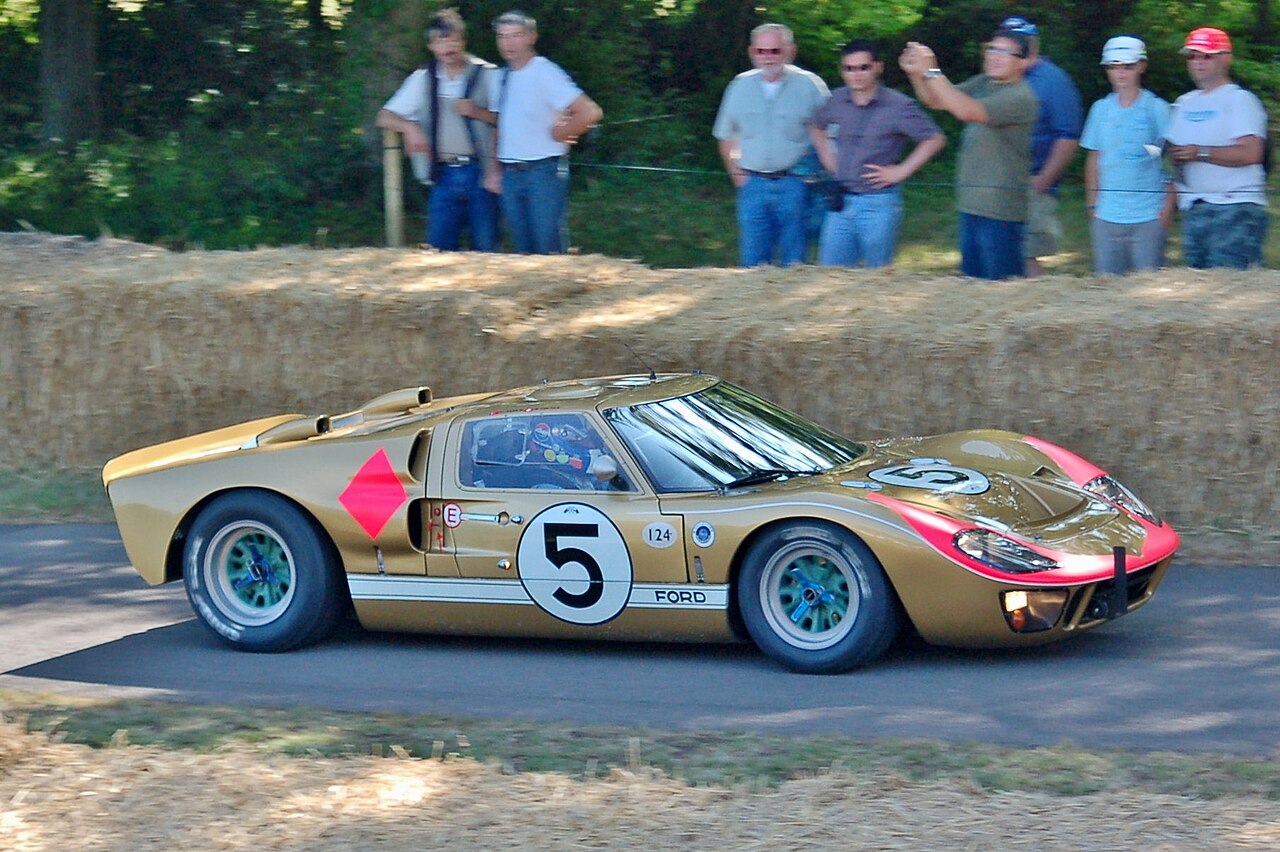
The Goodwood photograph shows the gold car in motion, with a black lower-body accent, large number 5 roundel and compact roofline. Its low nose and wide rear body communicate the sports-racing package clearly against the straw barriers. The documented 427-cubic-inch Ford V8 gives the Mk II a different mechanical identity from the small-block Mk I. The image establishes a later appearance of the named original P/1016 rather than a frame from the 1966 race itself. That distinction allows the visual presentation to remain vivid while keeping paint, equipment and event date attached to the actual photograph.
Identifying the original configuration
Retain the P/1016 chassis reference in every profile title, caption and import identity. A gold GT40 with number 5 markings is not automatically the original car, so the source photograph’s chassis identification is checked against custodial records. The linked museum account and auction history supply that original-car anchor. Another chassis, P/1015, has its own history and must not inherit this photograph. The same applies to a generic GT40 Mk II programme entry. Keeping those identities distinct protects the biography from being duplicated under a racing number, colour description or broad model heading while preserving the meaning of Ford’s 1966 result.
Collector context and preservation
For a collection file, follow the chassis through construction, competition and subsequent custody before presenting its present condition. Period race photographs and later historic-event photographs serve different purposes: one anchors the race configuration, and the other records the surviving subject at a dated event. Engine, transmission and body changes should be documented as part of that continuous history. The supplied image offers a strong whole-car view for an article, but cannot alone settle every installed component’s provenance. Use the biography to explain why P/1016 matters, then let the individual records show how the car’s material configuration has developed since its Le Mans appearance.
Reading the evidence for this profile
The original source links below identify the programme and the historical statements used in this article. The photograph has its own creator and licence record, separate from the manufacturer’s vehicle history. Keep both when transferring this profile into a collection catalogue. A manufacturing tally describes how many cars belong to a defined original programme; it does not measure how many survive, how many are publicly visible, or how many retain all their original components. Those individual questions require dated chassis and restoration evidence. The reference year likewise describes the programme’s introduction or named historic configuration, while the supplied caption states the photographed setting and any established individual identity. This lets future research expand the car’s history without blurring the scope of the record already assembled here.
Specifications and verified rarity
| Reference year | 1966 |
|---|---|
| Model / programme | GT40 Mk II P/1016 |
| Body / role | Original Le Mans competition chassis |
| Documented engine | Ford 427 cu in FE V8 in documented Le Mans configuration |
| Architecture / transmission | Mid-engine Mk II sports-racing architecture |
| Exact manufacturing tally | Not established |
| Eligibility bound | 133 for the documented scope or parent programme |
| Rarity scope | Archival biography of the single original GT40 chassis P/1016, within the estimated approximately 133-car original GT40 family. One identified subject is not a one-car manufacturing programme. Exact manufacturing total remains unset; later recreations are excluded. |
| Inventory reference | FRD-099 — Verified |
Frequently asked questions
What is the Ford GT40 Mk II P/1016?
The original Ford GT40 Mk II chassis P/1016, third at Le Mans in 1966 with Bucknum and Hutcherson; an individual archival biography.
What engineering defines this Ford?
Ford 427 cu in FE V8 in documented Le Mans configuration. Mid-engine Mk II sports-racing architecture. These are the documented programme or preserved-concept specifications. Connect an individual vehicle’s installed components to its own dated records before assigning a factory configuration to that particular example.
Why is 1966 the reference year?
It identifies the introduction or original historical configuration described in this article. The photograph can show a later example or a later display of the original subject. The source inventory’s original heading remains an identity alias wherever the date or model name has been corrected.
How should an individual GT40 Mk II P/1016 be documented?
Start with the chassis identity and connect it to dated construction, registration or custodial records. Keep exterior, interior, engine and underbody photographs together. Record changes to finish, equipment and mechanical specification as separate events, so the physical car’s history can grow without changing the definition of the original programme.
What rarity or archive scope is verified?
Archival biography of the single original GT40 chassis P/1016, within the estimated approximately 133-car original GT40 family. One identified subject is not a one-car manufacturing programme. Exact manufacturing total remains unset; later recreations are excluded.
Who took the supplied photograph?
Bahnfrend via Wikimedia Commons, under CC BY-SA 4.0. The original file and licence links accompany the image. Retain that credit when the photograph is uploaded, exported or reused.
Related Ford profiles
Sources and photo credits
- Manufacturer, institutional or original custodial record
- RM Sotheby’s: original P/1016 provenance and 1966 result
- Original GT40 family scale, approximate
Photograph: Bahnfrend via Wikimedia Commons original file, CC BY-SA 4.0. Source-provided photograph supplied without local cropping, retouching or text removal. A source thumbnail is used where available. Original GT40 Mk II P/1016 at Goodwood in 2019, identified in the photograph’s source record; later event appearance, not a 1966 race image.
Built in limited numbers
Archival biography of the single original GT40 chassis P/1016, within the estimated approximately 133-car original GT40 family. One identified subject is not a one-car manufacturing programme. Exact manufacturing total remains unset; later recreations are excluded.
Gallery
Specifications
Factory specifications may vary by model year, market and configuration.
Identity & production
- Official model
- GT40 Mk II P/1016