1963 Lotus Type 29 Indianapolis Car
Explore the 1963 Lotus Type 29 Indianapolis Car: programme history, design, verified rarity scope, specifications and credited photography.
The 1963 Lotus Type 29 takes Lotus’s compact monocoque experience into Indianapolis racing. Its wider structure, greater fuel provision and oval-specific suspension make it a separate programme from the Formula One Type 25 that informed its design.
History and verified programme identity
Classic Team Lotus identifies the Type 29 as a development of the Type 25 for Indianapolis. The custodian describes a longer and wider monocoque to accommodate the larger engine and more fuel, together with asymmetric suspension for a left-turning circuit. Its public register lists three entries. Those references define a small competition programme; they are not a current survivor census. The supplied photograph identifies the Barber museum car as 29/2, so the model and the individual display identity are retained separately. A later Lotus Indianapolis winner is not substituted for this earlier Type.
Engineering and design
An oval circuit asks different questions of a racing car from a road circuit with corners in both directions. The Type 29’s asymmetric suspension is therefore part of a deliberate competition arrangement, rather than a visual irregularity to be ignored. The larger engine and fuel requirement also change the scale of the central structure. The custodial description explains why a development related to the Type 25 needed to become longer, wider and more substantial. A model-level explanation can show that design problem without assigning an unsupported power output, fuel capacity or present wheel alignment to the photographed museum car.
The physical car in the supplied photograph
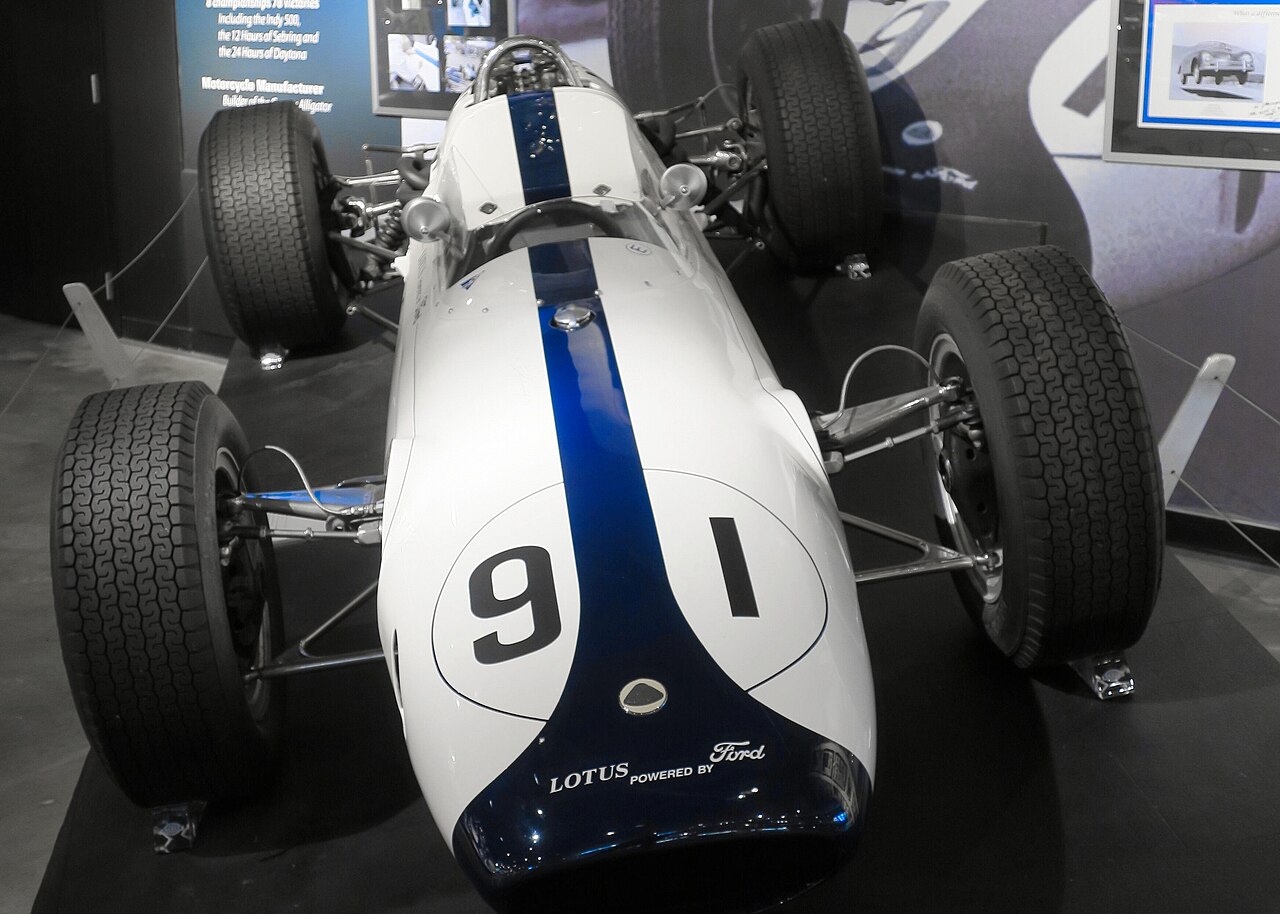
The supplied photograph shows the white-and-blue Type 29/2 Indianapolis car at the Barber Vintage Motorsports Museum in Birmingham, Alabama. Nheyob’s creator record identifies the museum and individual Type reference. The high-angle front view makes the open wheels, narrow driver space and long nose easy to read. The caption records the exhibition appearance without presenting it as a period race image or certifying the originality of every visible component.
An oval car asks a different packaging question
The Type 29’s museum photograph makes the long central body and open wheels especially prominent. Its Indianapolis purpose explains why the design needed a different scale and suspension arrangement from its Formula One basis. The custodian’s account of a larger engine and increased fuel provision supplies the context that the photograph alone cannot. The asymmetry also needs to be read as an intentional response to a left-turning circuit rather than as a restoration fault inferred from appearance. A technical assessment of the displayed car would still require actual measurements and its configuration record. The profile’s task is to connect the visible object with the original design role, preserving the individual 29/2 caption and the separate programme identity before later Indianapolis achievements are introduced.
Collecting and chassis evidence
An Indianapolis car’s individual history should connect chassis identity, original entrant, race preparation and later ownership. The three-entry register is a useful starting point, while the museum photo supplies a named physical example. Those sources should be reconciled before a particular race finishing position or driver association is assigned to that example. Restoration and display changes also need dates. The reference count remains a custodial list statement rather than an independently audited completed tally. It is not added to the Type 25’s register merely because one design developed from the other.
Related Lotus designs and meaningful comparisons
The Type 25 provides the direct structural comparison named by Classic Team Lotus, while the Type 24 shows another contemporary Formula One programme. The Type 29’s oval-specific design explains why neither Formula One car can supply its complete specification. Comparing the cockpit and body scale helps make the change of role visible. Keeping the Indianapolis Type separate also preserves the sequence for later Lotus oval racers: a famous later victory cannot replace the identity and evidence of the original 1963 programme.
Reading the sources
The programme sources and the photograph answer different questions. Manufacturer and custodial records establish the original model, Type, category and published production scope. The creator’s file establishes the pictured subject, setting and image permission. An individual chassis history can then add ownership, competition entries and dated repairs without changing the scope of the original programme. Build references are not survivor counts, and a later specification does not automatically become an additional newly manufactured vehicle. Where primary evidence does not establish a complete fabrication census, that field remains unassigned.
Specifications and rarity evidence
| Programme reference year | 1963 |
|---|---|
| Model / Type | Type 29 Indianapolis Car — Type 29 |
| Body / competition role | Offset-suspension Indianapolis single-seater |
| Programme year | 1963 |
| Competition role | Indianapolis oval racing |
| Structural basis | Longer and wider monocoque developed from Type 25 |
| Suspension scope | Asymmetric arrangement for left-turning circuit |
| Photo identity | Type 29/2, Barber museum creator record |
| Published build / register reference | 3 listed register entries |
| Independently audited completed tally | Not assigned |
| Count scope | Published complete named programme reference: 3 listed register entries. This is a source-reported reference, not an independently audited completed tally or a surviving-car census. |
| Original inventory status | LOT-028 — Verified |
Frequently asked questions
Is the Type 29 the same programme as the later Indianapolis-winning Type 38?
No. The Type 29 is the 1963 Indianapolis development recorded here. The Type 38 is a later, separate Lotus programme and is not used as its illustration or count.
How is Type 29 Indianapolis Car classified?
This is a Team Lotus competition Type archive. It remains separate from Lotus road-car production. Customer cars, works entries and converted chassis need a reconciled scope before any complete fabrication tally is assigned.
Which technical details are established for the programme?
The primary record supports programme year: 1963; competition role: Indianapolis oval racing; structural basis: Longer and wider monocoque developed from Type 25. These are programme or explicitly attributed photo references. A particular surviving car’s engine, chassis repairs and competition preparation require its own dated documentation.
Does the photographed appearance establish factory originality?
The caption records a real creator-identified Type 29 Indianapolis Car subject and its later setting. It establishes the illustration’s scope, while original components, restoration work and individual race provenance require chassis-specific evidence. A competition number, current paint or museum display is not used as an originality certificate.
What rarity or archive scope is verified?
Published complete named programme reference: 3 listed register entries. This is a source-reported reference, not an independently audited completed tally or a surviving-car census.
Who photographed the supplied image?
Nheyob via Wikimedia Commons, under CC0. The original file and licence are linked with the image. Retain the creator, source and licence when uploading, exporting or reusing it; local retouching and synthetic enlargement have not been performed.
Related Lotus profiles
Sources and photo credits
Photograph: Nheyob via Wikimedia Commons original source, CC0. Source-provided thumbnail supplied without local cropping, retouching or synthetic enlargement.
Built in limited numbers
Published complete named programme reference: 3 listed register entries. This is a source-reported reference, not an independently audited completed tally or a surviving-car census.
Gallery
Specifications
Factory specifications may vary by model year, market and configuration.
Identity & production
- Official model
- Type 29 Indianapolis Car