1963 Honda S500
Honda S500: early sports-car engineering, historical count evidence and a credited S500 photo.
The Honda S500 introduced a small, technically ambitious production sports car in 1963.
History and purpose
The Honda S500 introduced a small, technically ambitious production sports car in 1963. Honda’s own history places it at the start of the company’s sports-car line, following the separate T360 light truck into four-wheel manufacturing. Its historical importance comes from the scale of the engineering within such a compact open body. This profile covers the entire original S500 programme. Honda Denmark reports 1,363 cars, while the specialist Honda Sports Registry records 1,353. Both indicate a small run, but their disagreement prevents presenting either number as an exact reconciled manufacturing census. Production rarity and an individual car’s survival history remain different questions.
Design and engineering
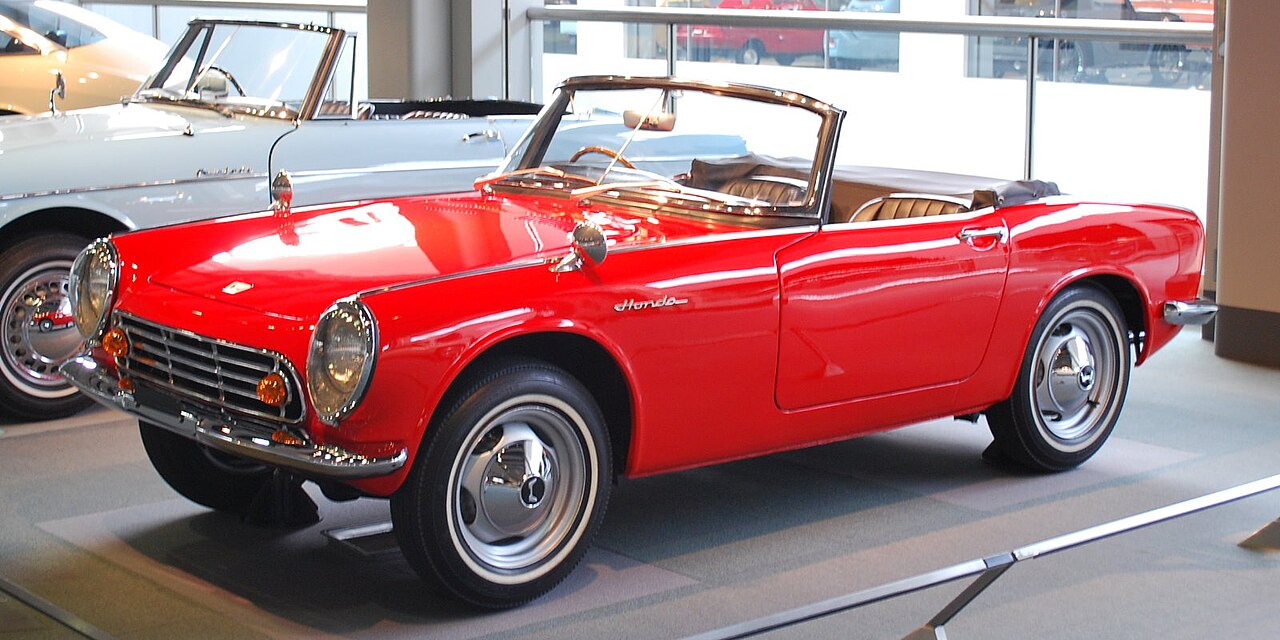
Honda’s model archive identifies a 531 cc four-cylinder engine, a four-speed manual gearbox and the characteristic rear chain-drive arrangement. That combination makes the S500 worth studying from below as well as above. The supplied photograph shows a red roadster with bright bumpers, a slim windscreen frame and an open two-seat cabin. Its restrained outer shape is an effective counterpoint to the compact machinery. An exterior image cannot establish the condition of the engine or chains, but it helps readers understand the car’s proportions: the wheels sit close to the body’s ends, while the low cabin keeps the whole silhouette visually light.
Identifying the original configuration
An S500 record should retain the model identity separately from S600 and S800 identities. Similar family proportions and replacement trim can make an isolated photograph less conclusive than it first appears. The selected source explicitly identifies this car as an S500, model AS280, and dates the photograph to August 2008. The caption describes a later view of the historic subject, rather than a photograph taken during 1963 production. For a particular car, retain its chassis markings and engine identification alongside the body photographs. A restoration can reproduce an attractive period appearance without documenting the original manufacturing identity on its own.
Collector context and preservation
The S500 provides a useful starting point for a Honda sports archive because it invites several kinds of comparison. Beside the S2000, its small body makes the different treatment of open-air driving easy to discuss. Beside an NSX, the mechanical packaging raises a different question about where the engine and driven wheels belong. Those are architectural comparisons, not claims of shared components. A collection record can give equal attention to chain housings, induction hardware, cockpit controls and the light exterior outline. Preserve the two published count references with their attribution so that future research can reconcile them without rewriting the identity of every surviving example.
Reading the evidence for this profile
The original source links below identify the programme and the historical statements used in this article. The photograph has its own creator and licence record, separate from the manufacturer’s vehicle history. Keep both when transferring this profile into a collection catalogue. A manufacturing tally describes how many cars belong to a defined original programme; it does not measure how many survive, how many are publicly visible, or how many retain all their original components. Those individual questions require dated chassis and restoration evidence. The reference year likewise describes the programme’s introduction or named historic configuration, while the supplied caption states the photographed setting and any established individual identity. This lets future research expand the car’s history without blurring the scope of the record already assembled here.
Specifications and verified rarity
| Reference year | 1963 |
|---|---|
| Model / programme | S500 |
| Body / role | Two-seat sports roadster |
| Power unit / proposal | 531 cc naturally aspirated DOHC four-cylinder; four carburettors; Honda Japanese rating 44 PS at 8,000 rpm |
| Layout / transmission | Front engine, rear drive; four-speed manual; chain-drive rear arrangement |
| Exact manufacturing tally | Not established |
| Rarity evidence | 1363 reported whole-programme reference; exact tally unresolved, no hard ceiling asserted |
| Rarity scope | Complete original S500 model programme, reported as 1,363 cars by Honda Denmark; the specialist Honda Sports Registry reports 1,353. Exact completed manufacturing tally unresolved. The 1,363 reference is an estimate, not a verified hard ceiling or surviving-car census. |
| Inventory reference | HON-001 — Verified |
Frequently asked questions
What is the Honda S500?
Honda’s original 1963 small sports roadster, documented as a complete low-volume model programme with conflicting historical count references.
What engineering defines this vehicle?
531 cc naturally aspirated DOHC four-cylinder; four carburettors; Honda Japanese rating 44 PS at 8,000 rpm. Front engine, rear drive; four-speed manual; chain-drive rear arrangement. The specifications describe the original programme or published concept proposal. An individual example’s installed equipment and any later changes need their own dated evidence.
Why does this profile use 1963?
This is the documented introduction or original configuration year. Photograph dates and market model years can differ. Keeping those dates separate makes it possible to follow the car’s development without creating a second identity for the same programme.
How should an individual S500 be authenticated?
Connect the chassis identifier to original delivery, edition or custodial records. Compare period exterior, cabin and mechanical photographs with the documented configuration. Record replacement parts, paint changes and restoration work as dated events. A badge or colour alone cannot establish that a car belongs to this original programme.
What rarity or archive scope is verified?
Complete original S500 model programme, reported as 1,363 cars by Honda Denmark; the specialist Honda Sports Registry reports 1,353. Exact completed manufacturing tally unresolved. The 1,363 reference is an estimate, not a verified hard ceiling or surviving-car census.
Who took the supplied photograph?
Mytho88 via Wikimedia Commons, under CC BY-SA 3.0. The original file and licence links accompany the image. Retain that credit when the photograph is uploaded, exported or reused.
Related Honda family profiles
Sources and photo credits
- Original manufacturer or contemporaneous programme record
- Honda model archive and engineering history
- Specialist registry: alternative historical count
Photograph: Mytho88 via Wikimedia Commons original file, CC BY-SA 3.0. Source-provided photograph supplied without local cropping, retouching or text removal. A source thumbnail is used where available. Honda S500 roadster, model AS280, photographed in August 2008. A later documentary view of the historic model; the individual chassis is not assigned here.
Built in limited numbers
Complete original S500 model programme, reported as 1,363 cars by Honda Denmark; the specialist Honda Sports Registry reports 1,353. Exact completed manufacturing tally unresolved. The 1,363 reference is an estimate, not a verified hard ceiling or surviving-car census.
Gallery
Specifications
Factory specifications may vary by model year, market and configuration.
Identity & production
- Official model
- S500