1958 Lotus Type 16 Formula One
Explore the 1958 Lotus Type 16 Formula One: programme history, design, verified rarity scope, specifications and credited photography.
The Lotus Type 16 records the final front-engined phase of Lotus single-seater design. Its compact body and sophisticated packaging give it a clear place between the earlier Type 12 and the rear-engined Type 18.
History and verified programme identity
Classic Team Lotus dates the Type 16 programme to 1958–1960 and identifies it as the last front-engined Formula single-seater Lotus. The custodial page describes a 2.5-litre Coventry-Climax Formula One design and a Lotus sequential gearbox, with eight numbered register entries visible. A register entry is retained as a custodial reference, without independently auditing the status of every chassis. The model was designed for Formula One, but the earlier Type 12 had already entered that category after starting in Formula Two. That distinction prevents the Type 16 from receiving an inaccurate claim to every possible Lotus Formula One first.
Engineering and design
The front-engine arrangement determines the relationship between the nose, driver and rear axle. In a small single-seater, the engine and transmission route can influence the height of the body and the occupant’s position even when the exterior looks compact. Classic Team Lotus describes the Type 16 as a sophisticated development of the Type 12, and its narrow body invites that comparison. The later rear-engine layout changes the same packaging question fundamentally by putting the principal power unit behind the driver. Understanding that transition is more useful than treating the Type 16 merely as an unsuccessful version of a later car.
The physical car in the supplied photograph
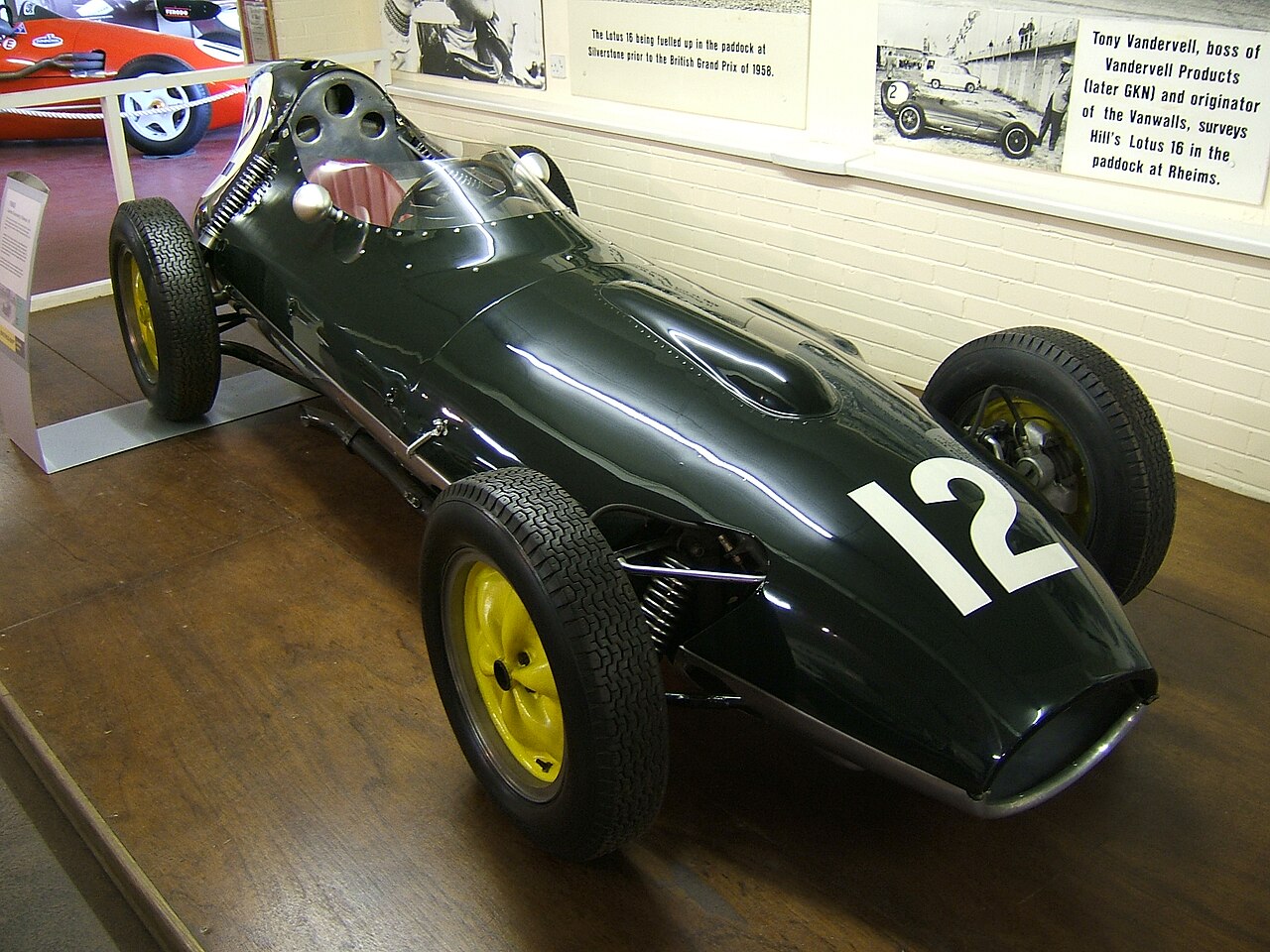
The supplied photograph shows a green Type 16 in the Donington Collection museum, with yellow wheels and a white number 12 on the nose. The creator identifies it as the Formula One model. The indoor display provides a clear view of the narrow front body and exposed wheels. Its present display livery is not used to assign a particular original Grand Prix entry or a chassis number.
A narrow body around a front powertrain
The Type 16’s museum view gives a clear sense of the distance between the nose and the driver. The wheels sit outside the body, while the central volume has to accommodate the front engine and the route toward the driven rear axle. The primary record identifies that arrangement as the final front-engined Formula single-seater phase for Lotus. Comparing it with the Type 18 is therefore about a changed packaging problem, not merely a different body style. The Type 16’s sophistication can be understood within its own constraints before the later layout is considered. This avoids making a historical development sound inevitable or reducing the earlier car to a mistake. An archive is more informative when it explains what the design was attempting and then records how a different arrangement changed the options available.
Collecting and chassis evidence
The register lists the original design’s chassis references, including more than one notation associated with the early numbers. Those details should be preserved when researching a specific car rather than reduced to a simplified survivor total. Competition cars can be rebuilt, fitted with different engines or displayed in an earlier appearance. The programme profile supplies the design boundary and period context; an individual vehicle file would establish the chronology of those changes. The photographed museum car is therefore used as a Type 16 illustration without transferring every register entry or race result to the pictured example.
Related Lotus designs and meaningful comparisons
The Type 12 is the useful earlier reference for the narrow front-engined single-seater, while the Type 18 makes the subsequent packaging change visible. Looking at the driver position and the length of the front body across the three explains the design sequence. It also prevents a visitor from identifying a Lotus only by its green paint and yellow wheels. The Type number, engine location and source record together supply a much stronger basis for a profile than a shared colour scheme or a museum display number.
Reading the sources
The programme sources and the photograph answer different questions. Manufacturer and custodial records establish the original model, Type, category and published production scope. The creator’s file establishes the pictured subject, setting and image permission. An individual chassis history can then add ownership, competition entries and dated repairs without changing the scope of the original programme. Build references are not survivor counts, and a later specification does not automatically become an additional newly manufactured vehicle. Where primary evidence does not establish a complete fabrication census, that field remains unassigned.
Specifications and rarity evidence
| Programme reference year | 1958 |
|---|---|
| Model / Type | Type 16 Formula One — Type 16 |
| Body / competition role | Front-engined Formula One competition car |
| Custodial programme period | 1958–1960 |
| Engine location | Front |
| Formula One engine reference | 2.5-litre Coventry-Climax |
| Gearbox reference | Lotus sequential gearbox |
| Photo setting | Donington Collection museum |
| Published build / register reference | 8 listed register entries |
| Independently audited completed tally | Not assigned |
| Count scope | Published complete named programme reference: 8 listed register entries. This is a source-reported reference, not an independently audited completed tally or a surviving-car census. |
| Original inventory status | LOT-012 — Verified |
Frequently asked questions
Was the Type 16 the first Lotus ever entered in Formula One?
No. The Type 12 was developed for Formula Two and entered Formula One earlier. The Type 16 is identified as the first Lotus designed specifically for Formula One and the last front-engined Formula single-seater programme.
How is Type 16 Formula One classified?
This is a Team Lotus competition Type archive. It remains separate from Lotus road-car production. Customer cars, works entries and converted chassis need a reconciled scope before any complete fabrication tally is assigned.
Which technical details are established for the programme?
The primary record supports custodial programme period: 1958–1960; engine location: Front; formula one engine reference: 2.5-litre Coventry-Climax. These are programme or explicitly attributed photo references. A particular surviving car’s engine, chassis repairs and competition preparation require its own dated documentation.
Does the photographed appearance establish factory originality?
The caption records a real creator-identified Type 16 Formula One subject and its later setting. It establishes the illustration’s scope, while original components, restoration work and individual race provenance require chassis-specific evidence. A competition number, current paint or museum display is not used as an originality certificate.
What rarity or archive scope is verified?
Published complete named programme reference: 8 listed register entries. This is a source-reported reference, not an independently audited completed tally or a surviving-car census.
Who photographed the supplied image?
Pyrope via Wikimedia Commons, under CC BY-SA 3.0. The original file and licence are linked with the image. Retain the creator, source and licence when uploading, exporting or reusing it; local retouching and synthetic enlargement have not been performed.
Related Lotus profiles
Sources and photo credits
- Primary manufacturer or custodial programme record
- Classic Team Lotus: early-years programme context
Photograph: Pyrope via Wikimedia Commons original source, CC BY-SA 3.0. Source-provided thumbnail supplied without local cropping, retouching or synthetic enlargement.
Built in limited numbers
Published complete named programme reference: 8 listed register entries. This is a source-reported reference, not an independently audited completed tally or a surviving-car census.
Gallery
Specifications
Factory specifications may vary by model year, market and configuration.
Identity & production
- Official model
- Type 16 Formula One