1958 Lotus Type 15 Sports Racer
Explore the 1958 Lotus Type 15 Sports Racer: programme history, design, verified rarity scope, specifications and credited photography.
The 1958 Lotus Type 15 develops the streamlined sports-racing family beyond the Eleven. Its programme is defined by the Type number and its adaptable competition powertrain, rather than by a single universal engine specification.
History and verified programme identity
Classic Team Lotus identifies the Type 15 as a sports-racing car based on the Eleven. Its programme record lists twin-cam Coventry-Climax FPF, Ford and Buick applications. Lotus’s manufacturer timeline places the Type 15 in the 1958 development sequence. That evidence establishes the original physical model family, but the accessible custodial page does not provide a complete fabrication tally. The profile therefore leaves the manufacturing total unassigned rather than filling it from an unverified secondary figure. The competition archive classification also keeps this model separate from road-car production totals.
Engineering and design
The Type 15’s body continues the idea of covering the running gear within a low sports-car form, while its engine variety makes packaging a central subject. A larger or differently shaped engine can alter cooling, exhaust routing and the relationship between the powertrain and cockpit even when the outer model remains recognizable. The useful question is how a particular chassis was equipped at a particular time. A model-level profile can explain the programme’s range without pretending that one photographed car represents every installation. It also allows the Type 15 to be compared with the Eleven through visible body relationships while keeping the mechanical record distinct.
The physical car in the supplied photograph
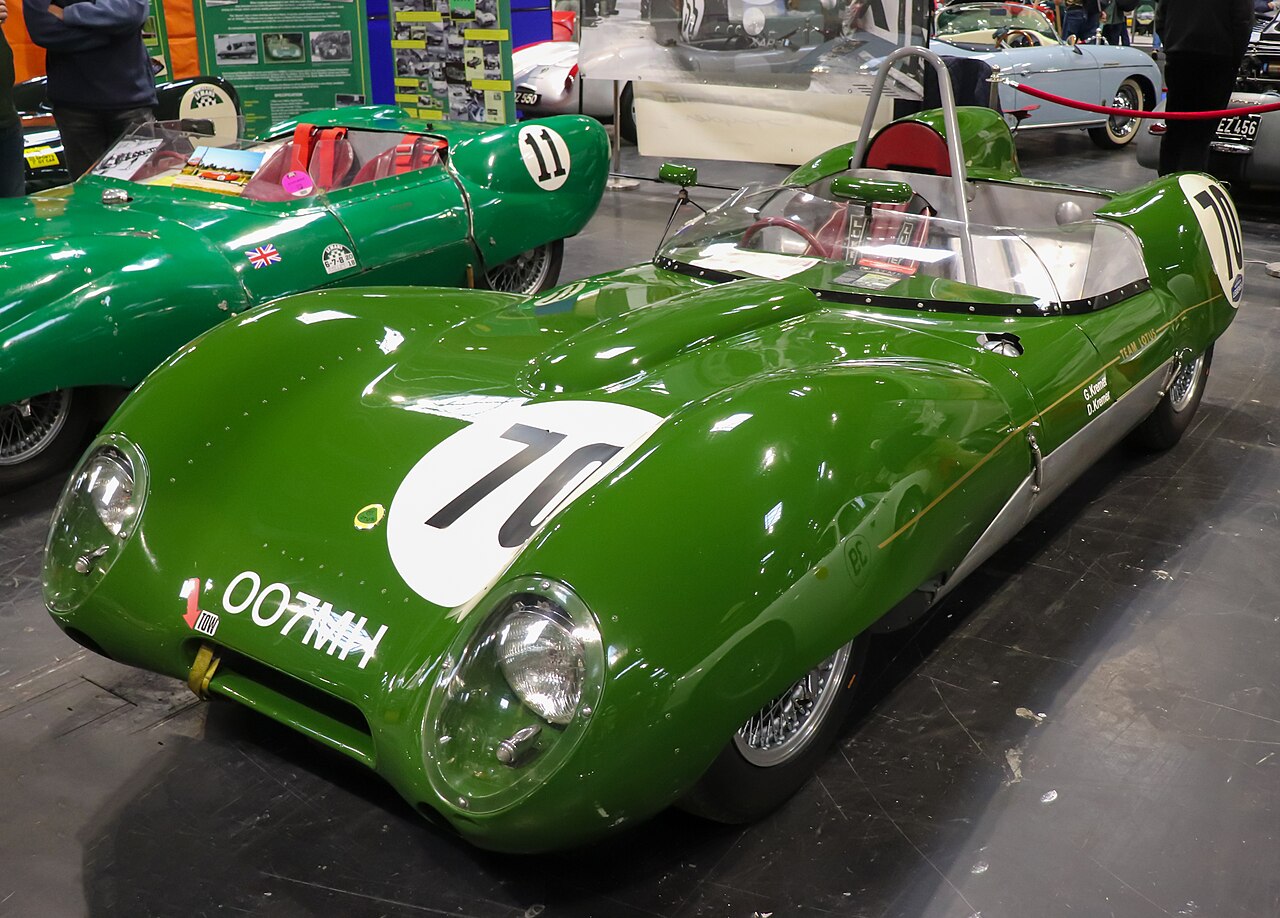
The supplied photograph shows a green 1958 Type 15 at the NEC Classic Motor Show in 2019. Its wide front opening, small screen and open cockpit are visible, with number 110 on the body. The creator identifies the model and photographed example’s year. The modern indoor setting is retained in the caption; the image is not described as an original-period works photograph.
Engine diversity needs a chassis-level record
The Type 15’s custodial description names several engine families, which is a useful warning against borrowing the specification of the best-known auction example. A model can remain a Type 15 while its individual mechanical history becomes more complicated. The supplied show photograph documents one green body and its visible cockpit arrangement; it does not reveal enough to assign every hidden component. That distinction makes the profile more durable. Later research can add a specific chassis’s engine history without requiring the general model page to change its description of all cars. The relationship to the Eleven also remains useful when treated as a design connection. It supplies context for the body and competition role, while the individual build record determines which engine, transmission and subsequent alterations belong to a particular surviving example.
Collecting and chassis evidence
A Type 15 collection file should separate the original Type identity from later powertrain changes. The source explicitly allows multiple engine families, so a present engine should not be labelled factory-original merely because its manufacturer appears in the programme description. Chassis records, period entries and workshop history would establish the individual sequence. Body repairs and restored competition numbers deserve the same treatment. The profile records a physical model and a credited photograph, while leaving the complete fabrication census open. That gives future research a clear place to add evidence without rewriting an invented production number.
Related Lotus designs and meaningful comparisons
The Eleven offers the direct earlier comparison named by the custodial source. The Type 17 provides a later small-capacity sports-racing contrast, with a different suspension development story. Comparing their noses, cockpit positions and body proportions can help identify what changed across the family. It should not be used as a shortcut to identify an unknown chassis from one distant event photograph. The Type number and the individual documentation remain the catalogue boundary even where related Lotus sports racers share an overall streamlined appearance.
Reading the sources
The programme sources and the photograph answer different questions. Manufacturer and custodial records establish the original model, Type, category and published production scope. The creator’s file establishes the pictured subject, setting and image permission. An individual chassis history can then add ownership, competition entries and dated repairs without changing the scope of the original programme. Build references are not survivor counts, and a later specification does not automatically become an additional newly manufactured vehicle. Where primary evidence does not establish a complete fabrication census, that field remains unassigned.
Specifications and rarity evidence
| Programme reference year | 1958 |
|---|---|
| Model / Type | Type 15 Sports Racer — Type 15 |
| Body / competition role | Front-engined sports-racing development |
| Programme relationship | Development based on the Eleven |
| Engine families in custodial record | Coventry-Climax FPF, Ford and Buick |
| Layout | Front-engined sports racer |
| Photographed setting | NEC Classic Motor Show, 2019 |
| Published build / register reference | No complete tally assigned |
| Independently audited completed tally | Not assigned |
| Count scope | Documented physical Team Lotus competition Type archive. Complete fabrication census unassigned; works, customer and later converted cars are not added into an invented total. |
| Original inventory status | LOT-014 — Verified |
Frequently asked questions
Is a complete Type 15 build count assigned?
No. The primary custodial page establishes the model and its engine applications but does not give a complete fabrication tally. The field remains unassigned.
How is Type 15 Sports Racer classified?
This is a Team Lotus competition Type archive. It remains separate from Lotus road-car production. Customer cars, works entries and converted chassis need a reconciled scope before any complete fabrication tally is assigned.
Which technical details are established for the programme?
The primary record supports programme relationship: Development based on the Eleven; engine families in custodial record: Coventry-Climax FPF, Ford and Buick; layout: Front-engined sports racer. These are programme or explicitly attributed photo references. A particular surviving car’s engine, chassis repairs and competition preparation require its own dated documentation.
Does the photographed appearance establish factory originality?
The caption records a real creator-identified Type 15 Sports Racer subject and its later setting. It establishes the illustration’s scope, while original components, restoration work and individual race provenance require chassis-specific evidence. A competition number, current paint or museum display is not used as an originality certificate.
What rarity or archive scope is verified?
Documented physical Team Lotus competition Type archive. Complete fabrication census unassigned; works, customer and later converted cars are not added into an invented total.
Who photographed the supplied image?
Vauxford via Wikimedia Commons, under CC BY-SA 4.0. The original file and licence are linked with the image. Retain the creator, source and licence when uploading, exporting or reusing it; local retouching and synthetic enlargement have not been performed.
Related Lotus profiles
Sources and photo credits
Photograph: Vauxford via Wikimedia Commons original source, CC BY-SA 4.0. Source-provided thumbnail supplied without local cropping, retouching or synthetic enlargement.
Built in limited numbers
Documented physical Team Lotus competition Type archive. Complete fabrication census unassigned; works, customer and later converted cars are not added into an invented total.
Gallery
Specifications
Factory specifications may vary by model year, market and configuration.
Identity & production
- Official model
- Type 15 Sports Racer