1955 GMC Suburban Carrier
Discover the GMC Suburban Carrier: styled pickup history, GM Heritage’s 1955–1957 production estimate, reference specifications and credited photography.
The GMC Suburban Carrier brought a more polished visual character to the pickup in 1955.
History and purpose
The GMC Suburban Carrier brought a more polished visual character to the pickup in 1955. GM Heritage identifies its relationship to Chevrolet’s Cameo and describes close to a thousand Suburban pickups across 1955–1957. That is a manufacturer’s historical estimate for the named programme, rather than a production number for every GMC truck carrying a Suburban badge. The original inventory’s description as an early SUV is corrected here: this subject has an open pickup bed. Its appeal begins with that combination of a working body layout and a finish intended to be noticed. The complete estimate supplies the rarity context without pretending that an approximate account is a chassis-by-chassis census.
Design and engineering
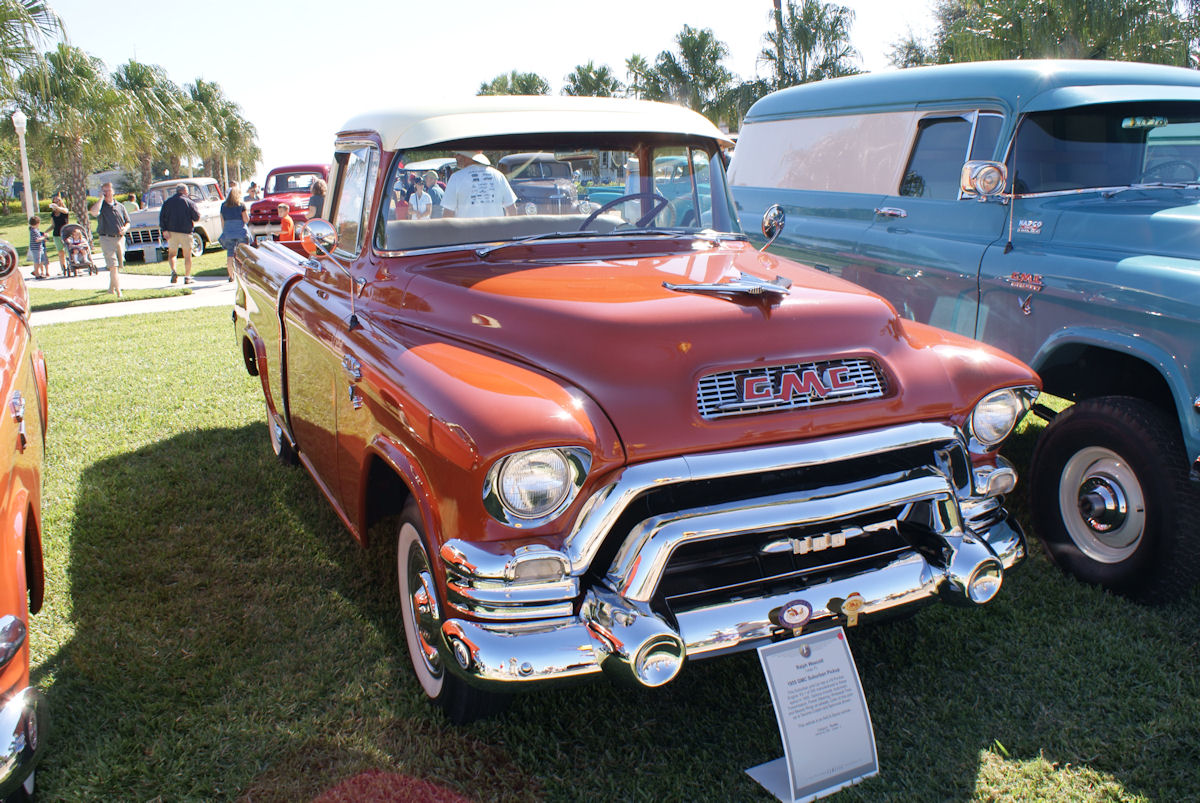
The supplied photograph makes the GMC grille and rounded bonnet the dominant parts of the composition. Bright trim catches the light across the front, while the cab roof provides a strong contrast to the body colour. From this angle, the truck’s visual personality comes from the relationship between the tall, rounded nose and the relatively compact cabin behind it. GM Heritage explains the styled bed construction as fibreglass outer fenders attached to a steel cargo box. That distinction matters when discussing restoration: the smooth exterior is a styling treatment around a usable bed, not evidence that the whole truck is built from fibreglass.
Identifying the original configuration
The name Suburban Carrier needs care because GMC’s wider history also includes enclosed vehicles with the Suburban name. This profile covers the styled pickup programme described by the manufacturer’s collection record. The licensed photograph is identified as a 1955 GMC Suburban pickup at the Lake Mirror Classic in 2010. Its visible GMC front end and open-bed configuration support that match. A show photograph does not establish the engine inside this particular truck, its original paint, or the history of every chrome component. The specification table therefore labels the museum vehicle’s V8 and automatic transmission as reference information rather than assigning them to the photographed example.
Collector context and preservation
For collectors, the Suburban Carrier offers an approachable way to examine how utility vehicles acquire a second life as display objects. The exterior can be enjoyed for its shape while the vehicle file preserves the separate questions of factory specification, restoration and later customization. A useful viewing sequence starts with the front emblem and grille, continues along the cab and bed junction, and finishes with the rear body and cargo floor. Each view answers a different question. Keep the chassis documents with those photographs before making an originality claim. In a GMC collection, this pickup also provides a useful historical comparison with Denali XT: both use an open cargo area, but their proportions express very different ideas of a stylish truck.
Reading the evidence for this profile
The original source links below identify the programme and the historical statements used in this article. The photograph has its own creator and licence record, separate from the manufacturer’s vehicle history. Keep both when transferring this profile into a collection catalogue. A manufacturing tally describes how many cars belong to a defined original programme; it does not measure how many survive, how many are publicly visible, or how many retain all their original components. Those individual questions require dated chassis and restoration evidence. The reference year likewise describes the programme’s introduction or named historic configuration, while the supplied caption states the photographed setting and any established individual identity. This lets future research expand the car’s history without blurring the scope of the record already assembled here.
Specifications and verified rarity
| Reference year | 1955 |
|---|---|
| Model / programme | Suburban Carrier |
| Body / role | Styled light-duty pickup |
| Documented engine | GM Heritage reference vehicle: 287.2-cubic-inch V8, rated 180 hp |
| Architecture / transmission | Heritage reference vehicle: four-speed Hydra-Matic; photographed example’s installed drivetrain unconfirmed |
| Exact manufacturing tally | Not established |
| Historical programme estimate | Close to 1,000 across 1955–1957, according to GM Heritage |
| Rarity scope | GM Heritage describes close to 1,000 Suburban pickups across the complete 1955–1957 programme. Historical approximate total, not an exact count or a 1,000-unit hard ceiling. Photograph identifies a 1955 example; individual mechanical originality unconfirmed. |
| Inventory reference | GMC-014 — Verified |
Frequently asked questions
What is the GMC Suburban Carrier?
A factory styled GMC pickup introduced in 1955. The manufacturer’s heritage account estimates close to 1,000 across 1955–1957; no exact manufacturing tally is asserted.
What engineering defines this GMC?
GM Heritage reference vehicle: 287.2-cubic-inch V8, rated 180 hp. Heritage reference vehicle: four-speed Hydra-Matic; photographed example’s installed drivetrain unconfirmed. These are the documented programme or preserved-concept specifications. Connect an individual vehicle’s installed components to its own dated records before assigning a factory configuration to that particular example.
Why is 1955 the reference year?
It identifies the introduction or original historical configuration described in this article. The photograph can show a later example or a later display of the original subject. The source inventory’s original heading remains an identity alias wherever the date or model name has been corrected.
How should an individual Suburban Carrier be documented?
Start with the chassis identity and connect it to dated construction, registration or custodial records. Keep exterior, interior, engine and underbody photographs together. Record changes to finish, equipment and mechanical specification as separate events, so the physical car’s history can grow without changing the definition of the original programme.
What rarity or archive scope is verified?
GM Heritage describes close to 1,000 Suburban pickups across the complete 1955–1957 programme. Historical approximate total, not an exact count or a 1,000-unit hard ceiling. Photograph identifies a 1955 example; individual mechanical originality unconfirmed.
Who took the supplied photograph?
Valder137 via Wikimedia Commons, under CC BY 2.0. The original file and licence links accompany the image. Retain that credit when the photograph is uploaded, exported or reused.
Related GMC profiles
Sources and photo credits
Photograph: Valder137 via Wikimedia Commons original file, CC BY 2.0. Source-provided photograph supplied without local cropping, retouching or text removal. A source thumbnail is used where available. 1955 GMC Suburban Carrier pickup at the Lake Mirror Classic on 16 October 2010. Photograph documents the displayed example; factory originality and its installed drivetrain are not certified.
Built in limited numbers
GM Heritage describes close to 1,000 Suburban pickups across the complete 1955–1957 programme. Historical approximate total, not an exact count or a 1,000-unit hard ceiling. Photograph identifies a 1955 example; individual mechanical originality unconfirmed.
Gallery
Specifications
Factory specifications may vary by model year, market and configuration.
Identity & production
- Official model
- Suburban Carrier