1950 Rolls-Royce Phantom IV
Explore the Rolls-Royce Phantom IV: history, verified identity, specification references, rarity evidence and real credited photos.
The Rolls-Royce Phantom IV is a remarkably small royal and state-car family: the manufacturer records 18 examples. Its straight-eight engine and individually commissioned coachwork mark a deliberate exception to the post-war drive towards simpler, shared-component motor cars.
A royal request revived the Phantom name
Post-war Rolls-Royce planning favoured a rationalised range, making an elaborate flagship a less obvious commercial proposition. The manufacturer’s Phantom history describes the Royal Household’s request for a formal limousine and the development work that preceded it. The first royal car helped turn what might have remained a special commission into a tiny series. This context explains the Phantom IV better than presenting it as merely the next ordinary showroom model in an uninterrupted sequence.
Rolls-Royce: Phantom, 100 years of perfection
The unusual straight-eight identity
Phantom IV used a straight-eight, distinguishing it from both the earlier Phantom III V12 and the later V8-engined formal cars. For interpretation, that engine architecture reflects a particular development path rather than a simple increase in cylinder count through successive generations. A responsible specification identifies the family without assuming that every car had identical tuning, installation and body weight. Individual state commissions need their own mechanical and service records.
Coachwork gave each car a separate character
The 18-car family contains differing coachbuilt bodies and commissions. Limousine, landaulette and other formal arrangements are not interchangeable descriptions. Roof construction, division layout and ceremonial fittings can materially alter the appearance and use of a vehicle even when the underlying family is the same. The photographed 4AF12 is therefore an identified family example, not a substitute photograph for the first Royal Mews limousine or another patron’s Hooper-bodied commission.
Rolls-Royce: Phantom, 100 years of perfection
Rarity without an invented survival census
Eighteen is the manufacturer’s historical production reference. It is not a statement that all 18 survive in their original state or remain available to collectors. The number also must not be multiplied by adding individual coachbuilt cars back to the family as extra production. A chassis-specific profile can sit within a family history, provided the relationship is explicit and a database does not treat the same physical car as two newly manufactured examples.
Rolls-Royce: coachbuilding heritage
An individual file requires individual evidence
For a Phantom IV, record the chassis number, coachbuilder, body number, original commissioning household and later custody. Distinguish ceremonial equipment from later museum presentation, and separate a royal association supported by records from a broadly regal appearance. This batch does not invent identities for the workbook’s two loosely described body-style rows. They remain held until their exact chassis and matching photographic evidence can be established without duplicating an existing vehicle.
Specifications and identity reference
| Introduction | 1950 |
|---|---|
| Engine architecture | Straight-eight |
| Construction | Individual coachwork on separate chassis |
| Manufacturer reference | 18 examples in the family |
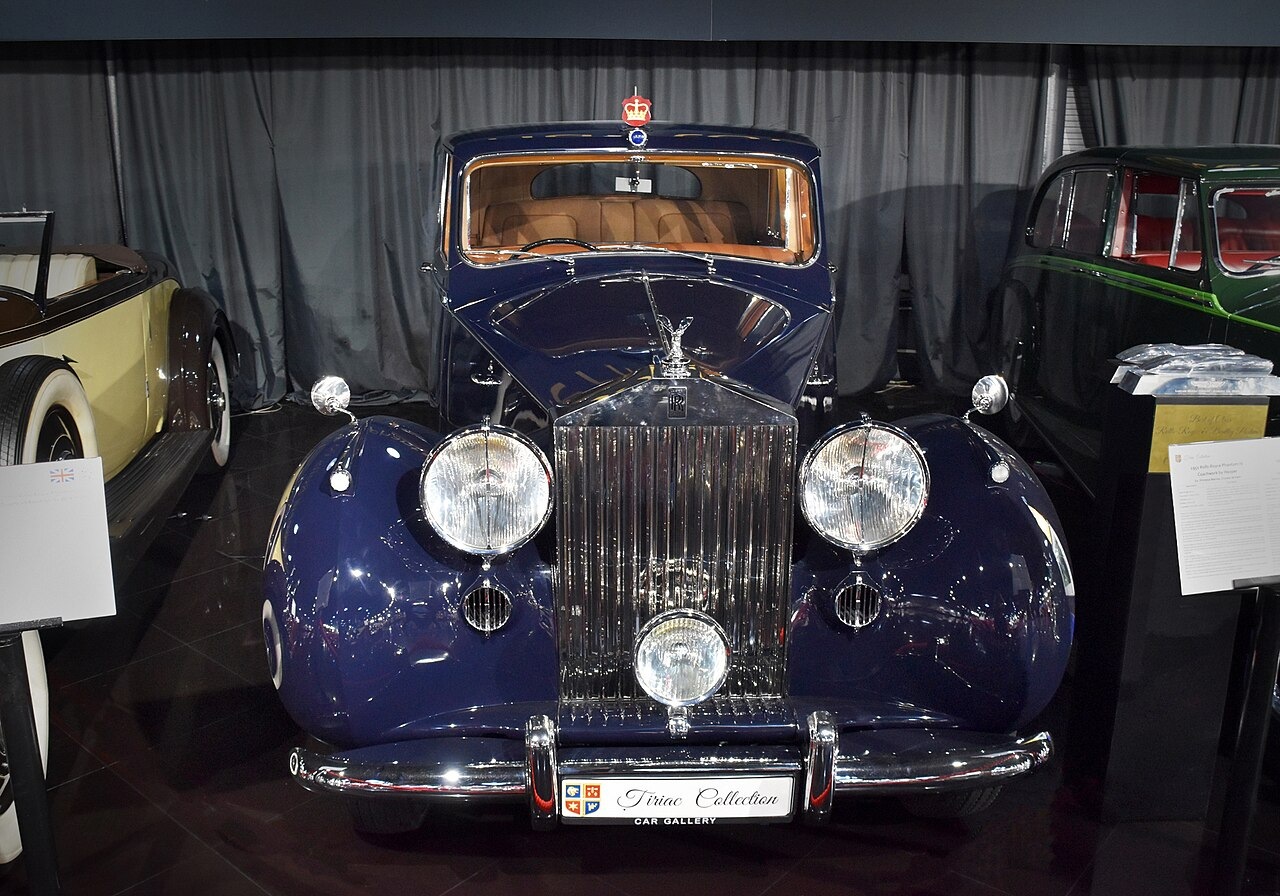
| Photographed chassis | 4AF12; Tiriac Collection |
Rarity and production scope
Rolls-Royce reports 18 Phantom IV examples. This is the whole family’s historical reference, not a count for Mulliner limousines, Hooper sedancas, surviving cars or public availability. Unidentified chassis-specific rows RR-034 and RR-035 are held for exact identity evidence rather than turned into additional one-offs. The pictured 4AF12 is identified separately and is not represented as the first royal car.
What the photograph represents
Phantom IV chassis 4AF12 at the Tiriac Collection. A surviving member of the 18-car family, rather than the first Royal Mews Phantom IV or every coachwork variation.
Related Rolls-Royce heritage profiles
Frequently asked questions
How many Phantom IVs were built?
The manufacturer’s retrospective records 18 examples, a family figure rather than a count for one body style.
Is the pictured car the first Royal Mews limousine?
No. The photograph is explicitly of chassis 4AF12 at the Tiriac Collection.
What is the production-count boundary for this profile?
Rolls-Royce reports 18 Phantom IV examples. This is the whole family’s historical reference, not a count for Mulliner limousines, Hooper sedancas, surviving cars or public availability. Unidentified chassis-specific rows RR-034 and RR-035 are held for exact identity evidence rather than turned into additional one-offs. The pictured 4AF12 is identified separately and is not represented as the first royal car.
Sources and further reading
Research checked 18 October 2026. Linked factory announcements, museum records and attributed specialist research support the specifically identified claims. Photographic descriptions identify the illustrated subject. Design analysis and suggested authentication steps are editorial interpretation.
Built in limited numbers
Rolls-Royce reports 18 Phantom IV examples. This is the whole family’s historical reference, not a count for Mulliner limousines, Hooper sedancas, surviving cars or public availability. Unidentified chassis-specific rows RR-034 and RR-035 are held for exact identity evidence rather than turned into additional one-offs. The pictured 4AF12 is identified separately and is not represented as the first royal car.
Gallery
Specifications
Factory specifications may vary by model year, market and configuration.
Identity & production
- Official model
- Rolls-Royce Phantom IV
Sources and verification
Source citations are being prepared for this profile.