1939 Citroën Traction Avant 15-Six Cabriolet Prototype
Explore the 1939 Citroën Traction Avant 15-Six Cabriolet Prototype: sourced history, design, specifications and rarity evidence, with credited documentary photos.
The Citroën Traction Avant 15-Six Cabriolet Prototype turns a familiar pre-war outline into a much rarer open-car proposition. Its significance comes from the authentic prototype project, whose history must be kept separate from later conversions of ordinary closed cars.
A prototype family with surviving evidence
Citroën’s Rétromobile 2026 account dates the first 15-Six cabriolet prototypes to 1939 and reports three authentic surviving examples worldwide. That manufacturer statement corrects the inventory’s suggestion of a single surviving prototype. Three survivors does not establish that only three were originally manufactured; this profile keeps the original production total unset.
The distinction matters because “prototype” describes an object’s role in development. A beautifully executed open conversion may resemble the idea while belonging to a different historical category. Authenticity here depends on a documented connection to the pre-war project. Neither attractive coachwork nor a period-looking finish can establish that connection on its own.
An open body changes the visual argument
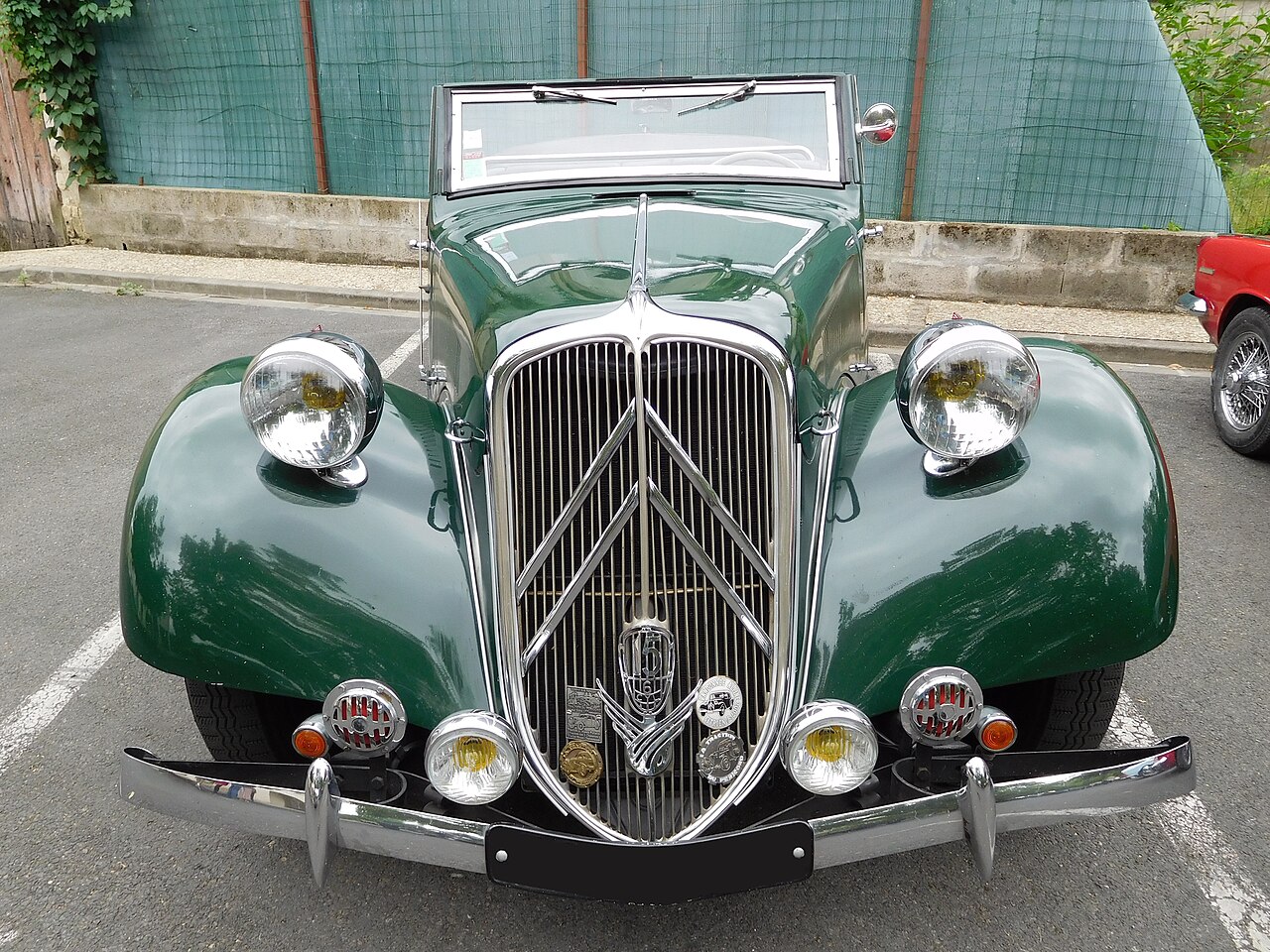
The supplied green-car photograph places the vertical grille and round lamps at the centre of the composition. Large curved wings spread toward the viewer, while the raised windscreen introduces a slim horizontal edge above them. The open passenger area removes the closed roof’s visual weight. Chrome trim provides sharp accents against the green bodywork rather than competing with it.
In design terms, the open form gives the Traction shape a different rhythm. The car’s front remains formal and substantial, but the cabin appears lighter and more exposed. This is an interpretation of the photograph, not a claim about measured structural stiffness. An exterior image can explain the styling effect while leaving the unseen engineering to appropriate documents.
Why the pictured example needs its own identity
The photo source names the green vehicle as a 15-6 cabriolet. Citroën’s 2026 release discusses a red example appearing at Rétromobile and recalls its earlier exhibition history. These are different visual records. The red car’s exhibition biography is not transferred to the green car shown here, and this page does not assign an unsupported serial number.
A serious prototype file should connect identifying marks, body details and old photographs over time. Period images showing the car before restoration are especially useful because finishes and upholstery can change. The continuity of the object is the central question; appearance at a prestigious event becomes meaningful after that identity has been established.
A bridge between familiar engineering and experimental bodywork
For a reader exploring Citroën heritage, this prototype is an effective companion to the early 7A. One profile examines the start of the production family, while the other asks what a different body could make of the same broad visual language. The comparison does not require pretending the two cars share identical mechanical specifications.
The cabriolet also invites a broader discussion of preservation. A development vehicle can carry marks of experiment, rework and later conservation. Those layers deserve description rather than concealment. A clear chronology lets the reader distinguish a factory development decision from a later custodian’s choice, giving the surviving car a richer and more credible story.
Specifications and verified rarity
| Reference year | 1939 |
|---|---|
| Model / project | Traction Avant 15-Six Cabriolet Prototype |
| Body / role | Cabriolet |
| Project year | 1939 |
| Body | Open prototype in the 15-Six family |
| Documented survivors | Three authentic prototypes reported by Citroën in 2026 |
| Rarity scope | Authentic pre-war 15-Six cabriolet prototype project. Citroën reported three authentic surviving prototypes in January 2026; surviving count is not a manufacturing tally. |
| Exact manufacturing tally | Not established |
| Inventory reference | CIT-018 — Verified |
Frequently asked questions
Does only one authentic prototype survive?
No. Citroën reported three authentic surviving prototypes in its 2026 account.
Is a later roof conversion automatically a prototype?
No. A conversion needs its own documented description and cannot inherit the factory project’s identity.
Is the green car the red Rétromobile example?
This profile makes no such claim; their photo and exhibition records are kept separate.
What makes the open body distinctive?
The absent fixed roof changes the visual balance above the substantial pre-war front end.
What rarity or archive scope is verified?
Authentic pre-war 15-Six cabriolet prototype project. Citroën reported three authentic surviving prototypes in January 2026; surviving count is not a manufacturing tally.
Who took the supplied photograph?
Cjp24 via Wikimedia Commons, under CC BY-SA 4.0. Keep the photographer, original-file link and licence credit with the image.
Related Citroën profiles
Sources and photo credits
Photograph: Cjp24 via Wikimedia Commons original file, CC BY-SA 4.0. Source photograph supplied without local cropping, retouching or text removal. A source-provided thumbnail is used where available. Green Traction Avant 15-6 cabriolet, identified by its source file. This is not asserted to be the red example in Citroën’s 2026 Rétromobile account.
Built in limited numbers
Authentic pre-war 15-Six cabriolet prototype project. Citroën reported three authentic surviving prototypes in January 2026; surviving count is not a manufacturing tally.
Gallery
Specifications
Factory specifications may vary by model year, market and configuration.
Identity & production
- Official model
- Traction Avant 15-Six Cabriolet Prototype