1934 Citroën Traction Avant 7A
Explore the 1934 Citroën Traction Avant 7A: sourced history, design, specifications and rarity evidence, with credited documentary photos.
The 1934 Citroën Traction Avant 7A is the opening chapter of a famous engineering story. Its collector identity lies in a brief early specification, before later Tractions turned the basic idea into a much longer production history.
The first specification deserves its own history
The 7A should be read as a particular early version. J. Cats’s period-document research places its introduction in spring 1934 and its replacement by the 7B in June. The small 1,303 cc engine and three-speed transmission belong to that initial configuration. Citroën’s anniversary account establishes why the Traction family matters: front-wheel drive, integrated body construction and a comparatively low silhouette formed a decisive departure from the familiar separate-chassis car.
The short interval creates a useful collecting question: which features survive from the opening specification? A car may retain the overall silhouette while incorporating later service parts. Its identity therefore depends on the relationship between documents and components. An early registration date alone is less informative than a record connecting the body, engine and original number to the version being described.
How rare is a 7A?
Two sources approach the numerical question differently. Aguttes’s original catalogue research cites a 7,000-number allocation, while Cats interprets an October 1934 parts manual as supporting 6,000. Neither figure is treated here as an audited total of completed cars. Both reported historical allocations fall below the 7,500 threshold; the manufacturing-total field remains blank to preserve that distinction.
This is a narrower claim than calling every Traction Avant a rare car. The 7A’s interest comes from the conjunction of early chronology and specific equipment. A later Traction can illustrate the broader engineering family beautifully, but it cannot supply the missing documentary history of an opening-series example. For a collector, the boundary between those descriptions is part of the appeal.
Reading the supplied museum photograph
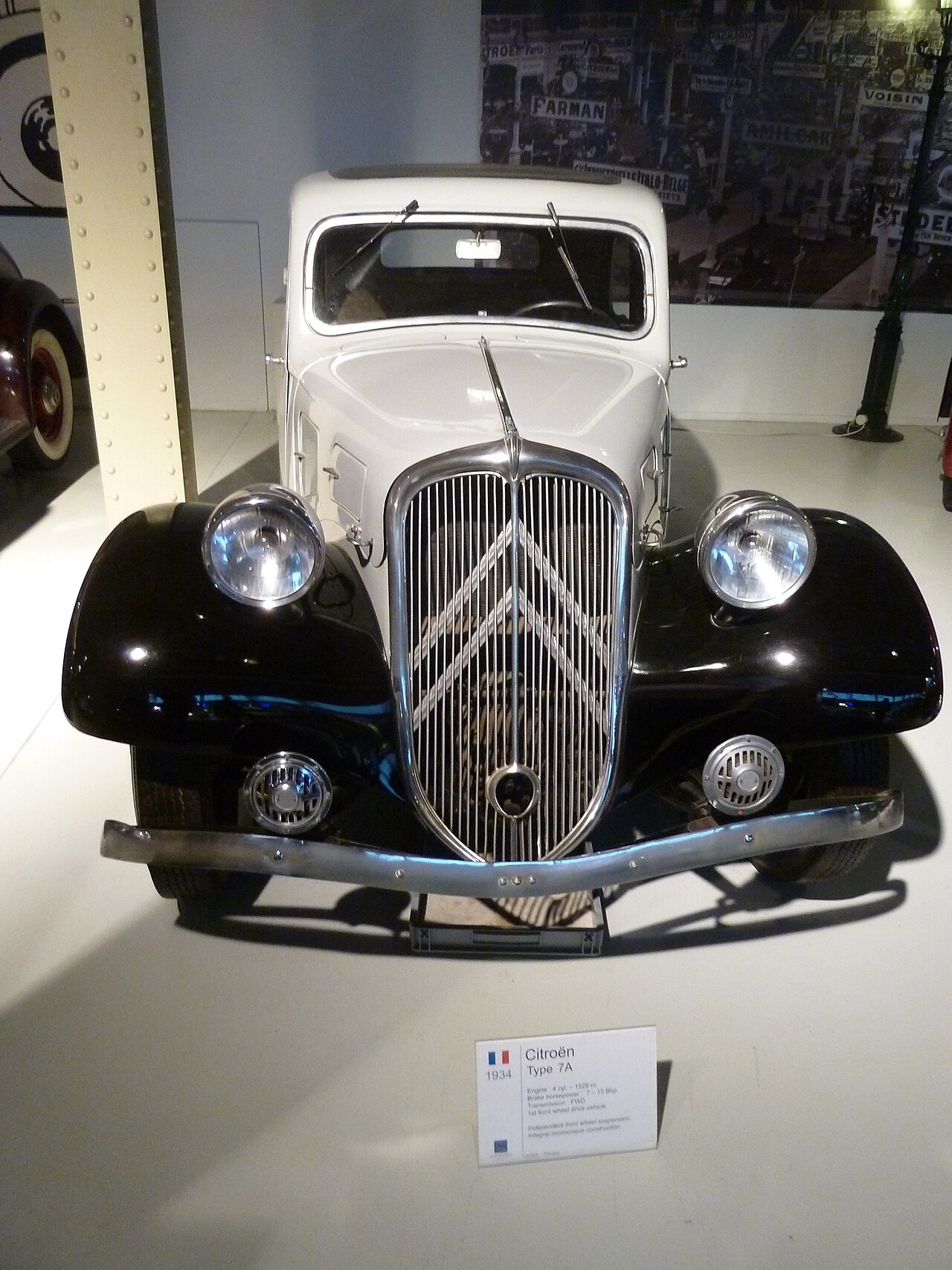
The head-on photograph presents the car through its tall radiator opening, freestanding round lamps and widely separated front wings. The pale body and dark wings make the construction easy to read. A small museum label appears below the nose, but the image is not used to certify a chassis number. The file is identified by its photographer as a Type 7A.
Its upright front detailing and low central body create an interesting visual tension. The car still uses familiar pre-war cues to announce itself, while the body between the wheels looks more integrated than those isolated lamps suggest. Seen this way, the 7A communicates a transition: technical change did not require every visible element to become unfamiliar at once.
What a useful early-Traction record contains
The most persuasive file begins with dated factory or registration evidence and adds clear photographs of original numbers and the features used to distinguish the version. Restoration invoices can then explain substitutions instead of leaving them to speculation. Preserve the dates of those interventions; a well-documented replacement is more useful history than an unexplained component presented as original.
A 7A profile should also keep the particular photographed car separate from an auction example used for research. The Aguttes listing supports the historical discussion, but the supplied museum image does not depict an asserted auction chassis. That separation allows readers to explore the type without accidentally inheriting someone else’s ownership story.
Specifications and verified rarity
| Reference year | 1934 |
|---|---|
| Model / project | Traction Avant 7A |
| Body / role | Saloon |
| Engine | 1,303 cc four-cylinder |
| Transmission | Three-speed manual |
| Historical allocation ceiling | 7,000 cited by Aguttes; 6,000 interpretation of period parts evidence by J. Cats |
| Rarity scope | Short-lived 1934 7A specification. Historic references cite 6,000 or 7,000 serial allocations; allocation is not a completed-car census. Exact completed total unset. |
| Exact manufacturing tally | Not established |
| Inventory reference | CIT-014 — Verified |
Frequently asked questions
Is every 1934 Traction Avant a 7A?
No. Version identity requires early-specification evidence; the 7B and other Traction versions need their own descriptions.
Were exactly 7,000 7As built?
Not established here. The historical references discuss serial allocations, with differing 6,000 and 7,000 interpretations.
What makes this an early-series collector subject?
The brief initial specification gives the car a distinct place at the beginning of the Traction story.
Does the photograph identify the auction chassis?
No. It is a separately sourced museum photograph identified as a Type 7A.
What rarity or archive scope is verified?
Short-lived 1934 7A specification. Historic references cite 6,000 or 7,000 serial allocations; allocation is not a completed-car census. Exact completed total unset.
Who took the supplied photograph?
Abxbay via Wikimedia Commons, under CC BY-SA 4.0. Keep the photographer, original-file link and licence credit with the image.
Related Citroën profiles
Sources and photo credits
- J. Cats: 7A history and period parts-catalogue evidence
- Aguttes: original catalogue research for a 1934 7A
- Citroën: ninety years of the Traction Avant
Photograph: Abxbay via Wikimedia Commons original file, CC BY-SA 4.0. Source photograph supplied without local cropping, retouching or text removal. A source-provided thumbnail is used where available. Front view of a museum-displayed Type 7A. Documentary type identification; no Aguttes auction-chassis identity asserted.
Built in limited numbers
Short-lived 1934 7A specification. Historic references cite 6,000 or 7,000 serial allocations; allocation is not a completed-car census. Exact completed total unset.
Gallery
Specifications
Factory specifications may vary by model year, market and configuration.
Identity & production
- Official model
- Traction Avant 7A