Naturally aspirated V12s: five rare cars built around the engine
A V12 occupies a great deal of space in a car’s identity. It also occupies real space in the body. Where it sits, how it breathes and how its output reaches the tyres influence the vehicle around it.
The five engines here are naturally aspirated: their intake systems operate without a turbocharger or supercharger supplying a compressed charge. That shared principle leaves plenty of room for different capacities, operating speeds, intake designs and installations.
Three of these cars place the engine ahead of the occupants, while two put it behind them. Each manufacturer also develops the transmission, cooling, body or chassis around its chosen installation. Following those connections makes a more revealing collection than arranging the cars by peak power alone.
01 / A front-mounted V12 with a particular brief — Ferrari 599 GTO
Ferrari’s 599 GTO specification identifies a 5,999 cc V12 producing 670 CV at 8,250 rpm. Its model account describes a road-car development connected with the 599XX programme. The GTO uses a front-mid engine arrangement, so the engine’s relationship with the front axle and cabin is fundamental to its proportions. [1]
The peak-power speed is part of the character described by the specification. It tells the reader where the engine makes its maximum output, rather than describing what happens at every point in the rev range. Intake, exhaust and engine-management development all belong within that wider picture.
The GTO also demonstrates how a familiar model can be developed around a narrower objective. Its individual identity comes from the combined specification of the engine, transmission and vehicle. The V12 is the centre of the story, but the rest of the car determines how that engine is integrated into the whole.

2010 Ferrari 599 GTO
The Ferrari 599 GTO brought the GTO designation to a front-engined V12 road berlinetta in 2010.
Explore the full profile02 / The engine and chassis develop together — Ferrari F12tdf
Ferrari’s 2015 reporting described the F12tdf as a special series limited to 799 cars, using a 6,262 cc V12 and a new rear-wheel steering system called Virtual Short Wheelbase. The manufacturer recorded maximum output at 8,500 rpm. The engine and the chassis system were presented as parts of the same development. [2] [6] [6] [6]
Rear-wheel steering does not change the number of cylinders. It changes how the vehicle responds around them. That makes the F12tdf a useful example of why an engine-led car still needs to be understood through its chassis: the manufacturer is developing the movement of the complete object.
Beside the 599 GTO, the F12tdf also shows progression within Ferrari’s front-engined V12 work. Capacity, operating speed and vehicle-control systems evolve, while the basic placement of a long engine ahead of the cabin remains an organising idea. Each series preserves a distinct point in that development.

2015 Ferrari F12tdf
The Ferrari F12tdf gave the front-V12 berlinetta a more concentrated performance role in 2015.
Explore the full profile03 / A V12 behind the occupants — Lamborghini Murciélago LP 670-4 SuperVeloce
Lamborghini’s SuperVeloce technical material describes a 6.5-litre V12 and a substantial weight-reduction programme. Its broader Murciélago history explains the longitudinal rear-engine installation, with the gearbox positioned ahead of the engine. The SV develops that established layout towards a more focused specification. [3] [7] [7] [7]
Moving from the Ferraris to the Murciélago changes the spatial story. The cabin is ahead of the engine, and the rear body has to accommodate the powertrain and its cooling needs. The proportions are a visible consequence of those decisions.
The familiar SV letters are therefore only the beginning. This particular Murciélago belongs to a late development stage of a specific V12 architecture. Looking at the engine position, transmission arrangement and changes to the surrounding vehicle explains how that stage differs from a general description of the whole Murciélago family.
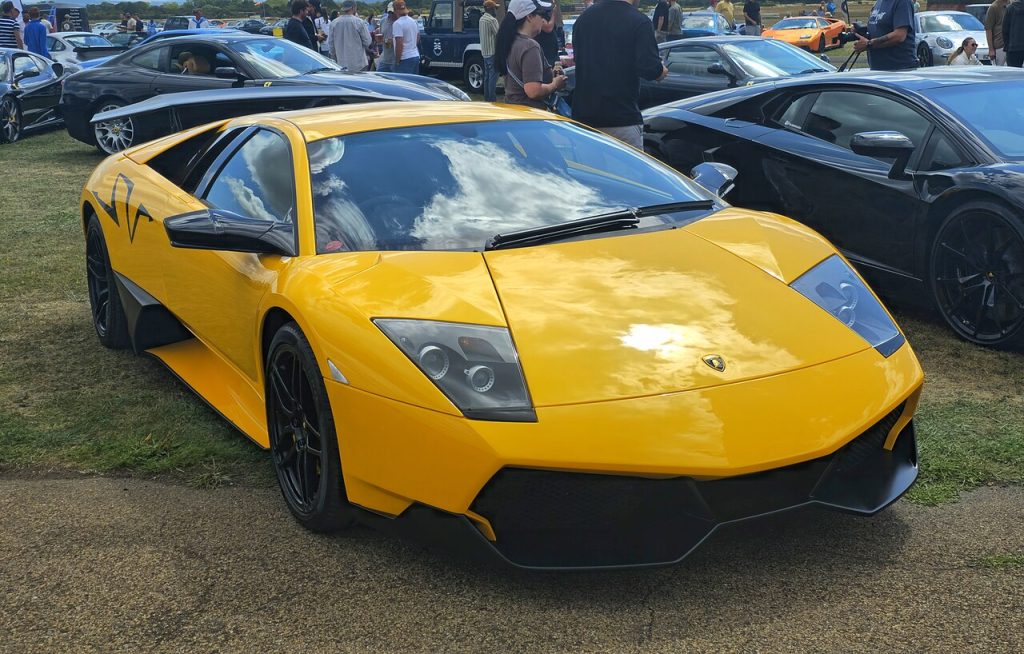
2009 Lamborghini Murciélago LP 670-4 SuperVeloce
The Lamborghini Murciélago LP 670-4 SuperVeloce records a distinct performance derivative within the small historic V12 family. Its supplied yellow-car photograph remains separate from R-SV competition cars and the China-specific edition.
Explore the full profile04 / Developing the next architecture — Lamborghini Aventador LP 750-4 SV
Lamborghini’s 2015 Aventador Superveloce announcement described a 6.5-litre naturally aspirated V12, increased output and reduced weight. The coupé programme was announced as 600 cars worldwide. The later SV Roadster has its own series scope and should remain separately identified. [4]
The Aventador carries the rear-mounted V12 idea into a different vehicle architecture from the Murciélago. Shared capacity and related naming do not make the installations identical. The structure around the occupants, the packaging of the powertrain and the development of the body all contribute to the new car.
That is the value of placing both SVs in one collection. They show continuity in a manufacturer’s priorities while preserving the differences between two generations. The V12 provides the family connection; the complete vehicle reveals how the idea was reworked.
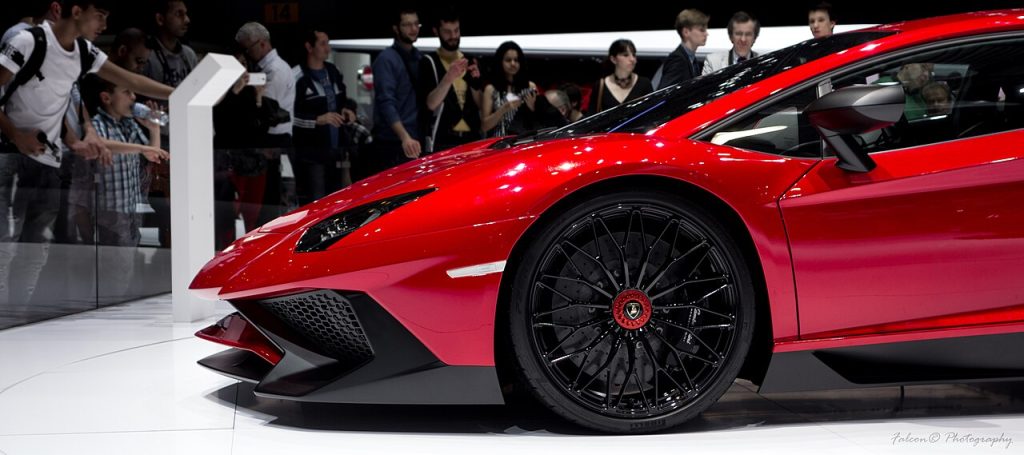
2015 Lamborghini Aventador LP 750-4 SV
The Aventador LP 750-4 SV gives the modern V12 family a defined Superveloce coupé edition. The special model’s 600-car announcement is the relevant rarity scope, rather than the volume of every Aventador.
Explore the full profile05 / The smaller body takes the larger engine — Aston Martin Vantage GT12
Aston Martin’s GT12 material identifies a naturally aspirated 6.0-litre V12 in a series-production programme limited to 100 cars. The GT12 connects that engine with a substantially developed Vantage body and aerodynamic package. [5]
The Vantage makes the engine-led brief especially visible. A large V12 has to be integrated into a comparatively compact sports-car form, with cooling, intake and exhaust paths organised around it. The body changes become part of understanding the powertrain installation.
Its place in this collection comes from that relationship. It shares neither the Ferrari body nor Lamborghini’s rear-engine proportions, yet its engineers face the same broad task of making the vehicle work around twelve cylinders. The differences in placement and packaging give the shared engine format several distinct expressions.

Aston Martin Vantage GT12
The Vantage GT12 turned Aston Martin’s compact V12 sports car into a distinctive road-going expression of its GT racing experience. The 100-car coupe series debuted in 2015 and was built into 2016.…
Explore the full profileFollow the engine into the rest of the car
Begin with the engine’s location, then trace the systems that support it. Look for the cooling paths, intake arrangement, transmission and the changes made to the body or chassis. A specification becomes much easier to understand when those pieces are connected.
The front-engined Ferraris, rear-engined Lamborghinis and V12 Vantage provide different routes through that exercise. Even a familiar capacity or model suffix needs a generation and programme around it to become a precise description.
Together, these five cars explain why cylinder count is only an opening line. The complete story lies in how a manufacturer makes room for the engine, manages its output and develops the surrounding vehicle to give the installation a purpose.
Sources & further reading
- Ferrari: 599 GTO model record — Factory specification and development account.
- Ferrari: FY 2015 results — F12tdf programme, naturally aspirated V12 and limited series; see also the Ferrari 2015 Form 20-F for chassis detail.
- Lamborghini: Murciélago SV technical release, archived — Original manufacturer technical release.
- Lamborghini: Aventador SV launch material, archived — Manufacturer Shanghai 2015 release, naturally aspirated V12 and 600-car coupé programme.
- Aston Martin: Vantage GT12 brochure, archived — Manufacturer product document identifying the engine and 100-car series.
- Ferrari: 2015 Form 20-F — F12tdf engine specification and Virtual Short Wheelbase rear-wheel steering.
- Lamborghini: Murciélago history — Manufacturer explanation of the longitudinal engine and gearbox layout.
Continue exploring
Follow a different use of twelve-cylinder engines in Hybrid hypercars explained, or choose another perspective from The Rarity Edit.