Alfa Romeo P33 Roadster Pininfarina
Paolo Martin’s 1968 P33 Roadster, whose original body preceded the Cuneo on the same chassis.
What does P33 Roadster identify?
The P33 Roadster is the original 1968 Pininfarina open design study in Alfa Romeo’s Tipo 33 concept lineage. It is associated with Paolo Martin. The profile concerns that original body identity, rather than the later Cuneo appearance. This distinction matters unusually strongly here because the factory museum explicitly describes a subsequent replacement of the body on the same underlying chassis. Read the cited reference for its documented context.
The link with Cuneo
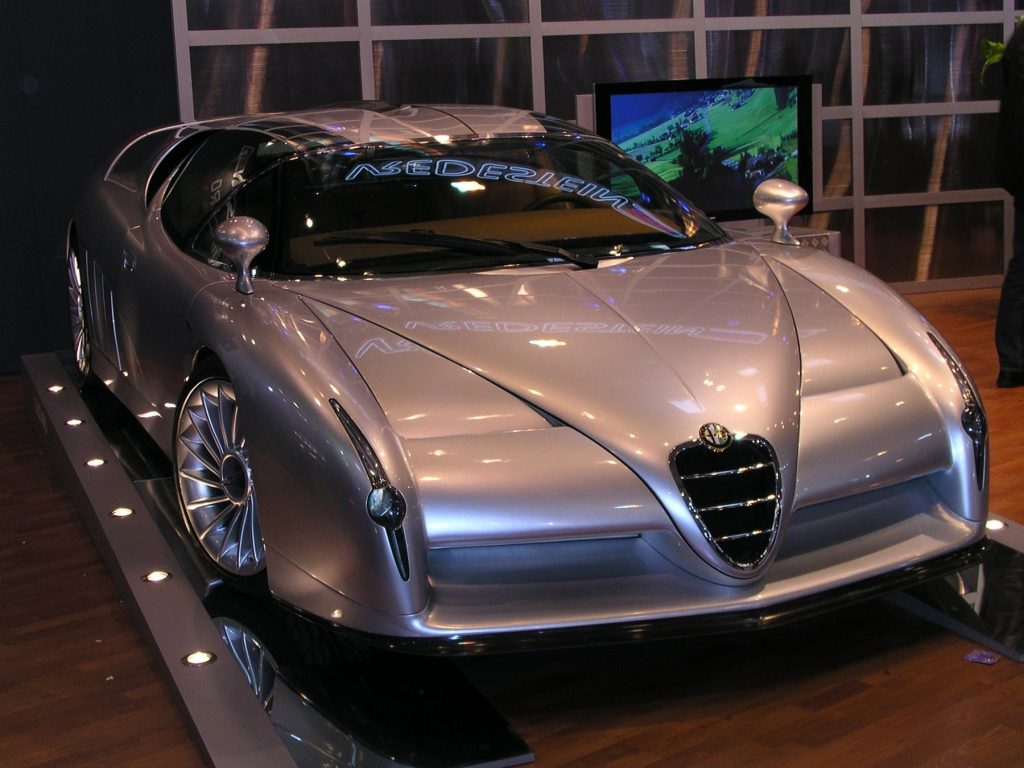
The museum’s Cuneo history states that the P33 Roadster’s coachwork was completely dismantled and replaced for the Cuneo presented at Brussels in 1971. The two names therefore mark different design stages of one chassis’s history. A collector archive can describe both stages, but counting them as two newly constructed independent chassis would misrepresent the evidence.
An original form with its own story
The period image candidate shows an open proposal with a distinctive overhead aerodynamic element. This is an observation about the documented original appearance, not a measured claim about its effectiveness. An image of Cuneo cannot illustrate the P33 body simply because the chassis is shared. The body’s disappearance is itself an important part of the historical account and explains the need for careful period-image selection.
Keeping specifications within their evidence
The museum publishes technical details for Cuneo, but those are not copied automatically into this P33 record. Shared chassis history does not prove that every installed component, dimension or output remained unchanged. This profile leaves unsupported numerical mechanical fields empty. That produces a more useful record than filling the gaps with figures belonging to the later design or a generic 33 Stradale.
How the count is defined
The inventory identifies a one-off P33 Roadster concept. The count of one refers to that named original design identity, supported by the factory’s singular rebodied-chassis account. It does not add another chassis to a cumulative count when Cuneo is considered. Separate names can be useful for indexing historical forms while a chassis register maintains the relationship between them.
Why the photograph is held
A matching 1968 photograph is available on Wikimedia Commons, attributed to an unknown photographer and marked public domain in Italy. Its file page also warns that the status may differ elsewhere. The required publication and reuse evidence has not been established for this upload, so the image is not bundled. A later Cuneo photograph would solve neither the identity issue nor the original-body illustration requirement.
Preserving a prototype’s identity
A prototype record needs more than a model name and an attractive photograph. Establish the chassis, the coachbuilder’s records and the dated sequence of show appearances. Record changes to paint, glazing, interior and mechanical equipment when evidence permits. A later alteration can be an important part of a show car’s working life. Keeping those stages separate allows the archive to explain the object as it developed rather than inventing a single specification that supposedly remained unchanged from its first presentation.
Restoration evidence and interpretation
For a unique design study, conservation and reconstruction are central to its historical account. Keep photographs of the earliest known form alongside records of later repairs and the reasoning behind restored details. Identify what was retained, repaired or recreated wherever the evidence is available. Museum display and concours presentation can provide useful context, but neither alone documents every component. A photograph illustrates one moment in the car’s life; its caption should identify that moment, leaving detailed material authenticity to the accompanying chassis and restoration record.
Frequently asked questions
Is P33 Roadster the same body as Cuneo?
No. The museum says the original coachwork was dismantled and replaced.
Were two chassis necessarily built?
No. The cited account identifies the same chassis through both body stages.
Why are some specification fields empty?
Later Cuneo data is not automatically evidence for the original P33.
Why is there no bundled photo?
Matching period imagery was found, but reuse evidence remains unresolved.
Related vehicle profiles
Sources and further reading
Why this machine matters
The P33 Roadster is the original 1968 Pininfarina open design study in Alfa Romeo’s Tipo 33 concept lineage. It is associated with Paolo Martin. The profile concerns that original body identity, rather than the later Cuneo appearance. This distinction matters unusually strongly here because the factory museum explicitly describes a subsequent replacement of the body on the same underlying chassis.
Built in limited numbers
1 original named concept; same chassis subsequently rebodied as Cuneo
Specifications
Factory specifications may vary by model year, market and configuration.
Identity & production
- Official model
- Alfa Romeo P33 Roadster Pininfarina
- Country of manufacture
- Italy
Powertrain & performance
- Engine
- Tipo 33 mechanical lineage; original P33 numerical specification not asserted
- Drivetrain
- Rear-wheel drive