Alfa Romeo Iguana Italdesign
Italdesign’s 1969 Iguana: a unique Tipo 33 design study with an openly expressed structure.
Which Iguana is profiled?
The Iguana is Italdesign’s unique Alfa Romeo concept based on the Tipo 33 mechanical lineage. Italdesign dates the project to 1969, correcting the inventory’s 1968 reference for the displayed historical year. Its significance lies in the proposal as a complete design study. It should be read beside the other Tipo 33 concepts, while retaining its own identity and presentation chronology. Read the cited reference for its documented context.
Structure as a design subject
Italdesign describes visible structural elements and body panels attached to the frame. This makes the relationship between surface and supporting structure part of the design story. As an interpretation, the proposal encourages a viewer to think about how a body is assembled rather than seeing it only as a smooth outer shape. That distinction is useful when comparing restoration photographs with original project material.
Glazing and access
The designer’s account discusses large areas of glazing and front and rear sections that open for access. These are concrete design features, but the attraction of the study also comes from how they relate to its compact cabin. When documenting the car, photograph the closed exterior and opened sections separately. One position explains the silhouette; the other makes the design’s access arrangements easier to understand.
The museum mechanical specification
Museo Alfa Romeo records a 1995 cc V8 and six-speed rear-wheel-drive transmission for its Iguana reference. Those figures describe the documented museum configuration and are used with that scope. A unique working show car can receive alterations during its life, so competing descriptions should be tied to dates and records instead of merged into one supposedly timeless specification.
A single concept identity
The factory museum records one Iguana. That is the count used for this named study, rather than a number inferred from all the chassis associated with Tipo 33 concepts. Its rarity is straightforward once the scope is stated: a unique design proposal with its own name and history. It is not a small production series or a special trim package for a showroom model.
The modern museum image
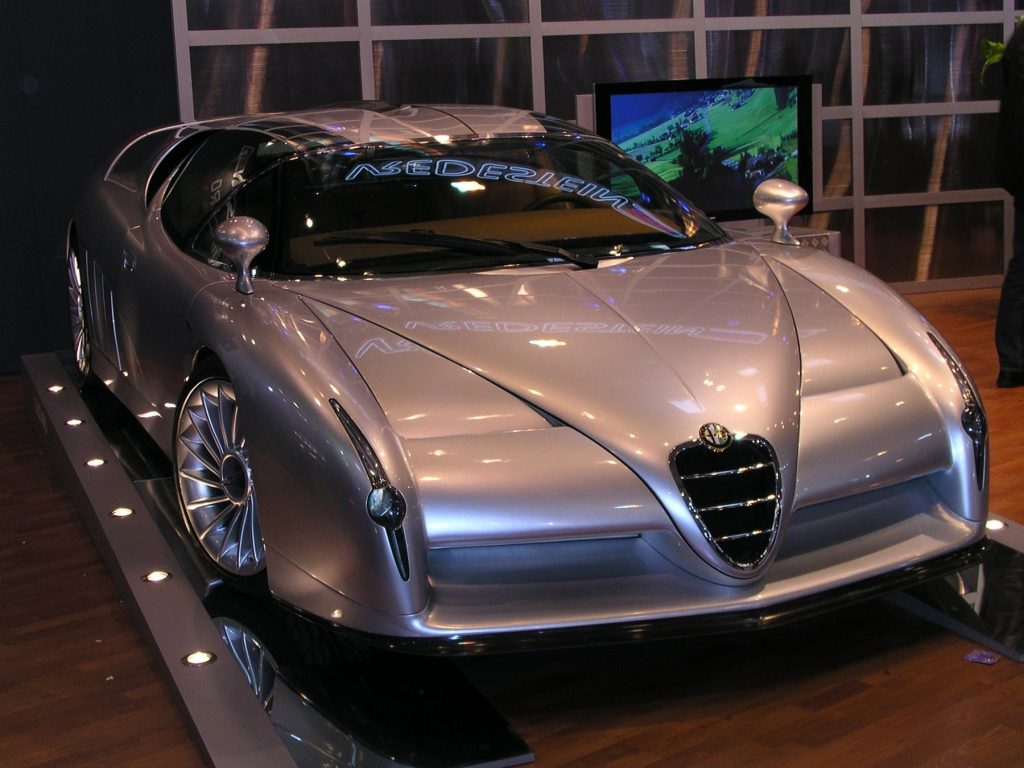
Zairon photographed the Iguana at Museo Alfa Romeo in September 2020. The featured image illustrates its preserved form, with linked author and licence information. Modern museum photography is valuable for studying the visible body and presentation, but it should remain labelled as modern. It does not independently establish the material specification, installed engine condition or every detail of the car at its original show appearance.
Preserving a prototype’s identity
A prototype record needs more than a model name and an attractive photograph. Establish the chassis, the coachbuilder’s records and the dated sequence of show appearances. Record changes to paint, glazing, interior and mechanical equipment when evidence permits. A later alteration can be an important part of a show car’s working life. Keeping those stages separate allows the archive to explain the object as it developed rather than inventing a single specification that supposedly remained unchanged from its first presentation.
Restoration evidence and interpretation
For a unique design study, conservation and reconstruction are central to its historical account. Keep photographs of the earliest known form alongside records of later repairs and the reasoning behind restored details. Identify what was retained, repaired or recreated wherever the evidence is available. Museum display and concours presentation can provide useful context, but neither alone documents every component. A photograph illustrates one moment in the car’s life; its caption should identify that moment, leaving detailed material authenticity to the accompanying chassis and restoration record.
Frequently asked questions
What year is used?
1969, following Italdesign’s project record.
How many Iguanas are recorded?
The factory museum lists one.
Which engine is entered?
1995 cc V8, scoped to the museum technical reference.
Does it share a profile with Carabo?
No. The related Tipo 33 concepts retain separate named identities.
Related vehicle profiles
Sources and further reading
- Italdesign: 1969 Iguana design and mechanical base
- Museo Alfa Romeo: Iguana technical reference and one-car count
Photo and credit
1969 Alfa Romeo Iguana at Museo Alfa Romeo, September 2020. Photo: Zairon / Wikimedia Commons · CC BY-SA 4.0. Resized and JPEG-compressed for web display; no content retouching. Website layouts may crop the image.
Why this machine matters
The Iguana is Italdesign’s unique Alfa Romeo concept based on the Tipo 33 mechanical lineage. Italdesign dates the project to 1969, correcting the inventory’s 1968 reference for the displayed historical year. Its significance lies in the proposal as a complete design study. It should be read beside the other Tipo 33 concepts, while retaining its own identity and presentation chronology.
Built in limited numbers
1; named Iguana concept
Gallery
Specifications
Factory specifications may vary by model year, market and configuration.
Identity & production
- Official model
- Alfa Romeo Iguana Italdesign
- Country of manufacture
- Italy
Powertrain & performance
- Engine
- 1995 cc V8; museum reference configuration
- Drivetrain
- Rear-wheel drive