2012 Lotus Evora Sports Racer
Explore the 2012 Lotus Evora Sports Racer: programme history, design, verified rarity scope, specifications and credited photography.
The Lotus Evora Sports Racer combines a distinctive factory appearance with an equipment-rich specification. Its name refers to a road edition, separate from the Evora competition cars.
History and verified programme identity
Announced at the end of 2012, the Sports Racer brings several desirable Evora options together in one named programme. Its position in the range is easier to understand through the original announcement than through the racing-sounding badge alone. Lotus offered the edition on both naturally aspirated Evora and supercharged Evora S bases. Those are configurations within the named edition, rather than evidence that every Sports Racer had the same engine. The published 6,117-car figure belongs to all Evoras, including other editions. Keeping that scope explicit explains the rarity screen without presenting a family total as the Sports Racer production count.
Engineering and design
Its visual identity centres on black accents across the roof and lower body, balanced against the principal exterior colour. Standard equipment included the 2+2 seating layout and the Sport and Tech packs. A mid-mounted 3.5-litre V6 underpins both engine choices, but the two branches have different induction and output references. The specification makes the Sports Racer an interesting equipment and presentation programme rather than a homologation racer. For comparison, a factory Evora GT4 needs its own competition identity and technical record. The Sports Racer remains a road model even when an owner later uses it at a circuit. Model-specific factory parts documentation is useful when an original component has been superseded. Record the replacement and its date rather than assuming every current part was fitted when the programme began. This keeps an archive comparison tied to original identity while allowing a surviving or exhibited car to have its own maintenance and configuration history.
The physical car in the supplied photograph
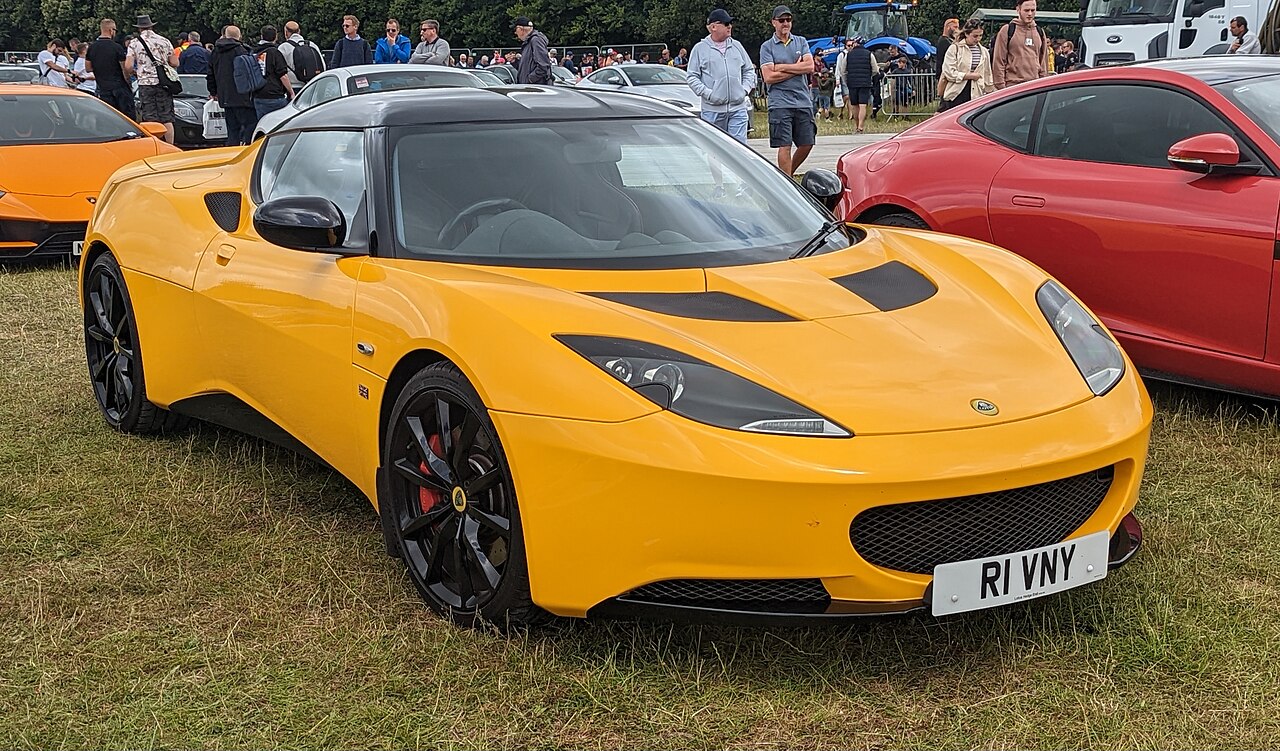
Calreyn88 photographed this creator-titled 2014 Evora Sports Racer outdoors. The yellow body and black roof and accents illustrate the named road edition; the exterior does not identify its induction or transmission option.
Identifying the original configuration
The Sports Racer label should be connected to the original delivery specification. A black roof or aftermarket black wheels can reproduce part of the appearance, so these features work best alongside documentary identity. The photographed car has a later example year than the programme announcement, which is normal for an edition offered beyond its reveal. Preserve both dates rather than moving the entire programme to the photo year. Naturally aspirated and supercharged examples should stay under one edition identity with their engine choice recorded separately. That prevents the two available specifications from turning into duplicate programme profiles.
Collecting and chassis evidence
A useful Evora Sports Racer history starts with the original model identity and dated factory specification. Record the chassis number, delivery market, original engine and transmission, and any numbered edition plate separately. Preserve changes in a chronological record: replaced panels, altered suspension, remapped engines and revised aerodynamic parts can affect the present configuration without creating a second original factory vehicle. Early invoices and photographs help distinguish an original edition from a later cosmetic recreation. A specialist inspection should connect those records to the car, especially its structure, mounting points and model-specific parts. A low programme volume makes careful documentation more useful; it does not establish the condition or completeness of an individual example.
Related Lotus designs and meaningful comparisons
Evora Sport 410 shows a later weight-focused evolution. The Hethel Edition shows how another Evora programme uses anniversary history and distinctive trim rather than the Sports Racer equipment bundle.
Reading the sources
The programme sources and the photograph answer different questions. Manufacturer and custodial records establish the original model, Type, category and published production scope. The creator’s file establishes the pictured subject, setting and image permission. An individual chassis history can then add ownership, competition entries and dated repairs without changing the scope of the original programme. Build references are not survivor counts, and a later specification does not automatically become an additional newly manufactured vehicle. Where primary evidence does not establish a complete fabrication census, that field remains unassigned.
Specifications and rarity evidence
| Programme reference year | 2012 |
|---|---|
| Model / Type | Evora Sports Racer — Evora / Type 122 |
| Body / competition role | Mid-engined road sports car |
| Announcement | December 2012 |
| Engine family | Mid-mounted 3.5-litre V6 |
| Original choices | Naturally aspirated or supercharged |
| Edition role | Road-car appearance and equipment package |
| Seating announcement | 2+2 |
| Published build / register reference | Family total 6,117 |
| Independently audited completed tally | Not assigned |
| Count scope | Named road edition announced December 2012, offered with naturally aspirated and supercharged engines. Lotus end-of-production release gives 6,117 for the complete Evora family. That broader total supports rarity screening; no exact Sports Racer tally assigned. |
| Original inventory status | LOT-152 — Verified |
Frequently asked questions
Was every Evora Sports Racer supercharged?
No. Lotus announced naturally aspirated Evora and supercharged Evora S versions. The exact engine choice requires the individual car’s original specification.
How is Evora Sports Racer classified?
This is a named original Lotus road-car programme. Its qualified source references fall below the 7,500 screening threshold. Completed production, announced allocations and survivor counts remain distinct, with any unresolved differences explained in the article.
Which technical details are established for the programme?
The primary record supports announcement: December 2012; engine family: Mid-mounted 3.5-litre V6; original choices: Naturally aspirated or supercharged. These are programme or explicitly attributed photo references. A particular surviving car’s engine, chassis repairs and competition preparation require its own dated documentation.
Does the photographed appearance establish factory originality?
The caption records a real creator-identified Evora Sports Racer subject and its documented setting. It establishes the illustration’s scope, while original components, restoration work and individual race provenance require chassis-specific evidence. A competition number, current paint or museum display is not used as an originality certificate.
What rarity or archive scope is verified?
Named road edition announced December 2012, offered with naturally aspirated and supercharged engines. Lotus end-of-production release gives 6,117 for the complete Evora family. That broader total supports rarity screening; no exact Sports Racer tally assigned.
Who photographed the supplied image?
Calreyn88 via Wikimedia Commons, under CC BY-SA 4.0. The original file and licence are linked with the image. Retain the creator, source and licence when uploading, exporting or reusing it; local retouching and synthetic enlargement have not been performed.
Related Lotus profiles
Sources and photo credits
Photograph: Calreyn88 via Wikimedia Commons original source, CC BY-SA 4.0. Source-provided thumbnail supplied without local cropping, retouching or synthetic enlargement.
Built in limited numbers
Named road edition announced December 2012, offered with naturally aspirated and supercharged engines. Lotus end-of-production release gives 6,117 for the complete Evora family. That broader total supports rarity screening; no exact Sports Racer tally assigned.
Gallery
Specifications
Factory specifications may vary by model year, market and configuration.
Identity & production
- Official model
- Evora Sports Racer