1964 Lotus Type 33 Formula One
Explore the 1964 Lotus Type 33 Formula One: programme history, design, verified rarity scope, specifications and credited photography.
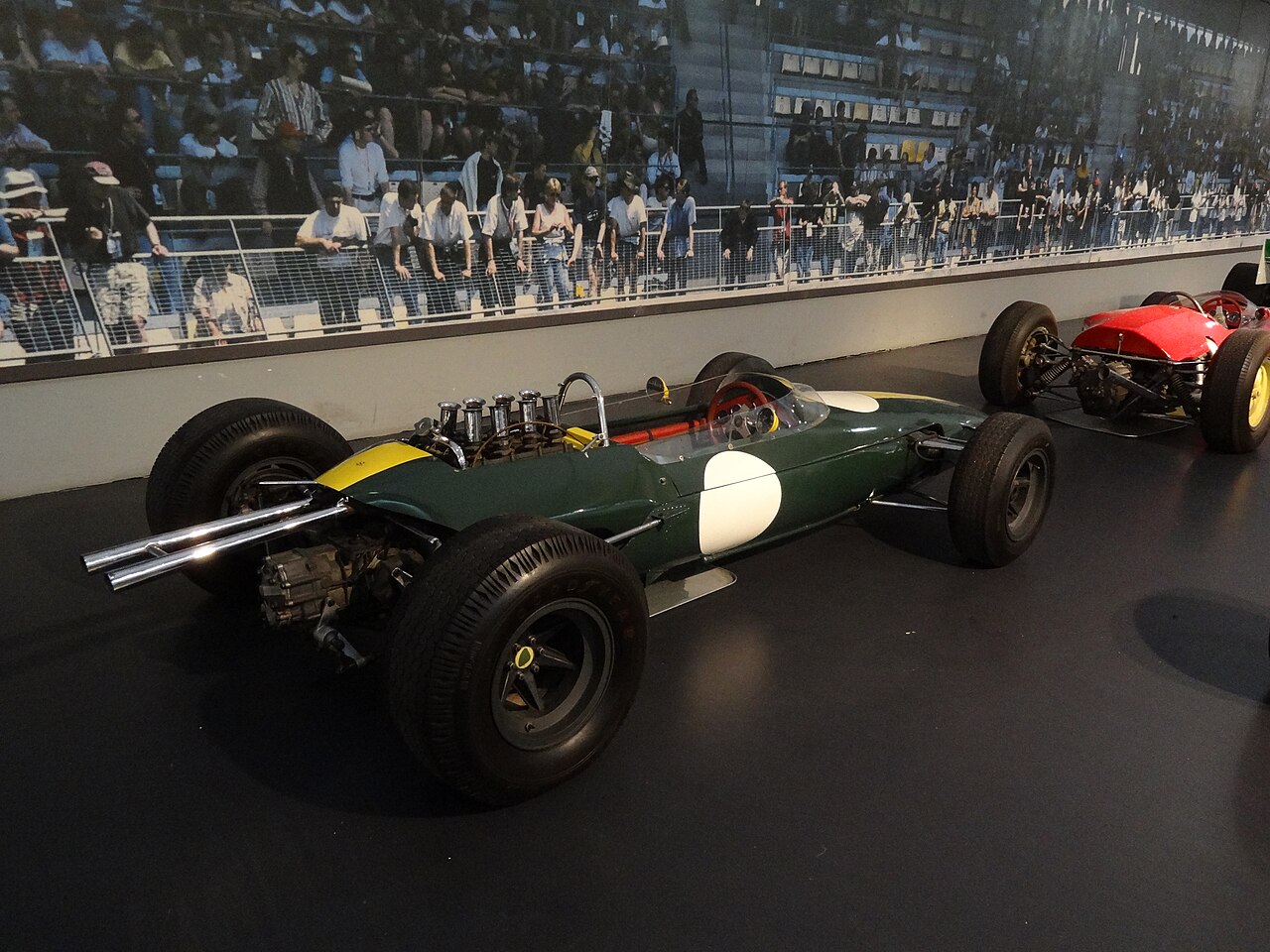
The Lotus Type 33 evolves the monocoque Formula One approach and carries Jim Clark’s second championship season into the Lotus record. Its 1964 debut and later configurations belong to one evolving programme, with original and converted chassis histories kept distinct.
History and verified programme identity
Lotus’s manufacturer history dates the Type 33 debut to the 1964 Aintree 200 and identifies Jim Clark with chassis R8. It describes the later 1965 championship season and suspension development around smaller wheels. Classic Team Lotus publishes a separate Type 33 register alongside a Type 25/33 record; its short listed Type 33 subset is not treated here as a complete census of every original or converted car. The full manufacturing total therefore remains unassigned. That preserves the distinction between a model family, a new chassis and an earlier car changed to a later specification.
Engineering and design
An evolved monocoque does not mean the original structure and suspension were simply left untouched. Lotus describes changes to suspension components and wheel arrangements during the Type 33’s development. The connection between those systems matters: wheel and tyre dimensions influence the space and geometry available to the suspension, while the structure has to carry the resulting loads. The model is therefore useful to study as an ongoing engineering programme. A later restored appearance can accurately represent one phase without documenting every previous specification. This profile keeps the design sequence visible and avoids using a museum photograph to certify hidden structural details.
The physical car in the supplied photograph
The supplied photograph shows a Type 33 at the Musée National de l’Automobile in Mulhouse in April 2012. The green open-wheel car is displayed in front of a wall of period racing imagery. The creator viann identifies it as a Lotus Formula One Type 33. The museum setting is retained, while the picture is not assigned the identity of every championship chassis or treated as a photograph from the 1965 season.
The programme and the converted chassis can coexist
The Type 33’s development story is more informative when it allows a car to change without counting each change as another original chassis. A programme can have a defined debut and championship history while its individual vehicles pass through related configurations. The separate Type 25/33 and Type 33 custodial records point toward that complexity. They should be reconciled with build and repair evidence before a complete new-build count is assigned. The museum photograph then documents a later car identified as Type 33, with its own date and location. This approach preserves the model’s significance while leaving individual questions open in the right place. It also makes future evidence easier to incorporate: a newly identified conversion can refine a chassis history without forcing an invented manufacturing total to be rewritten.
Collecting and chassis evidence
The Type 33 is a case where conversion history is part of accurate identification. A car can pass through a Type 25/33 configuration without becoming a newly constructed original chassis at each step. The manufacturer’s programme story and the custodial registers need to be read together with an individual build file. That deeper record would date structural alterations, engine changes and later restorations. The present profile establishes the Type 33 programme, introduction and a matched museum image, but does not resolve every chassis overlap or assign a complete fabrication tally from an incomplete register subset.
Related Lotus designs and meaningful comparisons
The Type 25 provides the direct earlier monocoque comparison, while the Type 24 shows the parallel 1962 customer Formula One programme. Together they help explain why Lotus’s history cannot be organized solely as one new car per year. Designs overlapped, cars evolved and individual chassis could be altered. The Type 33’s own record remains valuable precisely because it describes a defined later programme without flattening those changes into an invented production sequence. Its championship association is retained as model history, with individual car provenance still requiring specific evidence.
Reading the sources
The programme sources and the photograph answer different questions. Manufacturer and custodial records establish the original model, Type, category and published production scope. The creator’s file establishes the pictured subject, setting and image permission. An individual chassis history can then add ownership, competition entries and dated repairs without changing the scope of the original programme. Build references are not survivor counts, and a later specification does not automatically become an additional newly manufactured vehicle. Where primary evidence does not establish a complete fabrication census, that field remains unassigned.
Specifications and rarity evidence
| Programme reference year | 1964 |
|---|---|
| Model / Type | Type 33 Formula One — Type 33 |
| Body / competition role | Evolved monocoque Formula One programme |
| Manufacturer debut reference | 1964 Aintree 200 |
| Original role | Formula One monocoque development |
| Design relationship | Evolution of Type 25 |
| Later development | Suspension and wheel changes documented by Lotus |
| Photo setting | Musée National de l’Automobile, Mulhouse, April 2012 |
| Published build / register reference | No complete tally assigned |
| Independently audited completed tally | Not assigned |
| Count scope | Documented physical Team Lotus competition Type archive. Complete fabrication census unassigned; works, customer and later converted cars are not added into an invented total. |
| Original inventory status | LOT-031 — Verified |
Frequently asked questions
Can the short public Type 33 register be used as a complete fabrication census?
Not without reconciling original cars and Type 25/33 conversions. The complete tally remains unassigned here, while the manufacturer’s 1964 debut and programme history are retained.
How is Type 33 Formula One classified?
This is a Team Lotus competition Type archive. It remains separate from Lotus road-car production. Customer cars, works entries and converted chassis need a reconciled scope before any complete fabrication tally is assigned.
Which technical details are established for the programme?
The primary record supports manufacturer debut reference: 1964 Aintree 200; original role: Formula One monocoque development; design relationship: Evolution of Type 25. These are programme or explicitly attributed photo references. A particular surviving car’s engine, chassis repairs and competition preparation require its own dated documentation.
Does the photographed appearance establish factory originality?
The caption records a real creator-identified Type 33 Formula One subject and its later setting. It establishes the illustration’s scope, while original components, restoration work and individual race provenance require chassis-specific evidence. A competition number, current paint or museum display is not used as an originality certificate.
What rarity or archive scope is verified?
Documented physical Team Lotus competition Type archive. Complete fabrication census unassigned; works, customer and later converted cars are not added into an invented total.
Who photographed the supplied image?
viann from Mulhouse, France via Wikimedia Commons, under CC BY 2.0. The original file and licence are linked with the image. Retain the creator, source and licence when uploading, exporting or reusing it; local retouching and synthetic enlargement have not been performed.
Related Lotus profiles
Sources and photo credits
Photograph: viann from Mulhouse, France via Wikimedia Commons original source, CC BY 2.0. Source-provided thumbnail supplied without local cropping, retouching or synthetic enlargement.
Built in limited numbers
Documented physical Team Lotus competition Type archive. Complete fabrication census unassigned; works, customer and later converted cars are not added into an invented total.
Gallery
Specifications
Factory specifications may vary by model year, market and configuration.
Identity & production
- Official model
- Type 33 Formula One