1957 Lotus Elite Type 14
Explore the 1957 Lotus Elite Type 14: programme history, design, verified rarity scope, specifications and credited photography.
The original Lotus Elite Type 14 brought a glass-fibre structural body into a compact road-going coupe. Its 1957 debut, Coventry-Climax power and distinct first-generation identity make it a different collection subject from the larger Elite introduced in the 1970s.
History and verified programme identity
Lotus dates the Type 14’s public debut to the October 1957 Earls Court Motor Show. Its heritage statistics list 281 original-series cars and 749 Series 2 cars, while giving the SE volume as unconfirmed. Those statements are retained separately: the SE is not added as an invented third production run, and a combined figure is not assigned as an independently audited tally. The manufacturer describes a 1,216 cc Coventry-Climax FWE engine and a four-speed transmission for the standard model, with differing output for later specifications. This profile follows the original Type 14 family and its documented small production series. RM Sotheby’s separately reports an estimated 1,030 Type 14 cars, which supports the small whole-family scope without treating the unconfirmed SE figure as an additional run.
Engineering and design
The Elite’s structural body is the central engineering feature. Instead of draping a light shell over a conventional independent chassis, Lotus used a glass-fibre monocoque body/chassis unit with reinforcement where required. That makes the relationship between the body, suspension attachment points and running gear fundamental to the car’s identity. Its small engine also emphasizes how mass and shape can influence a sports car’s character without a large displacement figure. These are programme-level design principles. The condition of a particular structural shell, including repairs and replacement reinforcement, would need an individual inspection and a dated restoration file before an assessment could be made.
The physical car in the supplied photograph
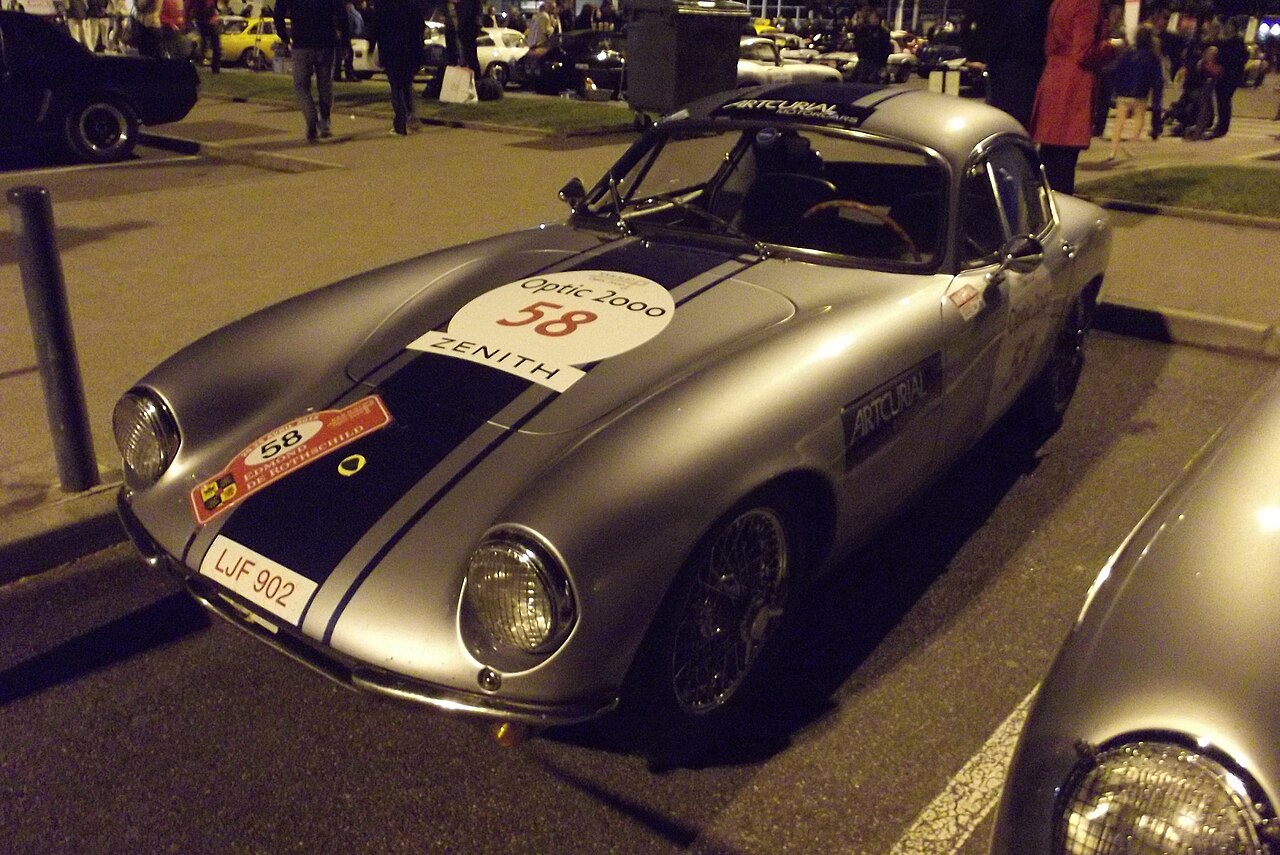
The supplied photograph shows a creator-identified 1959 Type 14 Elite at Tour Auto in Toulouse in 2015. The fixed roof, small nose opening and covered headlamps are visible under street lighting, with event markings on the body. Those markings belong to the photographed appearance; they do not establish a factory special edition. A 1959 example can illustrate the family introduced in 1957 without being described as a 1957-built chassis.
A road-car shell with a structural role
The Type 14 photograph is useful precisely because it shows a complete enclosed road car rather than a bare technical cutaway. The compact roof, small side windows and rounded front make the body read as a unified volume. The primary description then adds the essential fact that the body/chassis unit has a structural role. A viewer would not be able to establish that distinction from exterior appearance alone, particularly beside another glass-fibre-bodied Lotus. This is why the chassis explanation belongs next to the photograph. It connects the visible car with the design decision without claiming that a present repair is invisible or insignificant. The later Elan may share a light composite outer body, yet its separate backbone changes the structural story. Keeping those descriptions precise gives each road car a stronger identity.
Collecting and chassis evidence
A Type 14 file should preserve the series, chassis identity and structural body history before describing performance options. The manufacturer’s SE and Super variants require their own evidence, and a later carburettor installation alone does not establish a factory specification. Body repairs also deserve a clear chronology because the shell is part of the original structural concept. The source’s separate series volumes make the rarity scope readable, while the unconfirmed SE subset remains unassigned. This avoids counting a specification package as an additional car beyond the production series to which its chassis already belongs.
Related Lotus designs and meaningful comparisons
The Seven Series 1 makes a particularly useful comparison because it appeared in the same period with an almost opposite visual approach: exposed wheels and an open body rather than an enclosed structural coupe. The Elan S1 then shows a later road-car solution, using a backbone chassis under a glass-fibre body. Together the three illustrate different ways to organize a light sports car. Their common marque does not make their structures interchangeable, and the later 1970s Elite is outside this Type 14 profile.
Reading the sources
The programme sources and the photograph answer different questions. Manufacturer and custodial records establish the original model, Type, category and published production scope. The creator’s file establishes the pictured subject, setting and image permission. An individual chassis history can then add ownership, competition entries and dated repairs without changing the scope of the original programme. Build references are not survivor counts, and a later specification does not automatically become an additional newly manufactured vehicle. Where primary evidence does not establish a complete fabrication census, that field remains unassigned.
Specifications and rarity evidence
| Programme reference year | 1957 |
|---|---|
| Model / Type | Elite Type 14 — Type 14 |
| Body / competition role | First-generation glass-fibre monocoque coupe |
| Debut | Earls Court Motor Show, October 1957 |
| Structure | Glass-fibre monocoque body/chassis unit |
| Standard engine reference | 1,216 cc Coventry-Climax FWE four-cylinder |
| Transmission reference | Four-speed |
| Photo example year | 1959; Tour Auto photograph dated 2015 |
| Published build / register reference | 281 first-series; 749 Series 2; SE subset unconfirmed |
| Independently audited completed tally | Not assigned |
| Count scope | Published complete named programme reference: 281 first-series; 749 Series 2; SE subset unconfirmed. This is a source-reported reference, not an independently audited completed tally or a surviving-car census. |
| Original inventory status | LOT-010 — Verified |
Frequently asked questions
Is the 1970s Elite included in this profile?
No. The record follows the original Type 14 coupe introduced in 1957. The later Elite is a separate programme, and its production totals and mechanical specifications are not used here.
How is Elite Type 14 classified?
This is a named original Lotus road-car production programme. Its source-reported series reference is below the 7,500 screening threshold; it is not a surviving-car estimate or an announced numbered allocation.
Which technical details are established for the programme?
The primary record supports debut: Earls Court Motor Show, October 1957; structure: Glass-fibre monocoque body/chassis unit; standard engine reference: 1,216 cc Coventry-Climax FWE four-cylinder. These are programme or explicitly attributed photo references. A particular surviving car’s engine, chassis repairs and competition preparation require its own dated documentation.
Does the photographed appearance establish factory originality?
The caption records a real creator-identified Elite Type 14 subject and its later setting. It establishes the illustration’s scope, while original components, restoration work and individual race provenance require chassis-specific evidence. A competition number, current paint or museum display is not used as an originality certificate.
What rarity or archive scope is verified?
Published complete named programme reference: 281 first-series; 749 Series 2; SE subset unconfirmed. This is a source-reported reference, not an independently audited completed tally or a surviving-car census.
Who photographed the supplied image?
Handelsgeselschaft via Wikimedia Commons, under CC BY-SA 4.0. The original file and licence are linked with the image. Retain the creator, source and licence when uploading, exporting or reusing it; local retouching and synthetic enlargement have not been performed.
Related Lotus profiles
Sources and photo credits
- Primary manufacturer or custodial programme record
- RM Sotheby’s: complete original Type 14 programme estimate
Photograph: Handelsgeselschaft via Wikimedia Commons original source, CC BY-SA 4.0. Source-provided thumbnail supplied without local cropping, retouching or synthetic enlargement.
Built in limited numbers
Published complete named programme reference: 281 first-series; 749 Series 2; SE subset unconfirmed. This is a source-reported reference, not an independently audited completed tally or a surviving-car census.
Gallery
Specifications
Factory specifications may vary by model year, market and configuration.
Identity & production
- Official model
- Elite Type 14