2012 Honda CR-Z Mugen RZ
Honda CR-Z Mugen RZ: Mugen’s 300-car complete programme, supercharged hybrid specification and credited photography.
The Honda CR-Z Mugen RZ turned a sporting hybrid into a complete M-TEC car programme in 2012.
History and purpose
The Honda CR-Z Mugen RZ turned a sporting hybrid into a complete M-TEC car programme in 2012. Mugen’s original September announcement defines a 300-car scope and a specific engineered configuration. That is different evidence from an ordinary CR-Z carrying Mugen accessories or an earlier show concept. The named customer programme qualifies on its announced ceiling, while the completed manufacturing tally remains unconfirmed. Its interest lies in combining hybrid assistance with a supercharged engine and a carefully identified complete-car identity. The article preserves M-TEC’s role alongside the Honda base car instead of attributing every modification to standard Honda production.
Design and engineering
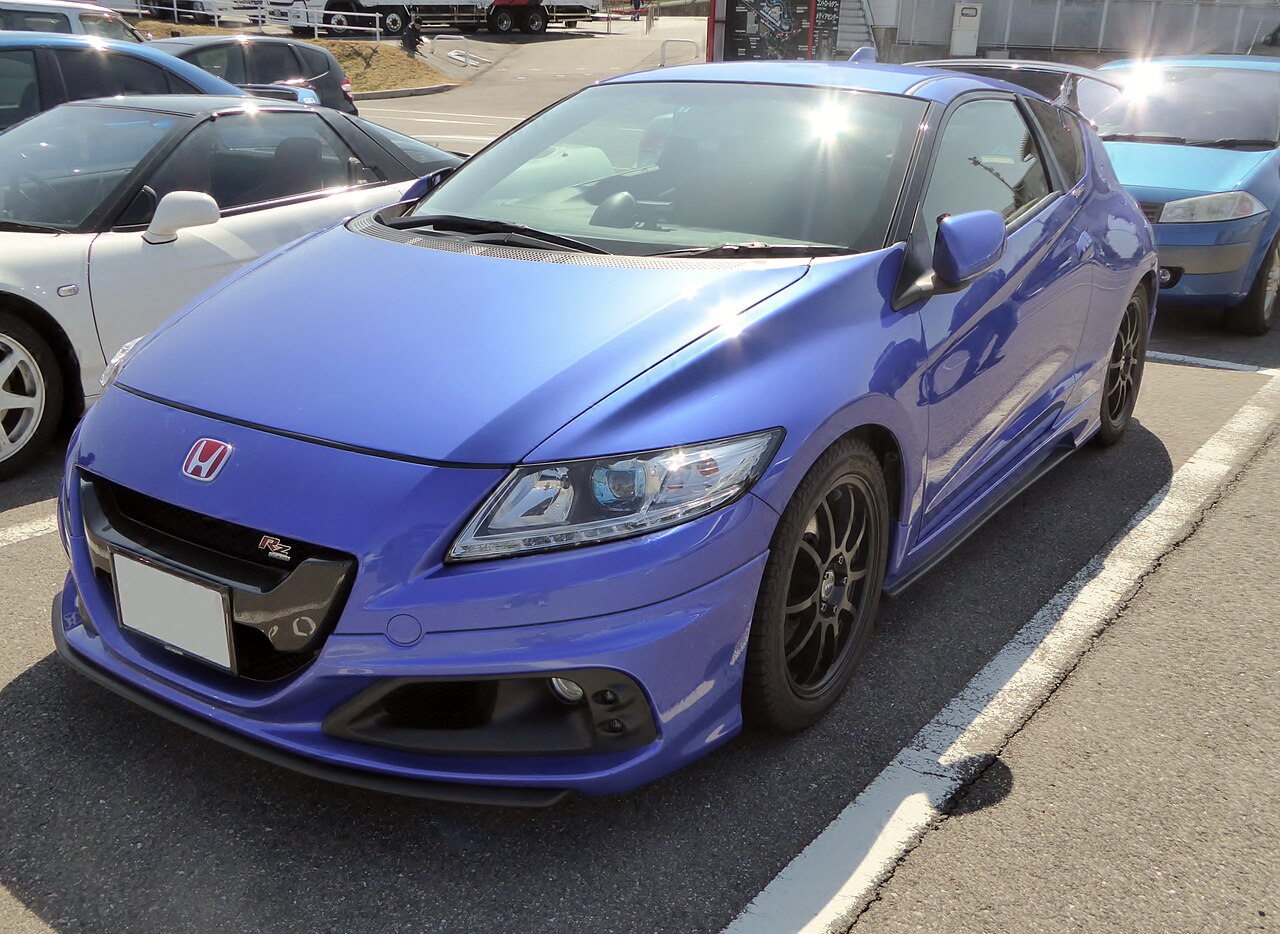
Mugen rates the supercharged 1.5-litre petrol engine at 156 PS and lists the IMA electric motor separately at 20 PS. Those figures should not be added into a claimed 176 PS system rating. The programme uses six manual gears and front-wheel drive. The supplied blue car shows a pronounced front treatment and dark wheels in a street photograph. Its short cabin and tapering rear body give the coupe a compact, purposeful appearance. The image supports the named model match, but it cannot demonstrate supercharger installation, motor condition or the calibration of a particular example. Those questions belong to component-level records.
Identifying the original configuration
The photo creator explicitly identifies a ZF2 CR-Z Mugen RZ and dates the image to March 2015. Keep that exact RZ identity, since CR-Z Mugen concept images illustrate other programmes. For an individual customer car, connect edition and chassis records to the original delivery configuration. Document the induction system, interior identifier and programme-specific components with clear photographs. Blue paint or a fitted aero part is useful descriptive evidence but does not independently establish complete-car membership. Any later mechanical work should be preserved as a dated change, allowing the original programme specification and the current vehicle to be understood together.
Collector context and preservation
The RZ makes a useful companion to Mugen RR and S660 Mugen RA. Their histories demonstrate why the complete-car programme needs to be distinguished from a catalogue of optional parts. Compare the visible body treatment in the actual photographs, then use each programme’s own documentation for technical differences. A collector file can retain original equipment, replacement-part invoices and hybrid-system servicing without assuming that rarity means untouched condition. The 300-car announcement should remain labelled as a programme limit until completed manufacture is established. That precision gives the profile a sound historical basis while leaving room for future chassis and production research.
Reading the evidence for this profile
The original source links below identify the programme and the historical statements used in this article. The photograph has its own creator and licence record, separate from the manufacturer’s vehicle history. Keep both when transferring this profile into a collection catalogue. A manufacturing tally describes how many cars belong to a defined original programme; it does not measure how many survive, how many are publicly visible, or how many retain all their original components. Those individual questions require dated chassis and restoration evidence. The reference year likewise describes the programme’s introduction or named historic configuration, while the supplied caption states the photographed setting and any established individual identity. This lets future research expand the car’s history without blurring the scope of the record already assembled here.
Specifications and verified rarity
| Reference year | 2012 |
|---|---|
| Model / programme | CR-Z Mugen RZ |
| Body / role | Two-seat complete-programme hybrid coupe |
| Power unit / proposal | 1.5-litre supercharged petrol engine rated 156 PS, with separately rated 20 PS IMA motor; outputs not added |
| Layout / transmission | Front drive; six-speed manual; complete M-TEC specification |
| Exact manufacturing tally | Not established |
| Rarity evidence | 300 for the documented complete programme |
| Rarity scope | Complete M-TEC/Mugen CR-Z RZ programme announced as 300 cars in September 2012. Completed manufacturing tally unconfirmed. Separate from earlier CR-Z Mugen concepts, ordinary accessory-equipped CR-Z cars and proposed U.K. programmes. |
| Inventory reference | HON-097 — Verified |
Frequently asked questions
What is the Honda CR-Z Mugen RZ?
A complete 300-car M-TEC/Mugen CR-Z RZ programme with a supercharged petrol engine and separately specified IMA motor.
What engineering defines this vehicle?
1.5-litre supercharged petrol engine rated 156 PS, with separately rated 20 PS IMA motor; outputs not added. Front drive; six-speed manual; complete M-TEC specification. The specifications describe the original programme or published concept proposal. An individual example’s installed equipment and any later changes need their own dated evidence.
Why does this profile use 2012?
This is the documented introduction or original configuration year. Photograph dates and market model years can differ. Keeping those dates separate makes it possible to follow the car’s development without creating a second identity for the same programme.
How should an individual CR-Z Mugen RZ be authenticated?
Connect the chassis identifier to original delivery, edition or custodial records. Compare period exterior, cabin and mechanical photographs with the documented configuration. Record replacement parts, paint changes and restoration work as dated events. A badge or colour alone cannot establish that a car belongs to this original programme.
What rarity or archive scope is verified?
Complete M-TEC/Mugen CR-Z RZ programme announced as 300 cars in September 2012. Completed manufacturing tally unconfirmed. Separate from earlier CR-Z Mugen concepts, ordinary accessory-equipped CR-Z cars and proposed U.K. programmes.
Who took the supplied photograph?
Tokumeigakarinoaoshima via Wikimedia Commons, under CC0. The original file and licence links accompany the image. Retain that credit when the photograph is uploaded, exported or reused.
Related Honda family profiles
Sources and photo credits
Photograph: Tokumeigakarinoaoshima via Wikimedia Commons original file, CC0. Source-provided photograph supplied without local cropping, retouching or text removal. A source thumbnail is used where available. Honda CR-Z Mugen RZ, ZF2 generation, photographed on 8 March 2015.
Built in limited numbers
Complete M-TEC/Mugen CR-Z RZ programme announced as 300 cars in September 2012. Completed manufacturing tally unconfirmed. Separate from earlier CR-Z Mugen concepts, ordinary accessory-equipped CR-Z cars and proposed U.K. programmes.
Gallery
Specifications
Factory specifications may vary by model year, market and configuration.
Identity & production
- Official model
- CR-Z Mugen RZ